
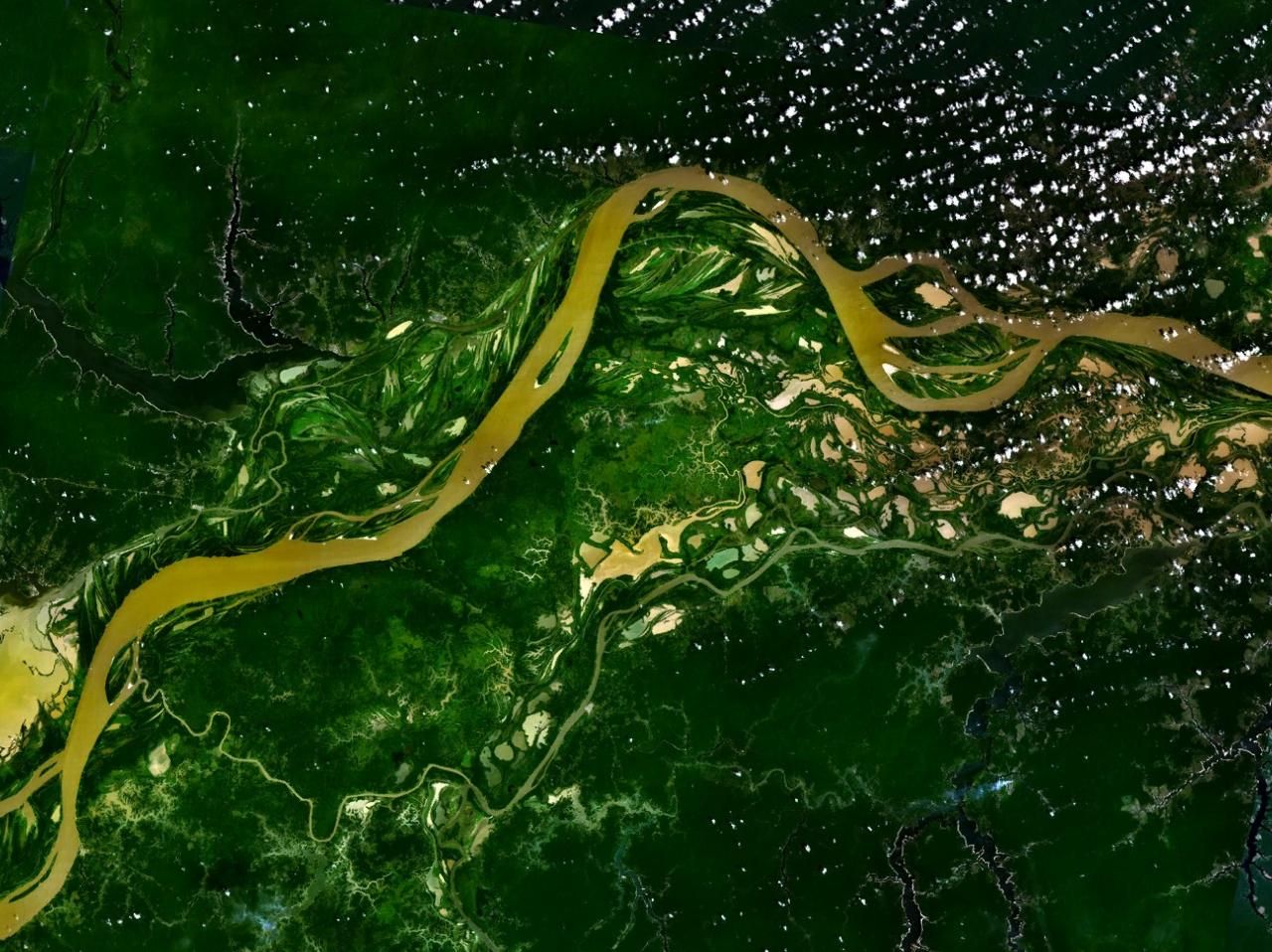
The Amazon from the air: a forest at the centre of the argument over who decides its future.
Generated by User:Rex, Amazon 57.53278W 2.71207S, 2005EcoAxes / Included ideologies / Indigenous, decolonial and justice-based approaches
Theoretical and political movementDecolonial Ecology
A body of thought holding that the ecological crisis and colonialism are one history. Modern environmentalism, it argues, has repeated a "colonial double fracture" by separating environmental questions from slavery, racism and empire, and an adequate ecology has to be decolonial, starting from the peoples and places colonialism turned into resources. It includes the critique of extraction, strongest in Latin America, which sees mining, oil and export farming as a model of development that sacrifices whole territories and the peoples who live in them.
- Key figures
- Malcom Ferdinand, Arturo Escobar, Aníbal Quijano (coloniality), Kathryn Yusoff, Ramachandra Guha
Where it stands
- Environmental EthicsAnthropocentrismEcocentrism
- Human–Nature RelationsHuman SeparationHuman Integration
- Economic PhilosophyGreen GrowthPost-Growth
- Resource OwnershipPrivate StewardshipCommons Governance
- Environmental AuthorityCentralized AuthorityLocal Autonomy
- Environmental JusticeAggregate OutcomesDistributive Justice
- Technological OutlookTechnological OptimismEcological Precaution
- Conservation StrategySustainable UseStrict Protection
- Agricultural EcologyLand SparingLand Sharing
- Global ResponsibilityNational SovereigntyInternational Ecological Obligation
- Ecological Political PriorityIncremental ReformTransformative Change
Decolonial ecology is a critique and an orientation rather than a programme; its justice, systemic and anti-exclusionary commitments are firm, its economic and technological positions derived from allied movements.
Definition
Decolonial ecology holds that the environmental crisis cannot be understood or tackled apart from the history of colonisation, the plantation, slavery and the racial ordering of the world, which made some peoples and lands into resources for others.
Malcom Ferdinand gave the position its name in Decolonial Ecology (2019, English edition 2022). He describes a “double fracture” in modern thought. Environmentalism has ignored colonialism and racism, and anti-colonial politics has ignored the earth. Decolonial ecology sets out to think from the places colonialism made, such as the Caribbean, the plantation and the mine, and from the knowledge and struggles of the people who live there. Its aim is a “world-ship” where everyone can live.
Historical development
The position has deep roots in anti-colonial thought, in Frantz Fanon and Aimé Césaire. It also draws on the “environmentalism of the poor” documented by Ramachandra Guha and Joan Martinez-Alier, and on Arturo Escobar’s critique of development in Encountering Development (1995). Aníbal Quijano’s idea of the “coloniality of power” (2000) and the Latin American decolonial school supplied the theory. Indigenous and Afro-descendant movements across the Americas supplied the practice.
Kathryn Yusoff argued in A Billion Black Anthropocenes or None (2018) that the story of the Anthropocene erases the racial history of extraction. Ferdinand’s book, Françoise Vergès’s writing on the “racial Capitalocene” and Macarena Gómez-Barris’s The Extractive Zone (2017) consolidated the field. It now spans geography, philosophy, literature and activism.
Principal claims
- Colonisation and ecological destruction are a single process. The plantation is the model for the modern relationship with nature.
- Mainstream environmentalism’s silence about race, slavery and empire is built into its structure. It is a “fracture”, not an oversight.
- The knowledge and practices of colonised peoples are sources of ecological alternatives. They are not obstacles to development.
- Conservation, development and climate policy that are not decolonial carry colonial relations forward.
- An adequate response means transforming the economic and political order colonialism built, including property, borders and the global division of labour.
Policy implications
Decolonial ecologists call for reparations and repayment of ecological debt, the return of land and of territorial control, and an end to removing people for conservation. They want climate finance treated as justice and not as aid, support for agroecology and for the territories of Indigenous and Afro-descendant communities, and the dismantling of economies built on extraction. Colonised peoples should be represented in environmental decisions at every level.
Internal disagreements
Decolonial, postcolonial and Marxist thinkers disagree about whether capitalism or coloniality comes first. They disagree about the nation-state, which decolonial thinkers distrust but postcolonial states rely on, and about the usefulness of international law. A further question is how to turn criticism into practice inside institutions.
Criticisms and controversies
Critics argue that decolonial ecology diagnoses well but offers little policy. They say it can treat colonialism as the explanation for everything, that its rejection of modernity leaves it little to build with, and that it romanticises the colonised. Some Indigenous scholars object to being folded into a general “decolonial” category.
Supporters answer that the environmental movement’s own history bears the critique out, from wilderness parks that excluded local people to carbon offsets on Indigenous land.
Relationships to other traditions
Decolonial ecology is the theoretical centre of the family of Indigenous, postcolonial and global South traditions. It draws on political ecology and the environmentalism of the poor, and supports Indigenous environmental sovereignty, land back and the fight against extraction. It shares the distributive commitments of environmental justice, climate justice and the idea of ecological debt, and meets Buen Vivir and ecofeminism on common ground. It opposes fortress conservation, planetary stewardship imposed from above, and any environmentalism that treats the colonial past as closed.
References and further reading
- Ferdinand, M. (2022). Decolonial Ecology: Thinking from the Caribbean World. Polity. (French original 2019.)
- Escobar, A. (1995). Encountering Development: The Making and Unmaking of the Third World. Princeton University Press.
- Yusoff, K. (2018). A Billion Black Anthropocenes or None. University of Minnesota Press.
- Quijano, A. (2000). “Coloniality of power, Eurocentrism, and Latin America.” Nepantla: Views from South 1(3), 533–580.
- Gómez-Barris, M. (2017). The Extractive Zone: Social Ecologies and Decolonial Perspectives. Duke University Press.