
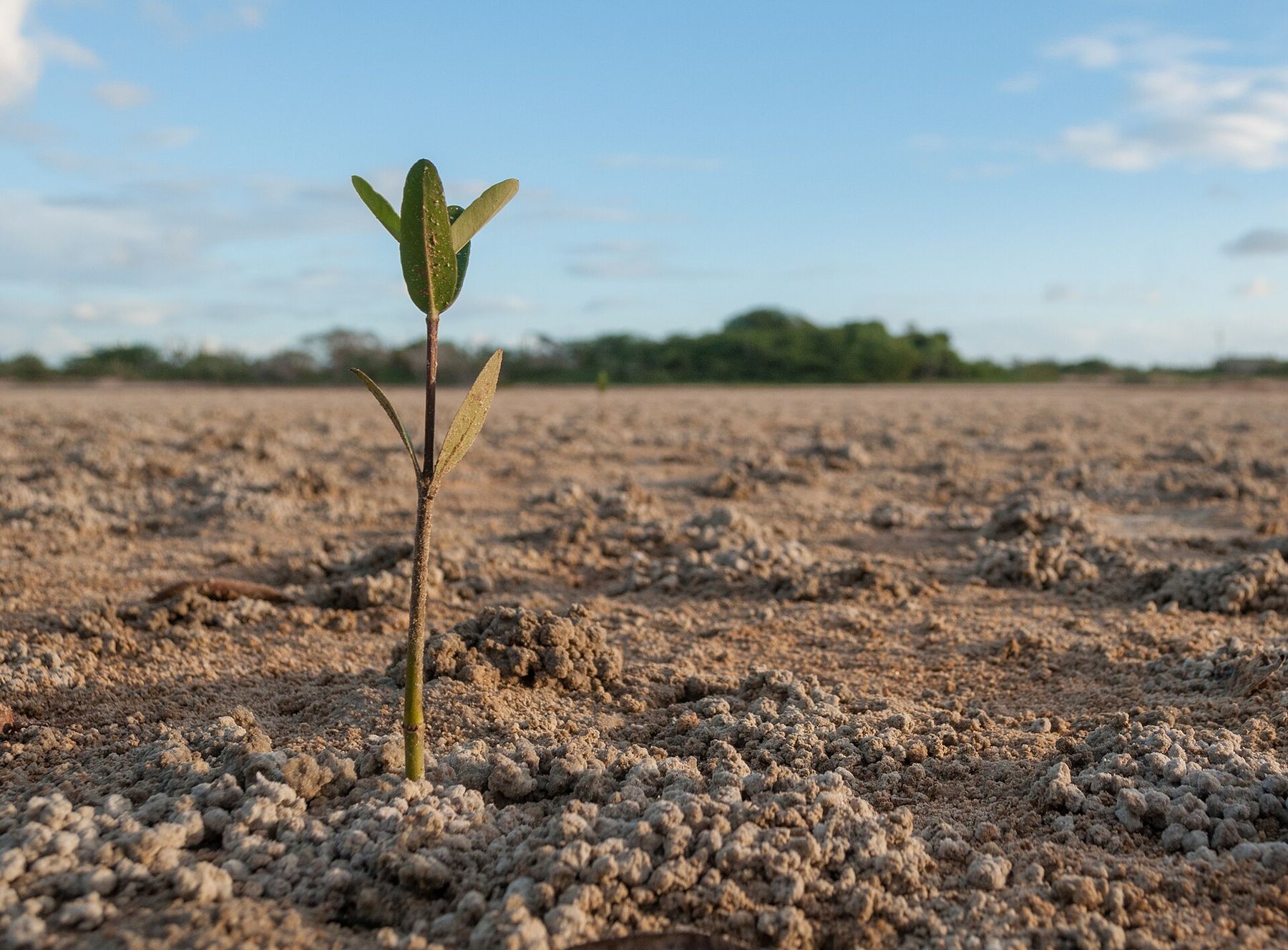
A young mangrove planted on an exposed coast: protection for the communities that bear the climate they did not cause.
Wilfredor, Mangrove young plant, 2013EcoAxes / Included ideologies / Indigenous, decolonial and justice-based approaches
Social movement and normative frameworkClimate Justice
The framework and movement that treat climate change as an ethical and political problem of unequal responsibility and unequal harm. Those who caused it, meaning wealthy countries, corporations and high-emitting individuals, owe emissions cuts, finance, help with adaptation and reparation to those who suffer most and contributed least, and climate policy must not repeat the injustices that produced the crisis. It includes the idea of ecological debt: the industrialised North owes the South for the resources it took and for the emissions it put into a shared atmosphere.
- Key figures
- Henry Shue, Simon Caney, J. Timmons Roberts and Bradley Parks, Brian Tokar, the Bali Principles of Climate Justice (2002)
Where it stands
- Economic PhilosophyGreen GrowthPost-Growth
- Resource OwnershipPrivate StewardshipCommons Governance
- Environmental AuthorityCentralized AuthorityLocal Autonomy
- Environmental JusticeAggregate OutcomesDistributive Justice
- Technological OutlookTechnological OptimismEcological Precaution
- Energy PhilosophyEnergy AbundanceEnergy Sufficiency
- Global ResponsibilityNational SovereigntyInternational Ecological Obligation
- Ecological Political PriorityIncremental ReformTransformative Change
Climate justice is explicit on responsibility, international obligation and distribution. Its positions on growth, energy and technology are those of its movement mainstream, which is sceptical of offsets, geoengineering and growth as usual; they carry wider bands.
Definition
Climate justice applies the idea of justice to climate change. The causes of warming are concentrated among the wealthy and the consequences fall on the poor. Emissions in the past create responsibility in the present. Vulnerable communities and countries have a right to protection, to help with adapting and to compensation. And the move to a low-carbon economy has to be fair, both in how it is decided and in who bears its costs.
Climate justice is an academic framework in moral and political philosophy. It is also an international movement that has changed both climate negotiations and climate activism.
Historical development
The ethical case came early. Henry Shue’s “Subsistence Emissions and Luxury Emissions” (1993) separated the emissions people need to survive from those that come with affluence. Simon Caney developed an account of climate duties that cross borders.
The movement grew up around the UN climate negotiations. Environmental justice groups and organisations from the global South drafted the Bali Principles of Climate Justice (2002), which carried the 1991 Principles of Environmental Justice over to climate. The Climate Justice Now! network formed at the Bali conference in 2007. The People’s Conference at Cochabamba in 2010 called for climate reparations and for the rights of Mother Earth.
International law carries traces of the movement in the principle of “common but differentiated responsibilities” (Rio, 1992) and in the fund for loss and damage agreed at COP27 in 2022. J. Timmons Roberts and Bradley Parks documented the unfairness of the climate regime in A Climate of Injustice (2007). In the 2010s the movement widened through Fridays for Future, Indigenous resistance to pipelines and trade unions’ demands for a just transition.
Principal claims
- Responsibility for climate change follows contribution to it, meaning past and present emissions, and luxury emissions above all.
- Those least responsible are the most vulnerable and suffer most.
- Wealthy countries owe poorer ones finance, technology and help with adaptation, and compensation for loss and damage.
- Climate policy must protect the poor, workers and the communities on the front line instead of sacrificing them. The transition has to be just.
- False solutions must be refused. These include offsets that push communities off their land, geoengineering, and continued extraction under a green label.
- Climate change is a symptom of an unjust economic order, and that order has to change.
Policy implications
The movement calls for wealthy countries to cut emissions steeply and soon. It wants climate finance on a large scale, owed as an obligation and not given as aid, along with compensation for loss and damage and the transfer of technology. Adaptation funding should be controlled by the people who receive it. Workers and regions that depend on fossil fuels need just-transition programmes. Carbon markets and offsets should be limited, and Indigenous and front-line communities should lead. Many versions add degrowth or post-growth policy in the North and debt cancellation for the South.
Internal disagreements
Supporters disagree about where to start counting responsibility: 1750, 1990 or today. They weigh differently the goal of equal emissions per person against the debt from past emissions. They are split on carbon pricing, offsets and carbon removal, and on growth, with some favouring green growth, some a Green New Deal and some degrowth. They also disagree about the roles of lawsuits and of direct action.
Criticisms and controversies
Critics argue that people alive now cannot be held responsible for their ancestors’ emissions, and that insisting on justice has slowed agreement. They say the framework can excuse rising emissions in large developing economies, and that refusing every market or technical tool does more harm than good.
Supporters answer that the delays have in fact come from the biggest emitters, and that policies people see as unfair do not survive politically.
Relationships to other traditions
Climate justice carries environmental justice to the global scale and draws on the ideas of ecological debt and decolonial ecology. Its economic demands overlap with ecosocialism, degrowth and ecological democratic socialism. It shares the language of “common but differentiated responsibilities” with sustainable development. It is critical of green growth, market environmentalism and ecomodernism, and opposed to environmental nationalism.
References and further reading
- Shue, H. (2014). Climate Justice: Vulnerability and Protection. Oxford University Press.
- Caney, S. (2005). “Cosmopolitan justice, responsibility, and global climate change.” Leiden Journal of International Law 18(4), 747–775.
- Roberts, J. T. and Parks, B. C. (2007). A Climate of Injustice: Global Inequality, North-South Politics, and Climate Policy. MIT Press.
- International Climate Justice Network (2002). Bali Principles of Climate Justice.
- Tokar, B. (2014). Toward Climate Justice: Perspectives on the Climate Crisis and Social Change, 2nd ed. New Compass Press.