
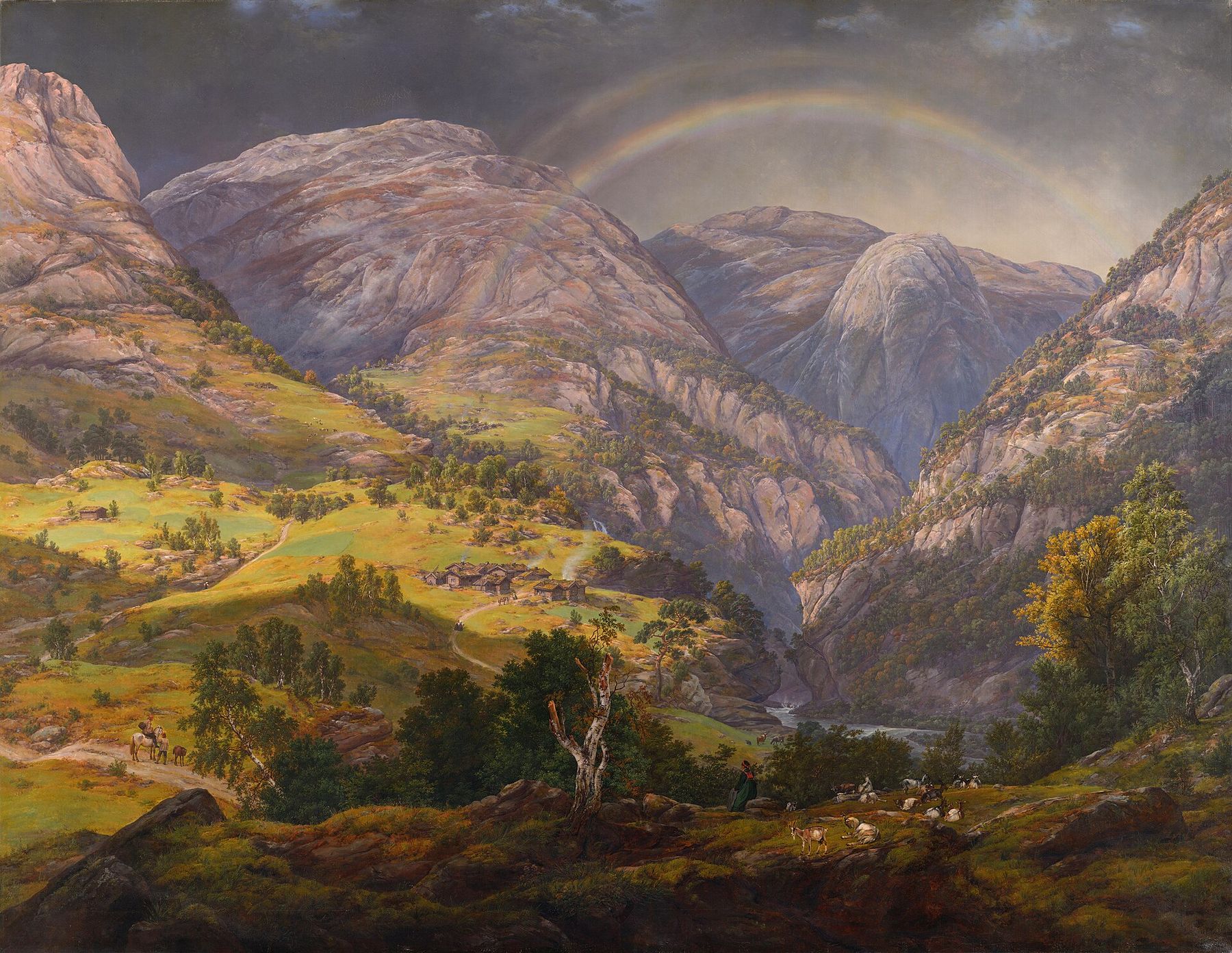
Dahl's Norwegian mountains, the landscape of Arne Naess, who named deep ecology.
Johan Christian Dahl, View from Stalheim, 1842EcoAxes / Included ideologies / Classical environmental philosophies
Philosophical movement and ethical positionDeep Ecology
A philosophy holding that all living beings and ecosystems have value in themselves, that people should live as equals with the rest of life on earth, and that this needs deep changes to economic, technological and political structures.
- Key figures
- Arne Naess, George Sessions, Bill Devall, Warwick Fox, Dolores LaChapelle
Where it stands
- Environmental EthicsAnthropocentrismEcocentrism
- Human–Nature RelationsHuman SeparationHuman Integration
- Ecological InterventionNoninterventionActive Stewardship
- Economic PhilosophyGreen GrowthPost-Growth
- Environmental AuthorityCentralized AuthorityLocal Autonomy
- Technological OutlookTechnological OptimismEcological Precaution
- Energy PhilosophyEnergy AbundanceEnergy Sufficiency
- Conservation StrategySustainable UseStrict Protection
- Human–Wildlife RelationsHuman PriorityWildlife Accommodation
- Ecological Political PriorityIncremental ReformTransformative Change
The platform is explicit on ethics, population and consumption, decentralisation and deep structural change.
Definition
Deep ecology is a philosophical movement holding that the flourishing of human and non-human life has value in itself, whatever its usefulness to people. It treats the richness and variety of living things as values that humans have no right to reduce, except to meet vital needs.
The Norwegian philosopher Arne Naess coined the name in 1973. He set a “deep, long-range” movement, which questions the basic assumptions of industrial society, against a “shallow” environmentalism. The shallow kind cares about pollution and the depletion of resources only as far as they affect the health and wealth of people in developed countries.
Historical development
Naess introduced the term in a short paper, “The Shallow and the Deep, Long-Range Ecology Movement” (1973), which summarised a lecture he had given in Bucharest the year before. In 1984 he and George Sessions drafted an eight-point platform, meant as a statement of principles that people with different underlying philosophies could all accept. Its points include the intrinsic value of non-human life and the value of diversity. They also say that human interference with the non-human world is excessive and getting worse, that the human population needs to be much smaller, and that policies affecting economic, technological and ideological structures must change at a deep level.
Bill Devall and George Sessions brought the platform to a wide readership in Deep Ecology: Living as if Nature Mattered (1985). Naess set out his own systematic version, which he called Ecosophy T, in Ecology, Community and Lifestyle (1989).
In the 1980s deep ecology shaped the radical wing of the North American wilderness movement, including Earth First!. It has been a major point of reference in environmental ethics ever since.
Principal claims
- Non-human life has value in itself. The richness and variety of living things are values in their own right.
- Humans have no right to reduce that richness and variety except to meet vital needs.
- Human life can flourish with a much smaller human population, and the flourishing of non-human life requires one.
- Human interference with the non-human world is excessive, and the situation is getting rapidly worse.
- Policy therefore has to change at a deep level, in economic, technological and ideological structures as well as in regulations.
- The change in outlook is mainly a matter of valuing quality of life over an ever higher standard of living.
- Naess also stressed “self-realisation”, a widening of the sense of self to include other beings. Caring for nature then expresses one’s own larger self, instead of being a duty imposed from outside.
Policy implications
Deep ecologists generally favour protecting large areas of wilderness, strict limits on extracting resources, lower consumption and smaller populations in rich societies, local self-reliance and decentralisation, and technology on a modest scale. The platform does not say which political means to use, and its supporters have ranged from pacifist communitarians to direct-action activists.
Internal disagreements
The platform was written so that people with different foundations could share it, whether Buddhist, Christian, Spinozist or secular. So disagreement about ultimate justification is deliberate. Beyond that, deep ecologists have disagreed about population: how a smaller population should be reached, and whether to say so at all. They have differed on the role of political organisation, and on whether identifying with nature or respecting its intrinsic value is the better foundation. Warwick Fox’s “transpersonal ecology” pushed the psychological reading, based on identification. Others preferred a reading based on the theory of value.
Criticisms and controversies
In the late 1980s Murray Bookchin and other social ecologists attacked deep ecology as mystical and blind to the social causes of ecological damage. Some remarks by Earth First! activists about famine and population were condemned as misanthropic. Ecofeminists argued that its account of domination left out gender. Ramachandra Guha argued in 1989 that its emphasis on wilderness, exported to India and elsewhere, served elites and tourists against the rural poor. Philosophers have asked whether “intrinsic value” can be made coherent, and whether identifying with nature can create obligations.
Supporters answer that the platform is compatible with social justice, and that the misanthropic remarks were made by individuals and are not part of the doctrine.
Relationships to other traditions
Deep ecology is the best-known form of ecocentrism and overlaps with biocentrism, wilderness preservation and eco-spirituality. It defined itself against shallow ecology and reform environmentalism. Its long argument with social ecology shaped both sides. Its call to consume less anticipates degrowth, although the two movements have little else in common as organisations.
References and further reading
- Naess, A. (1973). “The shallow and the deep, long-range ecology movement: A summary.” Inquiry 16(1–4), 95–100.
- Devall, B. and Sessions, G. (1985). Deep Ecology: Living as if Nature Mattered. Gibbs Smith.
- Naess, A. (1989). Ecology, Community and Lifestyle: Outline of an Ecosophy. Cambridge University Press.
- Fox, W. (1990). Toward a Transpersonal Ecology. Shambhala.
- Guha, R. (1989). “Radical American environmentalism and wilderness preservation: A Third World critique.” Environmental Ethics 11(1), 71–83.
- Bookchin, M. (1987). “Social ecology versus deep ecology: A challenge for the ecology movement.” Green Perspectives 4–5.