
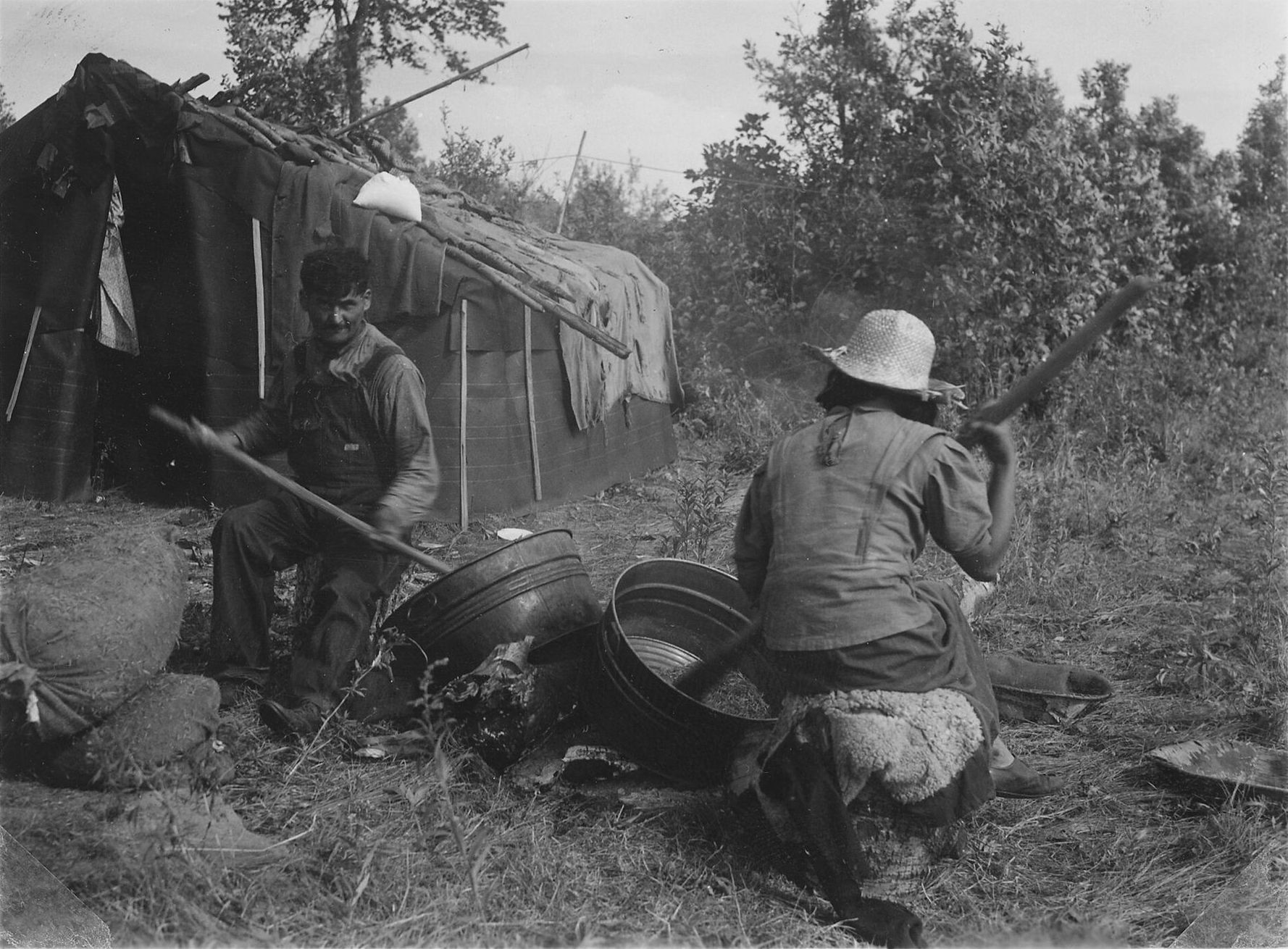
Paul Buffalo and his wife parching manoomin, wild rice, at their Ojibwe camp: a harvest tended by its people for centuries.
Unknown author Unknown author or not provided, Paul Buffalo and wife parching wild rice at their camp, 1937EcoAxes / Included ideologies / Indigenous, decolonial and justice-based approaches
Political movement and family of governance traditionsIndigenous Stewardship
The assertion by Indigenous peoples of their right to govern, care for and relate to their lands, waters and non-human kin under their own laws, knowledge and responsibilities. It goes with growing recognition that territories governed by Indigenous peoples hold much of the world's remaining biodiversity.
- Key figures
- Kyle Whyte, Robin Wall Kimmerer, Glen Coulthard, Leanne Betasamosake Simpson, Vine Deloria Jr.
Where it stands
- Environmental EthicsAnthropocentrismEcocentrism
- Human–Nature RelationsHuman SeparationHuman Integration
- Ecological InterventionNoninterventionActive Stewardship
- Resource OwnershipPrivate StewardshipCommons Governance
- Environmental AuthorityCentralized AuthorityLocal Autonomy
- Environmental JusticeAggregate OutcomesDistributive Justice
- Technological OutlookTechnological OptimismEcological Precaution
- Conservation StrategySustainable UseStrict Protection
- Human–Wildlife RelationsHuman PriorityWildlife Accommodation
- Agricultural EcologyLand SparingLand Sharing
- Global ResponsibilityNational SovereigntyInternational Ecological Obligation
- Ecological Political PriorityIncremental ReformTransformative Change
There are thousands of Indigenous peoples with distinct laws and ecologies; this profile describes the shared political claim of sovereignty and the relational stewardship widely documented across them, not any one nation's worldview. The ethics value reflects relational and kinship ethics that the anthropocentric–ecocentric axis captures only approximately.
Definition
Indigenous environmental sovereignty is a claim made by Indigenous nations and peoples around the world, and partly recognised in the United Nations Declaration on the Rights of Indigenous Peoples (2007). It holds that Indigenous peoples have the right to govern their traditional territories and to practise and pass on their own ecological knowledge and law. They have the right to give or refuse free, prior and informed consent to projects that affect their lands. And they have the right to keep up the relationships of reciprocity and responsibility with land, water, plants and animals that their traditions describe.
It is a political demand, a body of governance practice, and a set of environmental philosophies that differ from one people to another. What the peoples share is the political claim, not a single “Indigenous worldview”.
Historical development
Indigenous peoples governed their territories long before the states that now claim them, and their resistance to dispossession is as old as colonisation. The modern movement for environmental sovereignty grew through the twentieth century.
In the United States it grew through struggles over fishing rights, which led to the Boldt decision of 1974, through the American Indian Movement, and through the writing of Vine Deloria Jr. In Canada it grew through land claims, the Berger Inquiry (1977) and the recognition of Aboriginal title. In Latin America, Indigenous movements reshaped the constitutions of Ecuador (2008) and Bolivia (2009). In Australia came the Mabo decision (1992). Internationally, the Working Group on Indigenous Populations led, after twenty years of negotiation, to the UN Declaration in 2007.
Conservation science has lately confirmed how much land Indigenous peoples look after. A study in 2018 found that they manage or hold tenure over about a quarter of the world’s land, overlapping some 40 per cent of protected areas and ecologically intact landscapes. Scholars such as Kyle Whyte and Robin Wall Kimmerer have brought Indigenous environmental thought into academic environmental philosophy on its own terms.
Principal claims
- Indigenous peoples hold inherent rights to their territories and to govern themselves. Colonial states have violated those rights and must recognise them.
- Land and water are relatives, not resources. People owe them reciprocity.
- Indigenous knowledge of fire, harvest and water is a science of place that has sustained biodiversity for thousands of years.
- Conservation that removes Indigenous peoples from their lands continues colonial dispossession.
- Free, prior and informed consent is the minimum standard for anything that affects Indigenous territory.
- Environmental justice for Indigenous peoples needs the return of land and of jurisdiction. Consultation alone is not enough.
Policy implications
The movement calls for recognition of title and jurisdiction, and for Indigenous protected and conserved areas governed by the nations themselves. It wants co-management that carries real authority, and consent requirements for mining, drilling and infrastructure. It supports cultural burning, traditional harvest and the revival of languages. It wants land held by conservation bodies and governments returned, and funding paid directly to Indigenous governments.
Internal disagreements
Indigenous peoples disagree among themselves as any peoples do. Some nations develop their own resources on their own terms, and others refuse extraction. Some use state law and rights frameworks, while others refuse state recognition altogether, following Glen Coulthard’s critique of the “politics of recognition”. They differ on co-management as against exclusive jurisdiction, and on their relationship with non-Indigenous environmentalists, who have often been allies and often appropriated what was not theirs.
Criticisms and controversies
Governments and extractive industries have resisted consent requirements as a veto. Some conservationists have argued that sovereignty could allow harmful uses of land. Indigenous scholars warn against the stereotype of the “ecological Indian”, which casts Indigenous peoples as natural conservationists instead of as political actors. Who speaks for a nation is contested within nations, as it is everywhere.
Supporters note that the evidence on Indigenous stewardship is strong, and that the alternative, continued dispossession, has an environmental record of its own.
Relationships to other traditions
Indigenous environmental sovereignty is the ground of land back environmentalism. It is a central point of reference for decolonial ecology, environmental justice, community conservation, rights-based conservation and Buen Vivir. It stands against fortress conservation and against any planetary stewardship that would govern Indigenous lands from above. Its ethics of relationship resemble deep ecology and ecocentrism without being the same, and Indigenous scholars have often resisted being folded into them.
References and further reading
- United Nations (2007). Declaration on the Rights of Indigenous Peoples. A/RES/61/295.
- Whyte, K. P. (2018). “Settler colonialism, ecology, and environmental injustice.” Environment and Society 9(1), 125–144.
- Kimmerer, R. W. (2013). Braiding Sweetgrass. Milkweed Editions.
- Coulthard, G. S. (2014). Red Skin, White Masks: Rejecting the Colonial Politics of Recognition. University of Minnesota Press.
- Garnett, S. T. et al. (2018). “A spatial overview of the global importance of Indigenous lands for conservation.” Nature Sustainability 1, 369–374.
- Deloria, V., Jr. (1973). God Is Red. Grosset & Dunlap.