
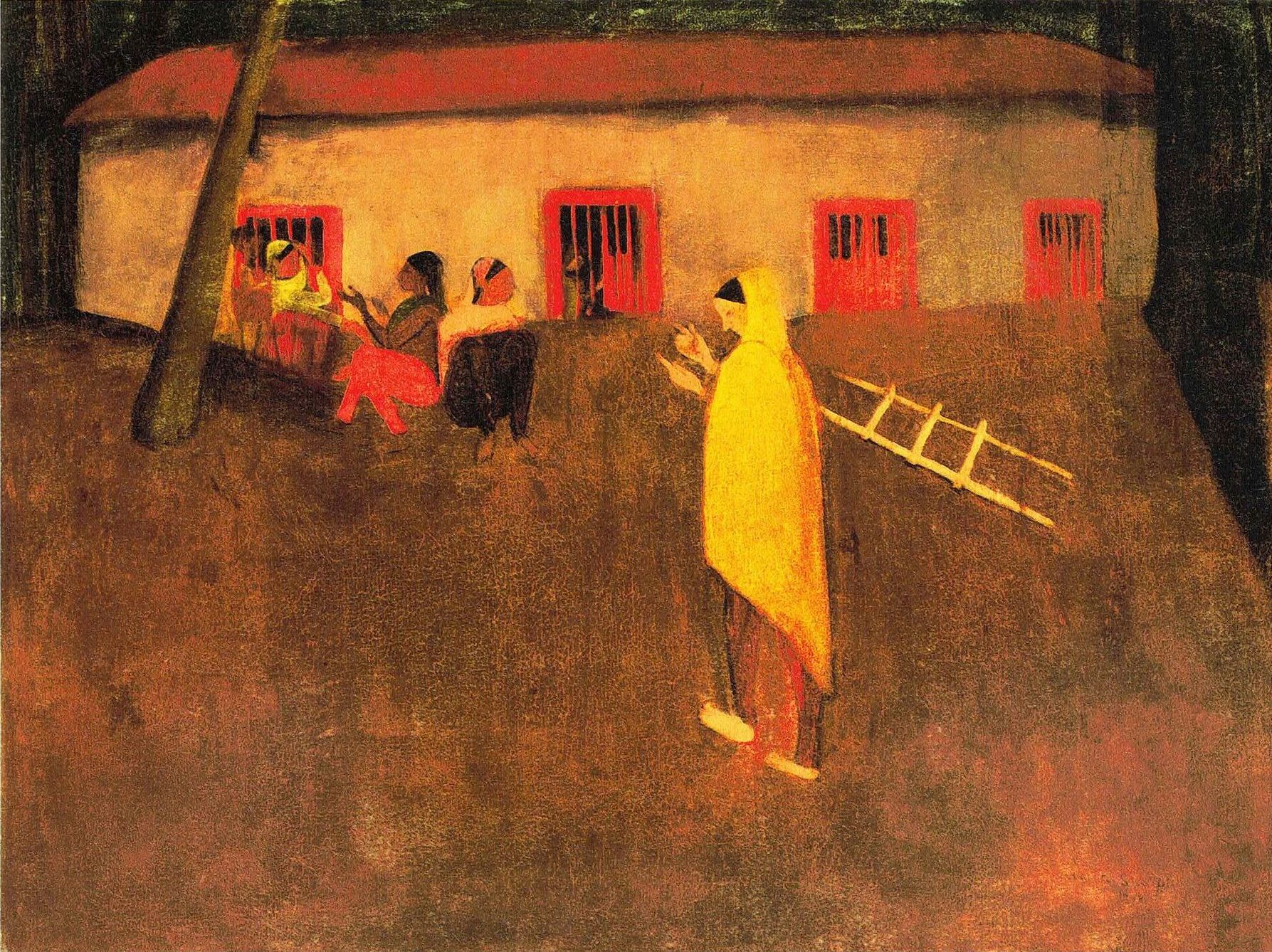
Amrita Sher-Gil's Village Scene (1938): rural India, where a living comes straight from the land, water and forest.
Amrita Sher-Gil, Amrita Sher-Gil Village Scene 1938 Simla, 1938EcoAxes / Included ideologies / Indigenous, decolonial and justice-based approaches
Social movements and analytical frameworkPopular Environmentalism
The environmental struggles of peasants, fishers, Indigenous peoples and the urban poor to keep the land, water and forests their livelihoods depend on, against mines, dams, plantations and polluting industry. Joan Martinez-Alier named it ecologismo popular, also translated as "the environmentalism of the poor". Its defenders often never called themselves environmentalists: for them, nature matters first as the source of a living.
- Key figures
- Joan Martinez-Alier, Ramachandra Guha, Chico Mendes, Ken Saro-Wiwa, Medha Patkar
Where it stands
- Environmental EthicsAnthropocentrismEcocentrism
- Human–Nature RelationsHuman SeparationHuman Integration
- Economic PhilosophyGreen GrowthPost-Growth
- Resource OwnershipPrivate StewardshipCommons Governance
- Environmental AuthorityCentralized AuthorityLocal Autonomy
- Environmental JusticeAggregate OutcomesDistributive Justice
- Technological OutlookTechnological OptimismEcological Precaution
- Energy PhilosophyEnergy AbundanceEnergy Sufficiency
- Conservation StrategySustainable UseStrict Protection
- Human–Wildlife RelationsHuman PriorityWildlife Accommodation
- Agricultural EcologyLand SparingLand Sharing
- Global ResponsibilityNational SovereigntyInternational Ecological Obligation
- Ecological Political PriorityIncremental ReformTransformative Change
Its firmest positions are on justice, communal control of land and resources, and the right of communities to decide; it values nature chiefly as livelihood and supports use over strict protection. Its views on growth, energy and technology come mostly from opposing particular extractive projects, so those bands are wider.
Definition
Popular environmentalism is the name the economist Joan Martinez-Alier gave to environmental struggles by the poor. In Spanish he called it ecologismo popular, and in English “the environmentalism of the poor”.
These are the conflicts of peasants, fishers, forest dwellers, Indigenous peoples and the urban poor whose living depends directly on land, water, forests and fisheries. They resist when a mine, a dam, an oil field, a plantation or a polluting factory threatens those resources. Many of the people involved never called themselves environmentalists. They were defending their fields, rivers and health. But because they defended the conditions of life against extraction, Martinez-Alier and the historian Ramachandra Guha argued, theirs was an environmentalism in its own right, and probably the largest in the world.
The idea answered a common assumption in the 1970s and 1980s that environmental concern is a luxury of rich societies, which people take up only once their material needs are met. That view is most associated with Ronald Inglehart’s thesis of “post-materialist” values.
Historical development
Guha’s The Unquiet Woods (1989) traced the Chipko movement in the Himalaya, where villagers who hugged trees to stop commercial logging were defending their forests as livelihood. The same year Guha published a sharp critique of American wilderness preservation from the point of view of the global South. Guha and Martinez-Alier set the comparison out together in Varieties of Environmentalism (1997), and Martinez-Alier gave the full theory in The Environmentalism of the Poor (2002), built around what he calls “ecological distribution conflicts”: disputes over who bears the costs of the economy’s growing use of materials and energy.
The movements came first. Chico Mendes organised rubber tappers in the Brazilian Amazon to defend the forest against ranchers, and was murdered in 1988. Ken Saro-Wiwa led the Ogoni people of Nigeria against the pollution of their land by oil companies, and was executed by the military government in 1995. In India, Medha Patkar and the Narmada Bachao Andolan fought the Sardar Sarovar dam from the 1980s. Rob Nixon’s Slow Violence and the Environmentalism of the Poor (2011) brought the idea into literary and cultural studies.
From 2012 Martinez-Alier and colleagues built the Environmental Justice Atlas (EJAtlas), which records thousands of these conflicts worldwide. A study of 2,743 of them by Arnim Scheidel and colleagues (2020) found that defenders faced criminalisation in 20 per cent of cases, physical violence in 18 per cent and assassination in 13 per cent, with higher rates where Indigenous peoples were involved. Defenders helped stop the project in 11 per cent of cases.
Principal claims
- The poor are often the first to defend the environment, because their living depends on it directly.
- Environmental concern is not a luxury that comes after wealth. It grows out of material need.
- The industrial economy keeps reaching for new sources of materials and energy and new places to dump waste, and those frontiers usually lie on the land of poor and Indigenous people.
- These “ecological distribution conflicts” are conflicts over who bears environmental costs. They are not only about the value of nature in the abstract.
- The people affected have the right to say no to projects on their land, and their knowledge of the land counts.
- Many such conflicts are expressed in the language of livelihood, the sacred, territory or rights, not in the language of economics, and they should not be reduced to a monetary price.
Policy implications
Popular environmentalism supports secure rights for communities to their land, forests, water and fisheries, and their right to refuse mines, dams and plantations. It calls for protection of environmental defenders, who are frequently threatened and killed. It favours common property and community management of resources over both private enclosure and protected areas that exclude local people. Internationally it supports recognition of the ecological debt that rich countries owe for the resources and dumping space they have taken, and limits on the extraction that feeds their consumption.
Internal disagreements
Scholars and activists disagree about how far the poor are really environmentalists. Some movements defend livelihoods and would welcome a fairer share of the same extraction, while others oppose extraction outright. They debate whether the framework romanticises poor communities, and how it relates to movements in rich countries, such as environmental justice in the United States. There is also tension between defending local livelihoods and protecting species that local livelihoods put under pressure.
Criticisms and controversies
Critics argue that the framework can overstate how environmental the motives of resisting communities are, and that it treats “the poor” as more united than they are. Some development economists argue that blocking mines and dams can keep poor regions poor. Conservationists have pointed out that some livelihood uses deplete wildlife and forests, so the interests of local people and of biodiversity do not always line up.
Supporters answer with the evidence of thousands of documented conflicts, and with the many defenders killed for protecting their land and water.
Relationships to other traditions
Popular environmentalism is the ground-level counterpart of political ecology, which supplies much of its analysis. It overlaps with environmental justice, which grew out of similar struggles in the United States, and with decolonial ecology and the critique of extraction. It supports food sovereignty, community conservation and Indigenous environmental sovereignty. It is critical of fortress conservation, which has often displaced the people it speaks for, and of ecomodernism and green growth, which it sees as moving extraction to new frontiers.
References and further reading
- Guha, R. (1989). The Unquiet Woods: Ecological Change and Peasant Resistance in the Himalaya. Delhi: Oxford University Press.
- Guha, R. (1989). Radical American environmentalism and wilderness preservation: a Third World critique. Environmental Ethics 11(1): 71–83.
- Guha, R. and Martinez-Alier, J. (1997). Varieties of Environmentalism: Essays North and South. London: Earthscan.
- Martinez-Alier, J. (2002). The Environmentalism of the Poor: A Study of Ecological Conflicts and Valuation. Cheltenham: Edward Elgar.
- Nixon, R. (2011). Slow Violence and the Environmentalism of the Poor. Cambridge, MA: Harvard University Press.
- Temper, L., Del Bene, D. and Martinez-Alier, J. (2015). Mapping the frontiers and front lines of global environmental justice: the EJAtlas. Journal of Political Ecology 22: 255–278.
- Scheidel, A. et al. (2020). Environmental conflicts and defenders: a global overview. Global Environmental Change 63: 102104.
- Inglehart, R. (1977). The Silent Revolution: Changing Values and Political Styles Among Western Publics. Princeton: Princeton University Press.