
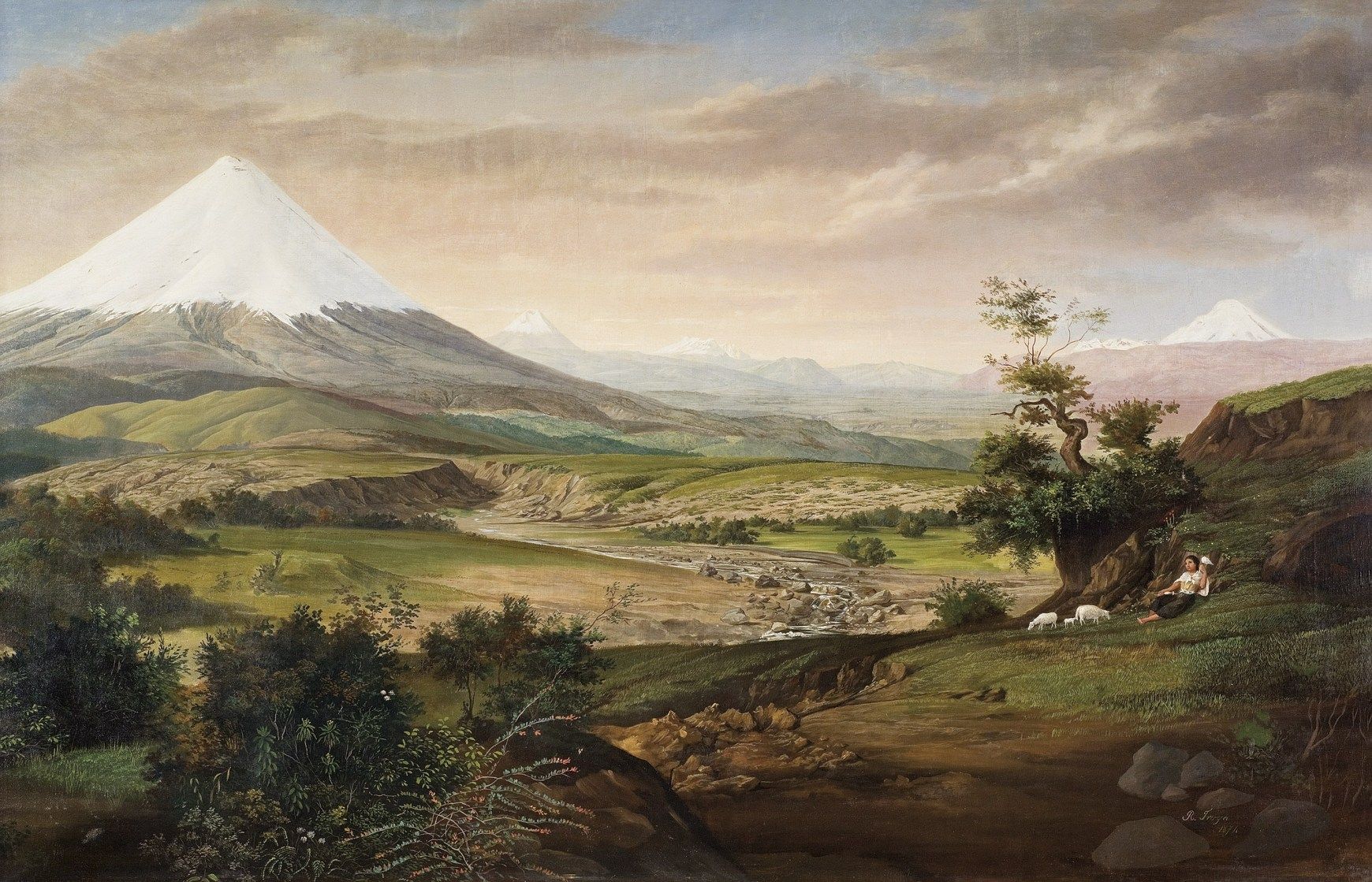
Rafael Troya's Cotopaxi, 1874: the Ecuadorian Andes, home of the sumak kawsay tradition, painted by an Ecuadorian.
Rafael Troya, Troya, El Cotopaxi, 1874, 1874EcoAxes / Included ideologies / Indigenous, decolonial and justice-based approaches
Philosophy, political concept and constitutional principleBuen Vivir
The Andean idea of living well in harmony with community and nature (sumak kawsay in Kichwa, suma qamaña in Aymara). Ecuador and Bolivia wrote it into their constitutions as an alternative to development. It goes with recognising the rights of nature and with a mixed economy aimed at sufficiency instead of growth.
- Key figures
- Alberto Acosta, Eduardo Gudynas, Catherine Walsh, Pablo Dávalos, Luis Macas
Where it stands
- Environmental EthicsAnthropocentrismEcocentrism
- Human–Nature RelationsHuman SeparationHuman Integration
- Economic PhilosophyGreen GrowthPost-Growth
- Resource OwnershipPrivate StewardshipCommons Governance
- Environmental AuthorityCentralized AuthorityLocal Autonomy
- Environmental JusticeAggregate OutcomesDistributive Justice
- Technological OutlookTechnological OptimismEcological Precaution
- Energy PhilosophyEnergy AbundanceEnergy Sufficiency
- Conservation StrategySustainable UseStrict Protection
- Agricultural EcologyLand SparingLand Sharing
- Global ResponsibilityNational SovereigntyInternational Ecological Obligation
- Ecological Political PriorityIncremental ReformTransformative Change
Buen Vivir is a plural concept with Indigenous, ecologist and statist readings; the profile describes the ecologist and Indigenous reading that dominates its philosophical literature, not the state-developmentalist version.
Definition
Buen Vivir means “living well” or “good living”. It translates two Andean Indigenous ideas, sumak kawsay in Kichwa and suma qamaña in Aymara. Both describe a life in balance with the community and with Pachamama, the living earth, and contrast it with a life of accumulation.
As politics, Buen Vivir is an alternative to development. It rejects the idea that every society advances along one path of economic growth. In its place it proposes economies of several kinds, communal and territorial self-government, nature recognised as a holder of rights, and needs met through sufficiency and reciprocity. Ecuador wrote it into its constitution in 2008, along with the rights of nature, and Bolivia did the same in 2009.
Historical development
The ideas belong to the Andean peoples. Indigenous movements that grew from the 1980s gave them political form, Ecuador’s CONAIE above all.
In the constitutional assemblies of 2007–09 in Ecuador and Bolivia, Indigenous delegates worked with ecologists such as Alberto Acosta, who presided over Ecuador’s assembly, and critics of development such as Eduardo Gudynas to make Buen Vivir a constitutional principle. Article 71 of Ecuador’s constitution gave nature “the right to integral respect for its existence.”
The governments of Rafael Correa and Evo Morales that followed spoke of Buen Vivir while expanding oil drilling and mining. This opened a sharp split. On one side was a reading that served state-led development. On the other was the ecological and Indigenous reading of Acosta, Gudynas and the movements. Outside the Andes, degrowth, post-development and decolonial thinkers have adopted Buen Vivir as an alternative to growth that comes from the global South.
Principal claims
- Wellbeing lies in relationships, in harmony with community, ancestors and nature. Owning more goods does not provide it.
- Nature, Pachamama, is a subject. It has rights, and people have duties toward it.
- Development understood as growth was imposed by colonialism. There are many ways of living well and no single path of progress.
- Economies should be mixed, communal and reciprocal, and aimed at having enough.
- Indigenous and peasant communities need their territories and their own government to live well.
- Extracting nature’s resources for export cannot be squared with Buen Vivir.
Policy implications
Supporters want the rights of nature in constitutions and law, communal land and territorial autonomy, and solidarity economies. They want limits on extraction and a way out of it. Ecuador’s Yasuní-ITT proposal, to leave oil in the ground, is the best-known example. They also back agroecology and food sovereignty, policy judged by wellbeing instead of GDP, and states that are intercultural and recognise many nations within them.
Internal disagreements
The main dispute is between two readings. The Indigenous and ecological reading rejects extraction and a state built around growth. The “socialist Buen Vivir” of the Correa and Morales governments used the idea to justify state-run extraction that paid for redistribution. Other debates concern whether Buen Vivir can be carried outside the Andes, how to balance communal and individual rights, and how it relates to Western ecological thought.
Criticisms and controversies
Critics argue that state appropriation has drained the idea of meaning and that it romanticises Indigenous life. They say its rejection of development offers little to poor people who want a better material life, and that the rights of nature have been weakly enforced. Some Indigenous critics object to non-Indigenous theorists turning it into a universal doctrine.
Supporters point to its continuing strength in Indigenous movements and campaigns against extraction, and to its influence on rights-of-nature law around the world.
Relationships to other traditions
Buen Vivir is a central point of reference for the decolonial family of traditions. It informs opposition to extraction and food sovereignty, rests on Indigenous environmental sovereignty, and meets degrowth and post-development on common ground. Its rights of nature connect it to ecocentrism. It opposes the growth model of sustainable development, and extraction under governments of any political colour.
References and further reading
- Gudynas, E. (2011). “Buen Vivir: Today’s tomorrow.” Development 54(4), 441–447.
- Acosta, A. (2013). El Buen Vivir: Sumak Kawsay, una oportunidad para imaginar otros mundos. Icaria.
- Walsh, C. (2010). “Development as Buen Vivir: Institutional arrangements and (de)colonial entanglements.” Development 53(1), 15–21.
- Constitution of the Republic of Ecuador (2008), Articles 71–74 (rights of nature) and Title VII (the regime of Buen Vivir).
- Huanacuni Mamani, F. (2010). Buen Vivir / Vivir Bien: Filosofía, políticas, estrategias y experiencias regionales andinas. CAOI.