
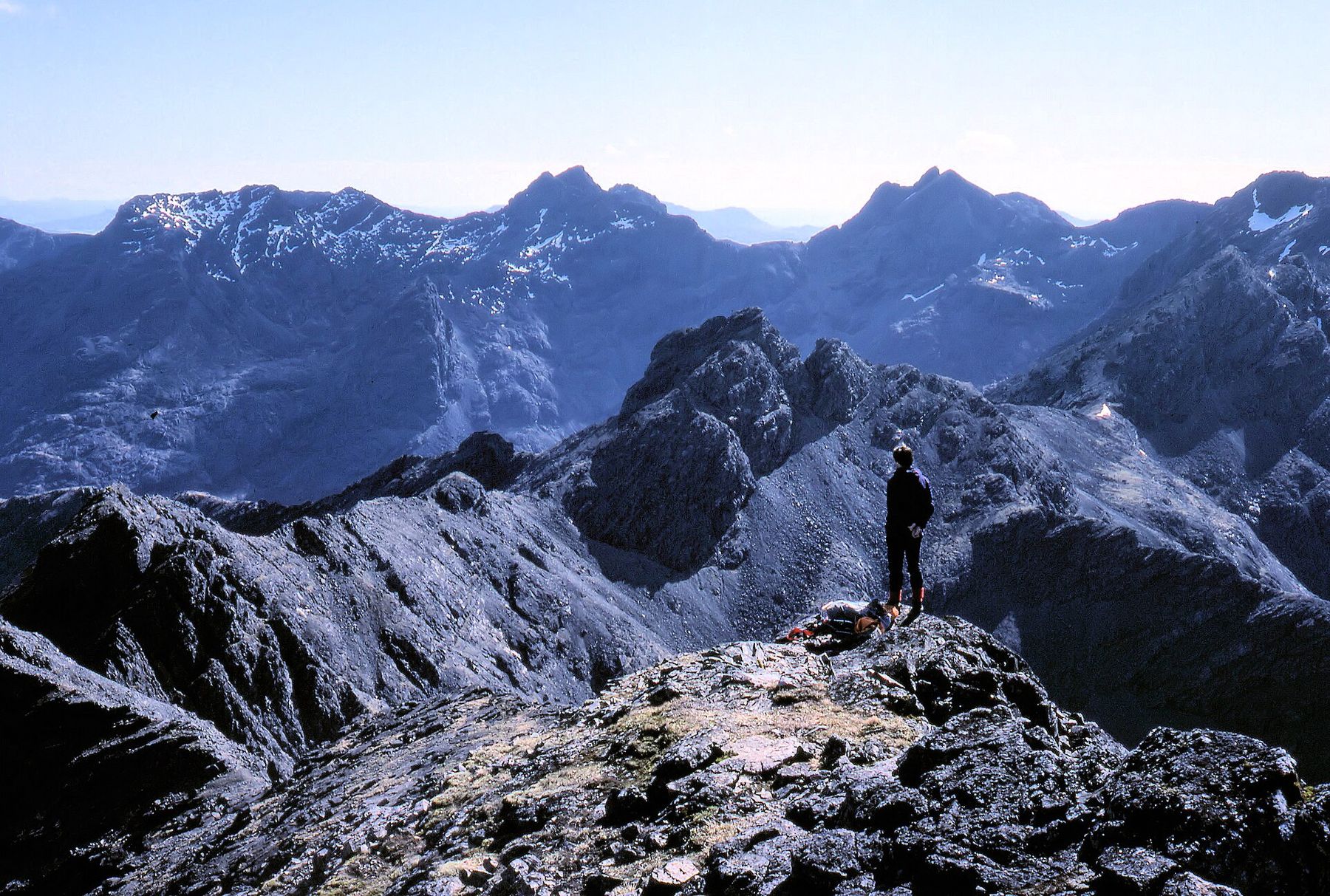
A lone walker on the main ridge of the Cuillin, Skye: one person among the wild and uncontrollable.
Adrian Pingstone, Main ridge of the cuillin in skye arp, 1976EcoAxes / Included ideologies / Classical environmental philosophies
Cultural movementDark Mountain
The cultural movement started by Paul Kingsnorth and Dougald Hine's 2009 manifesto Uncivilisation. It holds that industrial civilisation is coming apart and that politics, technology and campaigns cannot save it. It asks instead for grief, honesty, art, and a new rooting of human life in a wild world nobody controls.
- Key figures
- Paul Kingsnorth, Dougald Hine, Charlotte Du Cann, John Michael Greer, Robinson Jeffers (as antecedent)
Where it stands
- Environmental EthicsAnthropocentrismEcocentrism
- Human–Nature RelationsHuman SeparationHuman Integration
- Ecological InterventionNoninterventionActive Stewardship
- Economic PhilosophyGreen GrowthPost-Growth
- Resource OwnershipPrivate StewardshipCommons Governance
- Environmental AuthorityCentralized AuthorityLocal Autonomy
- Environmental JusticeAggregate OutcomesDistributive Justice
- Technological OutlookTechnological OptimismEcological Precaution
- Energy PhilosophyEnergy AbundanceEnergy Sufficiency
- Conservation StrategySustainable UseStrict Protection
- Human–Wildlife RelationsHuman PriorityWildlife Accommodation
- Agricultural EcologyLand SparingLand Sharing
- Global ResponsibilityNational SovereigntyInternational Ecological Obligation
- Ecological Political PriorityIncremental ReformTransformative Change
Its firmest commitments are to nature's own value, to deep scepticism of technology and of ever more energy, to living with less, and to the local and the small. Its stance on change is unusual: it expects the present order to collapse but places little faith in political programmes either to reform or to replace it, so it sits near the middle of the reform-to-transformation scale with a wide band.
Definition
Dark Mountain starts from the conviction that the ecological crisis has no solution, because it is the end of a story: the story of industrial civilisation’s endless progress and mastery over nature. The movement offers no programme.
What it asks is that people look honestly at how much is being lost and grieve for it. It asks them to find ways of living, making art and telling stories that put human beings back among the rest of life. “Uncivilised” in its sense means no longer imagining humanity at the centre. The name comes from Robinson Jeffers’s poem “Rearmament”, which speaks of the “dark mountain” that civilisation is moving toward.
Historical development
Paul Kingsnorth, a journalist and former campaigner, and the writer Dougald Hine published Uncivilisation: The Dark Mountain Manifesto in 2009, when the Copenhagen climate talks already looked likely to fail. A series of anthologies followed, along with festivals and gatherings in Britain from 2010.
Kingsnorth’s essays, collected in Confessions of a Recovering Environmentalist (2017), argued that mainstream environmentalism had become a project to keep industrial civilisation going with clean technology, at the expense of wild nature. The movement fed a wider culture of accepting collapse, from Jem Bendell’s “Deep Adaptation” to writing about climate grief. Kingsnorth himself later became an Orthodox Christian.
Principal claims
- Industrial civilisation cannot last and is already coming apart. The crisis will not be solved.
- Politics, technology and campaigning cannot prevent the collapse. By keeping the machine running, they often bring it closer.
- Humanity is one part of a larger, wild world. It is neither that world’s master nor its manager.
- The stories a culture tells shape what it does, so new stories, new art and new ways of seeing are needed.
- Grief for what is being lost is a necessary and honest response.
Policy implications
As a cultural movement it proposes no policies. Its writers support protecting land and letting it go wild, living locally and on a small scale, consuming less, and learning crafts and practical skills. They resist large technological schemes, including some industrial renewable energy projects that destroy wild places.
Internal disagreements
Participants disagree about how certain collapse is, and about whether it is still worth acting to reduce the harm. Some pull the movement toward spirituality, others toward practical local life and work on the land. Kingsnorth’s turn to religion and his criticism of progressive politics divided him from parts of the wider movement.
Criticisms and controversies
Critics call the movement’s acceptance of collapse a counsel of despair. They say it saps climate action and is a luxury for people who will not bear the worst consequences. Others find its suspicion of “civilisation” and its romantic view of wild nature politically ambiguous.
Supporters answer that honesty about the size of the crisis has to come before any real response, and that the movement has given many people words for their grief and a way to act through it.
Relationships to other traditions
Dark Mountain shares deep ecology’s ecocentrism and anarcho-primitivism’s criticism of civilisation, without primitivism’s political programme. It overlaps with eco-spirituality’s sense that nature is sacred and with degrowth’s call to live on less. It grew partly out of the disillusion of former activists, including some from radical wilderness defence.
References and further reading
- Kingsnorth, P. and Hine, D. (2009). Uncivilisation: The Dark Mountain Manifesto. The Dark Mountain Project.
- Kingsnorth, P. (2017). Confessions of a Recovering Environmentalist. London: Faber.
- Jeffers, R. (1935). Rearmament. In Solstice and Other Poems. New York: Random House.
- Bendell, J. (2018). Deep adaptation: a map for navigating climate tragedy. IFLAS Occasional Paper 2.
- Smith, D. (2014). It’s the end of the world as we know it… and he feels fine. The New York Times Magazine, 17 April.