
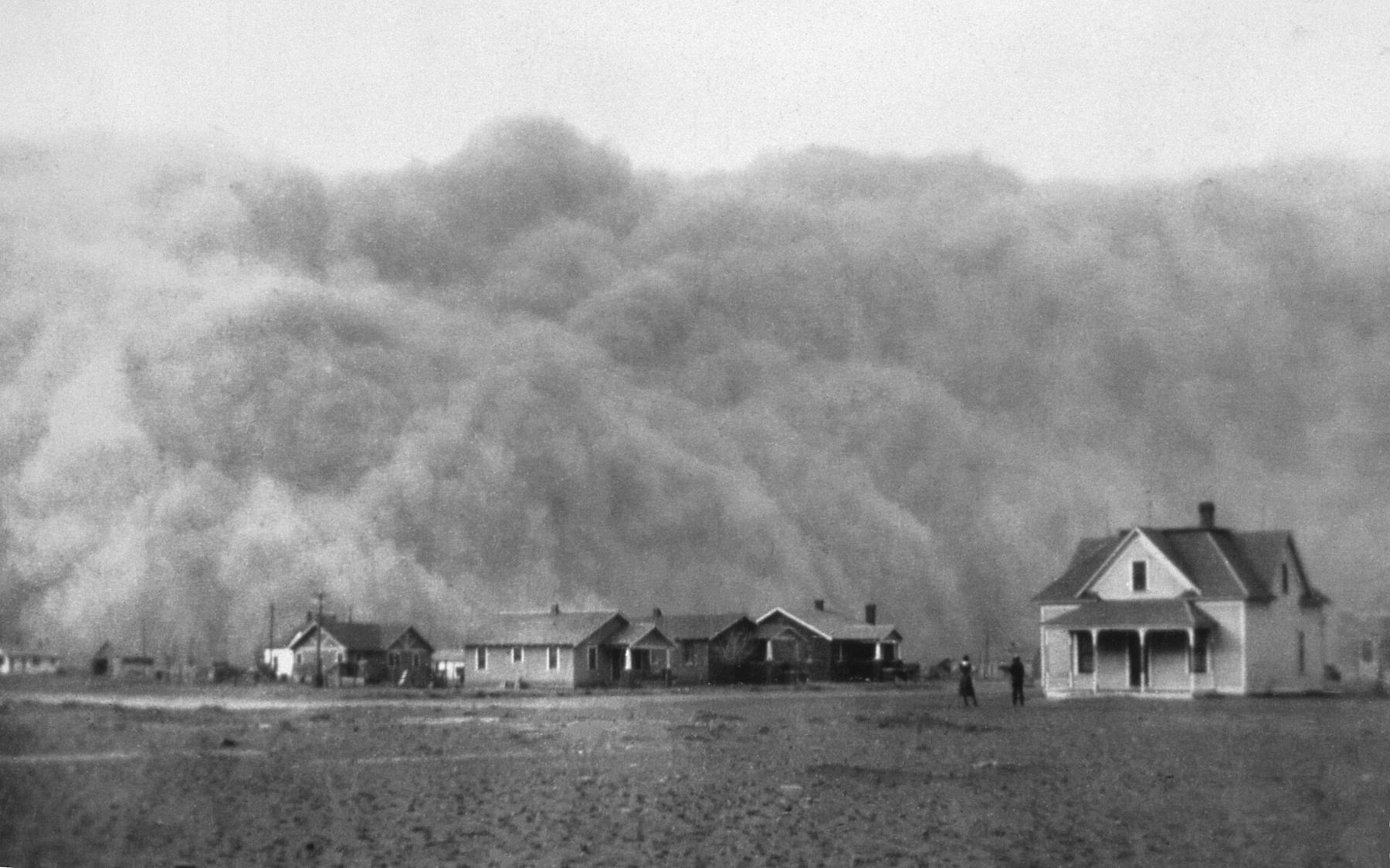
A dust storm over Stratford, Texas, 1935: the Dust Bowl, made by markets and ploughs as much as by drought.
George Everett Marsh Jr, Dust storm approaching Stratford, Texas, 1935EcoAxes / Included ideologies / Indigenous, decolonial and justice-based approaches
Academic field and critical orientationPolitical Ecology
The field, drawing on several disciplines, that explains environmental change and conflict through power, property and political economy. It holds that no environmental problem is free of politics: who damages, who conserves, who benefits and who pays are questions of justice before they are questions of technique.
- Key figures
- Piers Blaikie, Harold Brookfield, Paul Robbins, Michael Watts, Richard Peet
Where it stands
- Environmental EthicsAnthropocentrismEcocentrism
- Human–Nature RelationsHuman SeparationHuman Integration
- Economic PhilosophyGreen GrowthPost-Growth
- Resource OwnershipPrivate StewardshipCommons Governance
- Environmental AuthorityCentralized AuthorityLocal Autonomy
- Environmental JusticeAggregate OutcomesDistributive Justice
- Conservation StrategySustainable UseStrict Protection
- Global ResponsibilityNational SovereigntyInternational Ecological Obligation
- Ecological Political PriorityIncremental ReformTransformative Change
Political ecology is an analytical field whose practitioners hold varied normative positions; the values describe its characteristic critical commitments, especially on justice and on the critique of exclusionary conservation, with wide bands elsewhere.
Definition
Political ecology studies how political, economic and social forces relate to environmental change, and it does so critically. It holds that environmental problems are never simply natural or technical. Relations of power produce them, and the problems in turn reinforce those relations.
It also holds that the dominant stories about the environment often serve the people who tell them. Examples are stories of overpopulation, of ignorant peasants, of the tragedy of the commons, or of untouched wilderness. The field’s typical questions are who has access to resources, who is shut out, who bears environmental harm, and whose knowledge counts.
Historical development
Eric Wolf used the phrase in 1972. Piers Blaikie founded the field with The Political Economy of Soil Erosion in Developing Countries (1985), and with Harold Brookfield in Land Degradation and Society (1987). They showed that soil erosion in the global South came from marginalisation and the extraction of surplus, not from peasants farming badly. Michael Watts’s Silent Violence (1983) did the same for famine.
Nancy Peluso’s Rich Forests, Poor People (1992) and work on “coercive conservation” turned the field toward protected areas. Joan Martinez-Alier’s The Environmentalism of the Poor (2002) connected it to movements in the global South. Richard Peet and Michael Watts’s Liberation Ecologies (1996) brought in post-structural analysis of discourse. Paul Robbins’s textbook Political Ecology (2004, second edition 2012) is the standard introduction. The field now includes urban, feminist and decolonial political ecology, and work on politics beyond the human.
Principal claims
- Political economy explains environmental change: markets, property, state power and who gets the surplus.
- Stories of environmental damage are often wrong and serve power. The poor are more often victims of damage than its cause.
- Conservation is a political act with winners and losers. It has often taken land and resources from the people who lived with them.
- All environmental knowledge comes from somewhere. Local and Indigenous knowledge stands alongside science.
- Environmental movements of the poor are struggles over access and distribution, and they are central to environmental politics.
Policy implications
Political ecology is mainly analysis, but its practitioners generally favour secure rights to land and resources for the poor, community-based and rights-based conservation, recognition of local knowledge, environmental justice, and a fairer spread of environmental costs and benefits. They distrust market instruments, large technical fixes and protected areas that shut people out.
Internal disagreements
Political ecologists disagree about how much weight to give political economy as against the analysis of discourse, and how far to engage with ecology as a science, a gap critics call “politics without ecology”. They argue over whether the field should prescribe or only analyse, over the place of Marxism, and over decolonial and Indigenous approaches that question the field’s own origins.
Criticisms and controversies
Natural scientists have accused political ecology of denying real environmental limits. Conservationists say it weakens protection. Critics inside the field say it has paid so much attention to discourse that it has lost the ecology.
Supporters note that its findings on stories of degradation, on famine and on people displaced by conservation have been borne out again and again.
Relationships to other traditions
Political ecology supplies the analysis for decolonial ecology, environmental justice, climate justice and community conservation. It shares eco-Marxism’s political economy. It is the leading academic critic of fortress conservation, neo-Malthusianism, market environmentalism and technocratic planetary stewardship.
References and further reading
- Blaikie, P. and Brookfield, H. (1987). Land Degradation and Society. Methuen.
- Robbins, P. (2012). Political Ecology: A Critical Introduction, 2nd ed. Wiley-Blackwell.
- Peet, R. and Watts, M., eds. (1996). Liberation Ecologies: Environment, Development, Social Movements. Routledge.
- Martinez-Alier, J. (2002). The Environmentalism of the Poor. Edward Elgar.
- Peluso, N. L. (1992). Rich Forests, Poor People: Resource Control and Resistance in Java. University of California Press.