
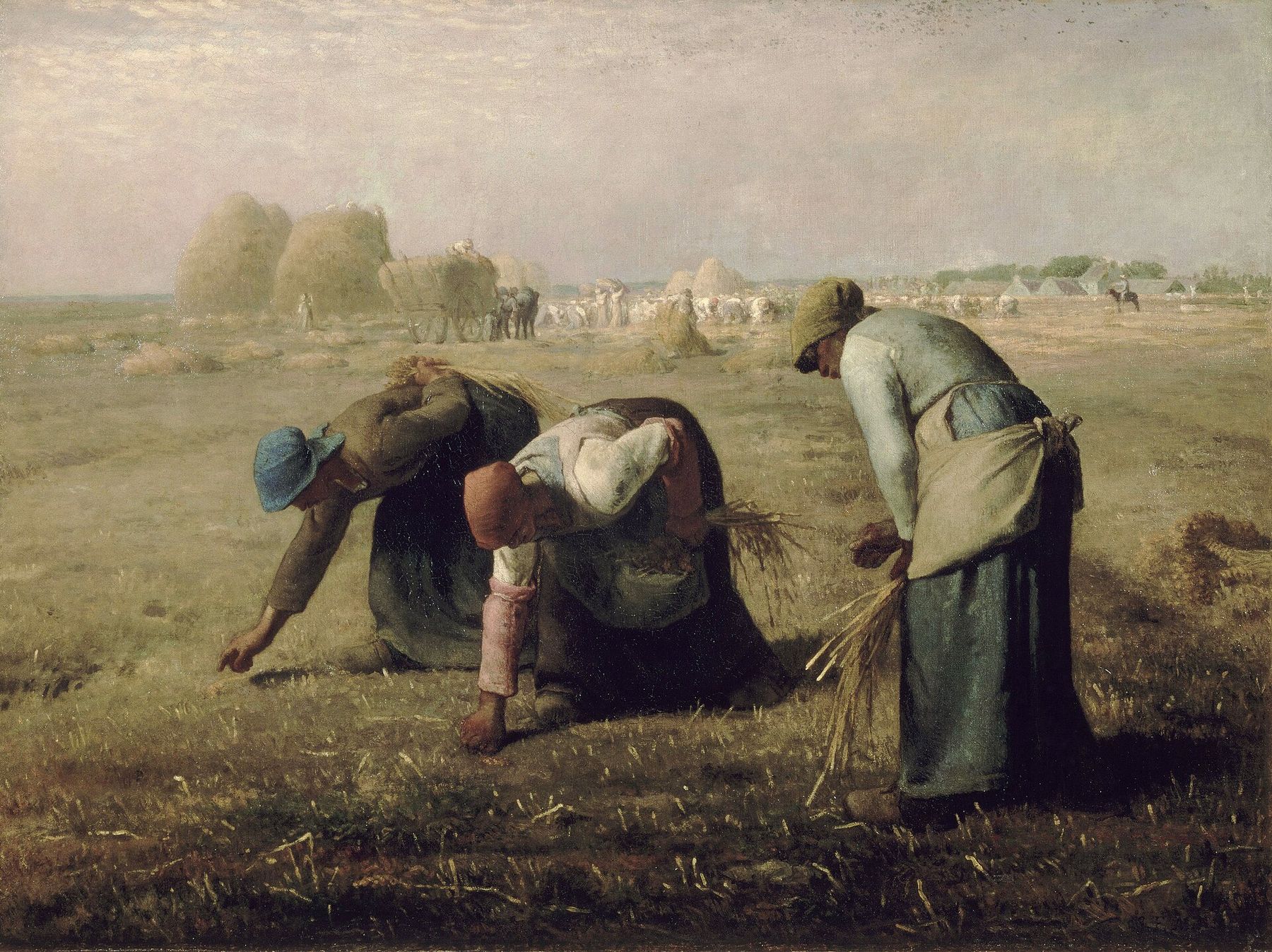
Millet's gleaners: women's subsistence work on the land.
Jean-François Millet, The Gleaners, 1857EcoAxes / Included ideologies / Left and socialist ecologies
Philosophical and political movementEcofeminism
A body of thought and activism holding that the domination of women and the domination of nature are linked, in history and in ideas. An ecological politics must therefore be feminist, centred on care, subsistence, the body and a critique of thinking in opposed pairs.
- Key figures
- Françoise d'Eaubonne, Carolyn Merchant, Val Plumwood, Vandana Shiva, Maria Mies
Where it stands
- Environmental EthicsAnthropocentrismEcocentrism
- Human–Nature RelationsHuman SeparationHuman Integration
- Economic PhilosophyGreen GrowthPost-Growth
- Resource OwnershipPrivate StewardshipCommons Governance
- Environmental AuthorityCentralized AuthorityLocal Autonomy
- Environmental JusticeAggregate OutcomesDistributive Justice
- Technological OutlookTechnological OptimismEcological Precaution
- Energy PhilosophyEnergy AbundanceEnergy Sufficiency
- Agricultural EcologyLand SparingLand Sharing
- Global ResponsibilityNational SovereigntyInternational Ecological Obligation
- Ecological Political PriorityIncremental ReformTransformative Change
Ecofeminism is explicit on justice, domination, subsistence agriculture and systemic change; its governance and ownership preferences are decentralist and commons-oriented but less uniform.
Definition
Ecofeminism covers a family of positions that connect the oppression of women with the exploitation of nature. Its writers trace the connection three ways.
One is shared history. Carolyn Merchant made this argument about the Scientific Revolution. Another is a shared logic of dualism, in which reason, culture and the masculine are set above nature, the body and the feminine. Val Plumwood made this argument. The third is a shared economics. Women’s unpaid work of subsistence and care, like the work nature does, is taken without being counted. Maria Mies and Vandana Shiva made this argument.
Ecofeminists hold that environmental politics has to take apart these linked forms of domination together.
Historical development
Françoise d’Eaubonne coined the word écoféminisme in Le Féminisme ou la mort (1974). Merchant’s The Death of Nature (1980) traced how early modern Europe moved from seeing nature as an organism to seeing it as a machine, and what that meant for women and for the environment. In the 1970s and 1980s the Chipko movement in India and anti-nuclear and peace camps such as Greenham Common gave ecofeminism an activist face.
Shiva’s Staying Alive (1988) and Mies and Shiva’s Ecofeminism (1993) rooted it in the subsistence struggles of women in the global South. Plumwood’s Feminism and the Mastery of Nature (1993) and Karen Warren’s Ecofeminist Philosophy (2000) gave it rigorous philosophical form. Later writers developed queer, materialist and decolonial ecofeminisms.
Principal claims
- The domination of nature and the domination of women are linked in history and in ideas, and have to be understood together.
- Western dualisms, such as reason and nature, mind and body, male and female, culture and nature, structure both oppressions and have to be unlearned.
- Subsistence, care and reproduction are the real economy. Production aimed at growth that ignores them does damage.
- What women know from their daily work with land, water and food is valid knowledge and belongs at the centre of politics.
- The remedy is a politics of care, relationship and sufficiency. Mastery, whether by technology or by management, is not.
Policy implications
Ecofeminists support women’s rights to land and to commons, agroecology and control of seed. They oppose extractive and nuclear projects. They want an economy built around care with public provision, sufficiency in rich countries along degrowth lines, and a voice for the women affected in environmental decisions. They distrust large technological fixes, including geoengineering and much biotechnology.
Internal disagreements
In the 1990s ecofeminists argued over whether the link between women and nature is natural or socially constructed. This “essentialism” dispute led some to prefer the names “ecological feminism” or “feminist environmentalism”. They also disagree about Marxism and about spirituality, and about whether ecofeminism is a form of deep ecology or a criticism of it. A further problem is how writers in the North can avoid speaking for women in the global South.
Criticisms and controversies
Critics charged early ecofeminism with essentialism and with a mystical spirituality of the goddess. Bina Agarwal argued in her “feminist environmentalism” (1992) that women’s environmental activism comes from their material relationship with the environment, not from some essential affinity. Some feminists feared that linking women with nature strengthened the very dualism ecofeminism opposed. Mainstream environmentalists have treated it as marginal.
Ecofeminists answer that the constructivist versions dealt with the charge of essentialism decades ago, and that the economy of care is now central to ecological economics.
Relationships to other traditions
Ecofeminism is a close ally of ecosocialism and degrowth and a source for decolonial ecology and food sovereignty. It is sometimes a critic and sometimes an ally of deep ecology. Its analysis of domination makes it a relative of social ecology.
References and further reading
- Merchant, C. (1980). The Death of Nature: Women, Ecology, and the Scientific Revolution. Harper & Row.
- Plumwood, V. (1993). Feminism and the Mastery of Nature. Routledge.
- Mies, M. and Shiva, V. (1993). Ecofeminism. Zed Books.
- Shiva, V. (1988). Staying Alive: Women, Ecology and Development. Zed Books.
- Warren, K. J. (2000). Ecofeminist Philosophy. Rowman & Littlefield.
- Agarwal, B. (1992). “The gender and environment debate: Lessons from India.” Feminist Studies 18(1), 119–158.