
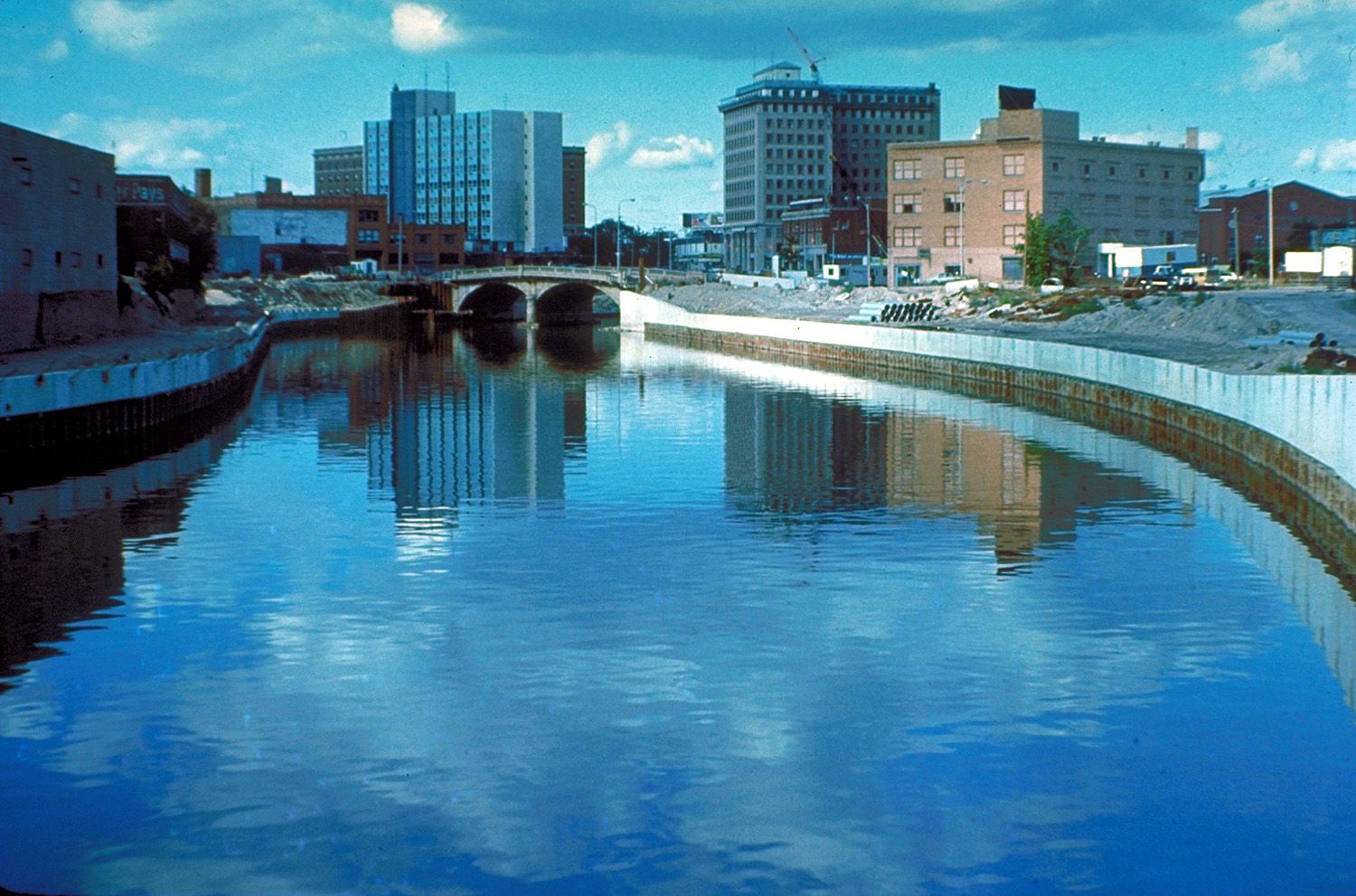
The Flint River, Michigan, whose water was switched into the city's pipes in 2014, poisoning a mostly Black city with lead.
U.S. Army Corps of Engineers, photographer not specified or unknown, Flint River in Flint MIchigan, 1979EcoAxes / Included ideologies / Indigenous, decolonial and justice-based approaches
Social movement and normative frameworkEnvironmental Justice
The movement and principle that no community should bear an unfair share of environmental harm or be denied a fair share of environmental goods, and that affected communities must have a real voice in decisions. It began in the struggles of Black, Latino, Indigenous and poor communities in the United States against toxic sites near their homes, and has since spread worldwide.
- Key figures
- Robert Bullard, Benjamin Chavis, Dorceta Taylor, David Schlosberg, Luke Cole and Sheila Foster
Where it stands
- Human–Nature RelationsHuman SeparationHuman Integration
- Economic PhilosophyGreen GrowthPost-Growth
- Resource OwnershipPrivate StewardshipCommons Governance
- Environmental AuthorityCentralized AuthorityLocal Autonomy
- Environmental JusticeAggregate OutcomesDistributive Justice
- Technological OutlookTechnological OptimismEcological Precaution
- Energy PhilosophyEnergy AbundanceEnergy Sufficiency
- Global ResponsibilityNational SovereigntyInternational Ecological Obligation
- Ecological Political PriorityIncremental ReformTransformative Change
Environmental justice is defined by its position on the justice axis and by its demand for procedural power; it is agnostic on growth and energy supply, which carry wide bands, and takes no position on the conservation-specific axes or on ethics.
Definition
Environmental justice holds that environmental burdens and benefits should be shared fairly. The burdens include pollution, waste, hazardous facilities and environmental damage. The benefits include clean air and water, green space and environmental investment. It also holds that communities affected by environmental decisions should take a real part in making them.
The movement began with a discovery: in the United States, environmental harm falls disproportionately on communities of colour and on the poor. That pattern was named “environmental racism”. The idea has since grown into a global framework covering four things: how harms and benefits are distributed, how decisions are made, whether affected people are recognised and respected, and what they are able to do and become.
Historical development
The movement dates its beginning to 1982, when people in Warren County, North Carolina, protested a landfill for PCBs placed in a mostly Black county. The United Church of Christ documented the pattern nationwide in Toxic Wastes and Race in the United States (1987). Robert Bullard’s Dumping in Dixie (1990) gave it a sociology. The First National People of Color Environmental Leadership Summit adopted seventeen Principles of Environmental Justice in 1991. President Clinton’s Executive Order 12898 (1994) told federal agencies to address impacts that fell unfairly on some communities.
The framework spread internationally through the environmentalism of the poor, the climate justice movement, and the recognition of procedural environmental rights in the Aarhus Convention (1998) and elsewhere. David Schlosberg’s Defining Environmental Justice (2007) widened the idea beyond distribution to recognition, participation and capabilities, and to future generations and non-human nature.
Principal claims
- Environmental harms and benefits are distributed unjustly by race, class and power. This is a matter of justice. It is not an accident.
- Affected communities have the right to take part in and shape the decisions that affect them, including the right to refuse.
- Justice includes recognition, meaning respect for the identity, knowledge and culture of affected communities.
- The mainstream environmental movement has neglected these communities and needs to change.
- Environmental policy must be judged by who bears its costs as well as by its overall results.
Policy implications
Environmental justice advocates want assessments of cumulative impacts and limits on building polluting facilities in communities that already carry too much. They want communities given a say that carries real authority, and investment in environmental quality aimed at disadvantaged communities, on the “Justice40” model. They call for environmental law to be enforced in those communities, for clean-up and health programmes, and for just-transition provisions in climate policy. They oppose market mechanisms that concentrate pollution in particular places.
Internal disagreements
Advocates disagree about how to relate to the mainstream environmental movement, whether to work with it or organise separately. Some reject market instruments on principle. They debate how broad the idea should be, and whether it should extend to non-human nature and future generations. They also weigh local control against the national standards needed to stop places competing to lower protections.
Criticisms and controversies
Some critics question the direction of cause and effect. Do polluting facilities come to poor communities, or do poor people move to cheap land near the facilities? Others argue that demands for justice can block the most cost-effective environmental measures, and that the framework turns technical decisions into political ones.
Supporters cite decades of studies confirming that some communities are more exposed, and argue that efficiency bought by sacrificing the same communities again and again is not a neutral result.
Relationships to other traditions
Environmental justice is the founding member of the family of traditions built on justice. Climate justice extends it to emissions and historical responsibility, the idea of ecological debt extends it to relations between countries, and decolonial ecology traces the colonial history behind the pattern. It draws on political ecology and informs ecological democratic socialism and ecosocialism. It is critical of market environmentalism and of environmental economics that only adds up totals.
References and further reading
- Bullard, R. D. (1990). Dumping in Dixie: Race, Class, and Environmental Quality. Westview Press.
- United Church of Christ Commission for Racial Justice (1987). Toxic Wastes and Race in the United States.
- First National People of Color Environmental Leadership Summit (1991). Principles of Environmental Justice.
- Schlosberg, D. (2007). Defining Environmental Justice: Theories, Movements, and Nature. Oxford University Press.
- Taylor, D. E. (2014). Toxic Communities: Environmental Racism, Industrial Pollution, and Residential Mobility. NYU Press.