
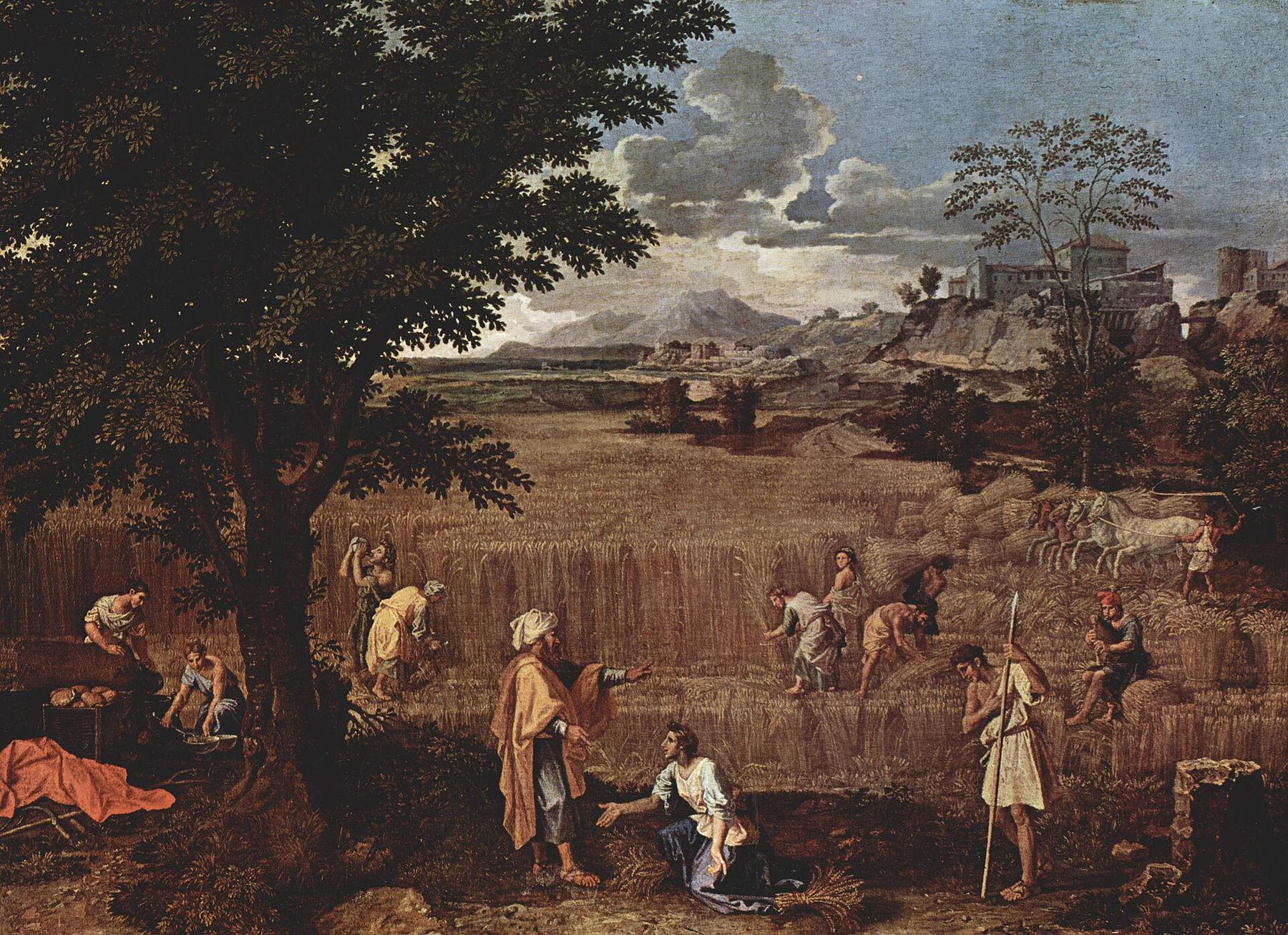
Poussin's Summer: Ruth gleaning in Boaz's field, under the law that leaves the harvest's edges for the poor.
Nicolas Poussin - L'Été ou Ruth et BoozEcoAxes / Included ideologies / Religious and spiritual environmental ethics
Religious ethical traditionJewish Bal Tashchit
The body of Jewish law, text and practice that grounds care for the earth in the teaching that "the earth is the Lord's" (Psalm 24:1), that people are placed in the garden "to work it and to keep it" (Genesis 2:15), and in commandments such as bal tashchit (do not destroy), shmita (the sabbatical rest of the land) and tza'ar ba'alei chayim (the ban on causing animals needless suffering). Since the 1980s it has grown into a distinct eco-theology and movement.
- Key figures
- Ellen Bernstein, Arthur Waskow, Hava Tirosh-Samuelson, Jeremy Benstein, Abraham Joshua Heschel (on Sabbath)
Where it stands
- Environmental EthicsAnthropocentrismEcocentrism
- Human–Nature RelationsHuman SeparationHuman Integration
- Ecological InterventionNoninterventionActive Stewardship
- Economic PhilosophyGreen GrowthPost-Growth
- Resource OwnershipPrivate StewardshipCommons Governance
- Environmental AuthorityCentralized AuthorityLocal Autonomy
- Environmental JusticeAggregate OutcomesDistributive Justice
- Technological OutlookTechnological OptimismEcological Precaution
- Energy PhilosophyEnergy AbundanceEnergy Sufficiency
- Conservation StrategySustainable UseStrict Protection
- Human–Wildlife RelationsHuman PriorityWildlife Accommodation
- Agricultural EcologyLand SparingLand Sharing
- Global ResponsibilityNational SovereigntyInternational Ecological Obligation
- Ecological Political PriorityIncremental ReformTransformative Change
Read from halakha: bal tashchit, the prohibition of wanton destruction (Deuteronomy 20:19), argued largely for human benefit; tza'ar ba'alei chayim, the prohibition of causing animals needless suffering; shmita, the sabbatical fallowing of the land and release of debts; and pe'ah and leket, the field's corners and gleanings left for the poor. Stewardship within a broadly pro-innovation, reform-minded tradition.
Definition
Jewish bal tashchit draws on the Hebrew Bible, the Talmud and later rabbinic law and thought to ground responsibility for the natural world. The earth belongs to God, not to people (Psalm 24:1). Leviticus 25:23 says, “the land is mine; you are but strangers and residents with me.” People are placed in the garden “to work it and to keep it” (Genesis 2:15).
From these principles the rabbis drew binding obligations. Bal tashchit forbids wanton destruction. The Torah bans cutting down fruit trees during a siege (Deuteronomy 20:19–20), and the Talmud extends the ban to all waste. In shmita, the sabbatical year, the land of Israel lies fallow and debts are released (Leviticus 25). The Sabbath is a weekly rest from making and mastering. Laws protect the welfare of animals (tza’ar ba’alei chayim). Farmers must leave the corners of the field and the gleanings for the poor (Leviticus 19:9–10).
Modern Jewish environmentalism reads these as an ethic of limits, restraint, justice and gratitude.
Historical development
The classical sources contain an extensive law of land, water, animals and waste. The agricultural festivals, Sukkot, Shavuot and Tu BiShvat, the New Year of Trees, tie the calendar to the land. In nineteenth-century Germany Samson Raphael Hirsch read bal tashchit as a general ethic against destruction. In the twentieth century, Abraham Joshua Heschel’s The Sabbath (1951) presented the Sabbath as a “sanctuary in time”, free of the drive to master nature. The Kabbalists of sixteenth-century Safed created a Tu BiShvat seder, which later became a modern ecological festival.
The organised movement began in the 1980s. Ellen Bernstein founded Shomrei Adamah (“Keepers of the Earth”) in 1988, and the Coalition on the Environment and Jewish Life (COEJL) was set up in 1993. Arthur Waskow’s Shalom Center, the Teva Learning Center (founded 1994) and Hazon (founded 2000, part of Adamah since 2023) developed Jewish environmental education, food and farming. Scholarship pulled the field together, among it Hava Tirosh-Samuelson’s Judaism and Ecology (2002). Interest in shmita as an environmental and economic idea has grown since the sabbatical year of 2014–15.
Principal claims
- The earth belongs to God. People hold it in trust and answer for how they use it.
- Wanton destruction and waste are forbidden (bal tashchit).
- Land, labour and people need rest. Growth without pause is a failure of right relationship, as the Sabbath and shmita teach.
- Animals must not be made to suffer needlessly.
- The poor have a claim on the harvest. Environmental justice and economic justice belong together.
- Gratitude and blessing for the gifts of creation shape how those gifts are used.
Policy implications
Jewish environmentalists frame waste reduction and conservation of resources as bal tashchit. They support climate action and clean energy in Jewish institutions, letting farmland rest and lie fallow, and standards for animal welfare in food production. They run community farms, food justice work and gleaning programmes. They revive ideas inspired by shmita about debt relief and pausing the economy, and plant trees and restore ecosystems around Tu BiShvat.
Internal disagreements
Scholars disagree about whether bal tashchit is a broad environmental principle or a narrower ban on destruction for no purpose, and about how far the commandments tied to the land of Israel apply elsewhere. The relationship with Zionist settlement of the land is contested. The tree planting of the Jewish National Fund, for example, has been praised as restoration and criticised for its effects on Palestinian land and native ecosystems. Readers balance dominion and stewardship in Genesis differently, and Orthodox and liberal communities differ in practice.
Criticisms and controversies
Critics point to the gap between the tradition’s ideals and the environmental record of Jewish communities and of Israel. They ask whether an ecological reading is faithful to sources concerned with ritual and law. Some argue that the tradition is human-centred at bottom. Others argue that biblical land ethics belong to one particular farming society.
Supporters answer that the legal tradition has always applied its principles to new circumstances.
Relationships to other traditions
Jewish bal tashchit shares the idea of trusteeship with Christian stewardship and Islamic amanah, and all three draw on the same texts of Genesis. Its teachings on the Sabbath and shmita have influenced degrowth and steady-state thought. Its laws on gleaning and justice connect it to environmental justice, and its farming and land traditions connect it to agrarian conservatism and food movements.
References and further reading
- Tirosh-Samuelson, H., ed. (2002). Judaism and Ecology: Created World and Revealed Word. Harvard University Press / Center for the Study of World Religions.
- Bernstein, E. (1998). Ecology and the Jewish Spirit: Where Nature and the Sacred Meet. Jewish Lights.
- Waskow, A., ed. (2000). Torah of the Earth: Exploring 4,000 Years of Ecology in Jewish Thought, 2 vols. Jewish Lights.
- Benstein, J. (2006). The Way Into Judaism and the Environment. Jewish Lights.
- Yaffe, M. D., ed. (2001). Judaism and Environmental Ethics: A Reader. Lexington Books.
- Heschel, A. J. (1951). The Sabbath: Its Meaning for Modern Man. Farrar, Straus and Young.