
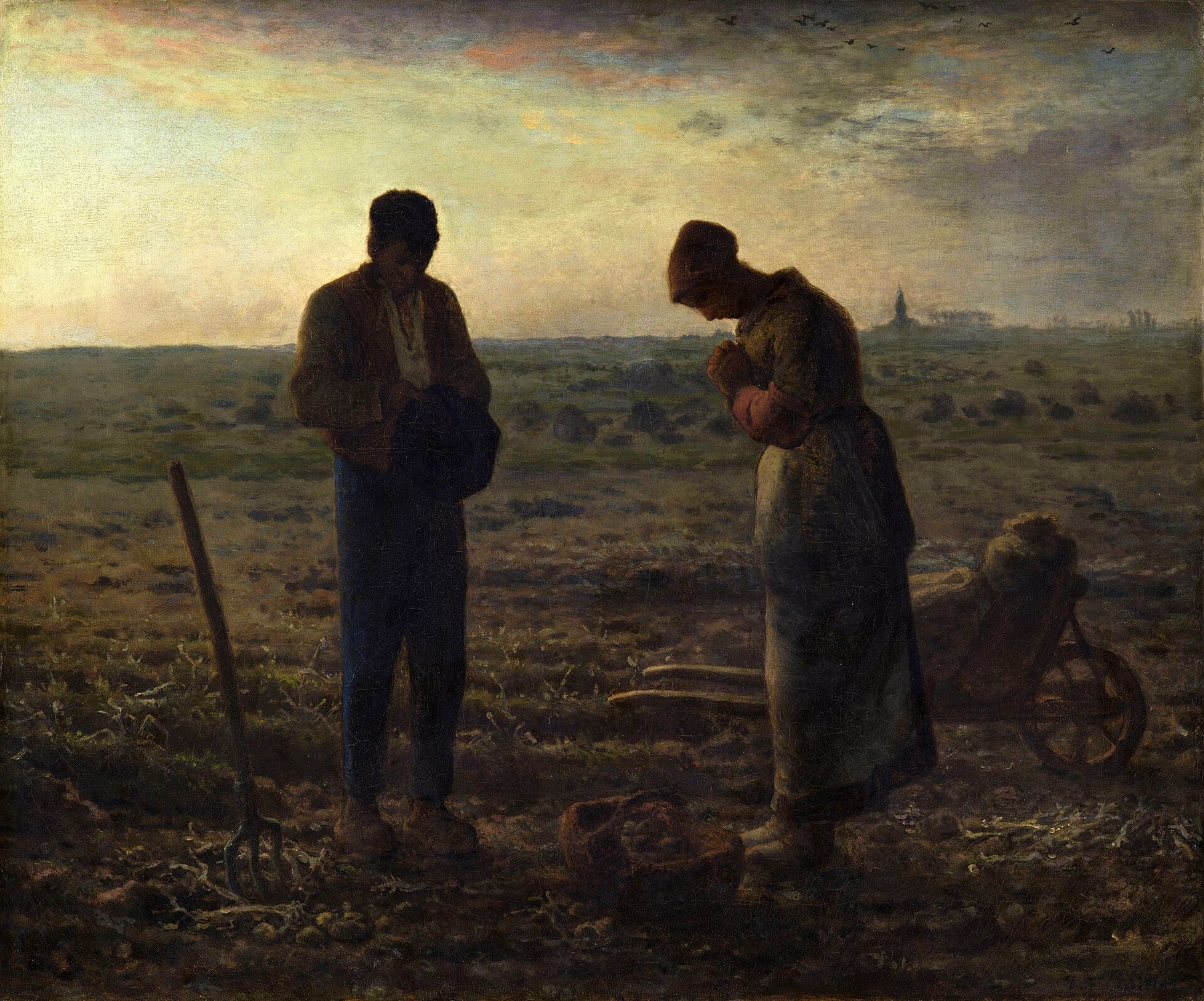
Millet's Angelus: a life of enough.
Jean-François Millet, French: L'Angélus The Angelus, 1857EcoAxes / Included ideologies / Left and socialist ecologies
Economic and political movementDegrowth
The movement and field of research holding that wealthy economies must deliberately cut the materials and energy they use and stop treating growth as a goal. That would let them live within the planet's limits and leave ecological room for the poor, with life reorganised around having enough, care, shared resources and living well together.
- Key figures
- Nicholas Georgescu-Roegen (antecedent), Serge Latouche, Giorgos Kallis, Jason Hickel, Federico Demaria
Where it stands
- Environmental EthicsAnthropocentrismEcocentrism
- Human–Nature RelationsHuman SeparationHuman Integration
- Economic PhilosophyGreen GrowthPost-Growth
- Resource OwnershipPrivate StewardshipCommons Governance
- Environmental AuthorityCentralized AuthorityLocal Autonomy
- Environmental JusticeAggregate OutcomesDistributive Justice
- Technological OutlookTechnological OptimismEcological Precaution
- Energy PhilosophyEnergy AbundanceEnergy Sufficiency
- Conservation StrategySustainable UseStrict Protection
- Agricultural EcologyLand SparingLand Sharing
- Global ResponsibilityNational SovereigntyInternational Ecological Obligation
- Ecological Political PriorityIncremental ReformTransformative Change
Degrowth is explicit on growth, energy, justice, international obligation and systemic change. Its governance preference is decentralist but not anti-state (many proposals need national policy), and its conservation strategy is not a focus; those carry wider bands.
Definition
Degrowth (décroissance) proposes that the world’s rich economies cut their use of energy and materials in a planned way and stop pursuing economic growth. Production and social life would be reorganised around sufficiency, equality and wellbeing. Human activity would then fit within the biosphere, and ecological room would be freed for poorer countries to develop.
Degrowth is three things at once: a critique of the growth paradigm, a field of research within ecological economics, and a social movement.
Historical development
André Gorz first used the word in 1972. The idea has roots in three sources. Nicholas Georgescu-Roegen’s The Entropy Law and the Economic Process (1971) argued that economic activity degrades usable resources and cannot reverse the damage. The Club of Rome’s The Limits to Growth (1972) modelled the collision between growth and a finite planet. Ivan Illich criticised industrial institutions.
Serge Latouche and other French critics of development revived the idea as décroissance in the early 2000s, and the first international degrowth conference met in Paris in 2008. A large academic literature has followed, including the vocabulary edited by Giacomo D’Alisa, Federico Demaria and Giorgos Kallis (2015), Kallis’s Degrowth (2018) and Jason Hickel’s Less Is More (2020). Empirical studies on decoupling, energy sufficiency and wellbeing at low levels of energy use have grown alongside.
Principal claims
- Growth has not been decoupled from resource use and environmental harm at the scale and speed required, and is unlikely to be.
- In rich countries growth no longer improves wellbeing, and it cannot be squared with staying inside the planet’s boundaries.
- The goal is a planned, democratic cut in the materials and energy that rich economies use. That is different from a recession, and it comes with redistribution to protect the poor.
- Sufficiency, shorter working hours, universal public services, shared resources and care work should replace consumption at the centre of economic life.
- When rich countries use less, they free ecological room for poorer countries, which have a right to develop. Degrowth is meant for the North.
- Technology should be small enough to serve people and suited to its place. It should not be scaled up for the sake of growth.
Policy implications
Degrowth proposals include caps on resource and energy use, shorter working weeks and shared jobs, and universal basic services or a basic income. Advertising and products designed to wear out would be limited. Commons and cooperatives would expand, and public money would go into low-energy infrastructure. Taxes would become more progressive, perhaps with a maximum income, and GDP would no longer be a target. Internationally, rich countries would pay climate reparations and cancel debts. In farming, the movement favours agroecology and local food.
Internal disagreements
Degrowthers disagree about whether degrowth is a form of ecosocialism or a broader coalition, and about how far to rely on the state as opposed to grassroots and city-level action. Most reject nuclear power, but not all. They argue over what to do about the word itself, which many people dislike, and over how much the North must shrink. Some prefer “a-growth”, meaning indifference to growth, as a better name.
Criticisms and controversies
Ecomodernists, green-growth economists and many on the left argue that decoupling is possible. They say degrowth could never win politically, would cause social harm, would starve the green transition of the investment it needs, and misreads what poor and working people want. Some Marxists see it as asceticism for the middle class.
Degrowthers answer with the evidence on decoupling so far and on wellbeing at low energy use. They add that the alternative to planned degrowth is the unplanned kind, which arrives as crisis.
Relationships to other traditions
Degrowth descends from steady-state economics and ecological economics. It overlaps with ecosocialism, social ecology and ecofeminism, draws on Buen Vivir and the environmentalism of the poor, and shares deep ecology’s call to consume less. It is the direct opposite of green growth and ecomodernism. It differs from the Green New Deal of ecological democratic socialism, which is compatible with growth.
References and further reading
- Kallis, G. (2018). Degrowth. Agenda Publishing.
- D’Alisa, G., Demaria, F. and Kallis, G., eds. (2015). Degrowth: A Vocabulary for a New Era. Routledge.
- Hickel, J. (2020). Less Is More: How Degrowth Will Save the World. William Heinemann.
- Latouche, S. (2009). Farewell to Growth. Polity.
- Georgescu-Roegen, N. (1971). The Entropy Law and the Economic Process. Harvard University Press.
- Parrique, T. et al. (2019). Decoupling Debunked. European Environmental Bureau.