
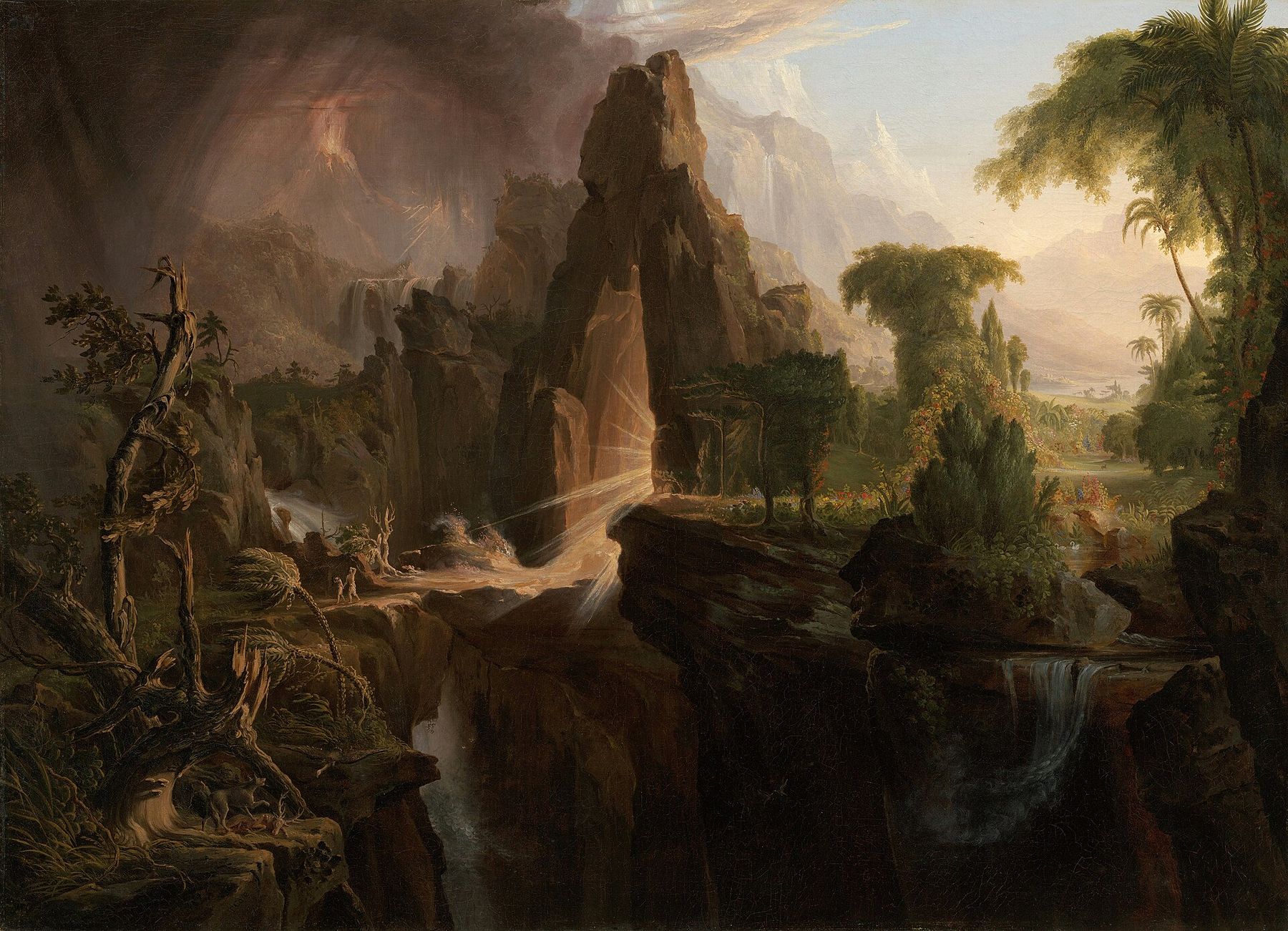
Cole's Garden of Eden, given to humanity "to till it and keep it".
Thomas Cole, Expulsion from the Garden of Eden, 1828EcoAxes / Included ideologies / Religious and spiritual environmental ethics
Religious ethical traditionChristian Stewardship
The main Protestant and wider Christian environmental ethic. The earth is God's creation, entrusted to humanity to care for and use responsibly, so destroying it is a failure of stewardship and a sin against the Creator. It grew in answer to Lynn White's charge in 1967 that Christianity was to blame for the ecological crisis, and now includes evangelical "creation care", mainline Protestant eco-theology and Orthodox teaching.
- Key figures
- Francis Schaeffer, Calvin DeWitt, Wendell Berry, Loren Wilkinson, Katharine Hayhoe
Where it stands
- Environmental EthicsAnthropocentrismEcocentrism
- Human–Nature RelationsHuman SeparationHuman Integration
- Ecological InterventionNoninterventionActive Stewardship
- Economic PhilosophyGreen GrowthPost-Growth
- Resource OwnershipPrivate StewardshipCommons Governance
- Environmental AuthorityCentralized AuthorityLocal Autonomy
- Environmental JusticeAggregate OutcomesDistributive Justice
- Technological OutlookTechnological OptimismEcological Precaution
- Energy PhilosophyEnergy AbundanceEnergy Sufficiency
- Conservation StrategySustainable UseStrict Protection
- Human–Wildlife RelationsHuman PriorityWildlife Accommodation
- Agricultural EcologyLand SparingLand Sharing
- Global ResponsibilityNational SovereigntyInternational Ecological Obligation
- Ecological Political PriorityIncremental ReformTransformative Change
Stewardship is a frame shared across Christian traditions whose political positions range from conservative to progressive; the values describe its centre and most carry wide bands.
Definition
Christian stewardship holds that the natural world is God’s creation, declared good before any human use of it. Humanity is made in God’s image and given “dominion” (Genesis 1:28). It holds the earth as a steward holds an estate: on the owner’s behalf, for the good of everyone who lives there and of generations to come, and answerable for its condition.
Read this way, dominion means responsibility and not licence. The command to till and keep the garden (Genesis 2:15), sometimes called the cultural mandate, becomes a command to care. Destroying the environment is a sin, and caring for creation is a Christian duty.
Evangelical “creation care”, mainline Protestant eco-theology, Eastern Orthodox teaching and much Catholic thought share this frame. Catholic social teaching has recently preferred the language of integral ecology.
Historical development
In 1967 Lynn White Jr. published “The Historical Roots of Our Ecologic Crisis” in Science. He argued that Christianity had stripped nature of its sacredness and that the doctrine of dominion lay behind Western environmental destruction.
Christian thinkers answered by recovering the stewardship tradition. Francis Schaeffer’s Pollution and the Death of Man (1970) made the case for evangelicals. Calvin DeWitt led the Au Sable Institute. The Evangelical Environmental Network formed in 1993 and issued the “Evangelical Declaration on the Care of Creation” in 1994. Loren Wilkinson published Earthkeeping (1980), Wendell Berry wrote his agrarian essays, and the World Council of Churches ran a programme on the “integrity of creation”. Since 1991 Patriarch Bartholomew I of Constantinople, known as the “Green Patriarch”, has called environmental destruction a sin and convened symposia on the seas.
In the United States, the Evangelical Climate Initiative (2006) and the climate scientist Katharine Hayhoe carried the argument into evangelical churches. They were opposed by the Cornwall Alliance and others who read stewardship as a mandate for development.
Principal claims
- Creation belongs to God and is good in itself. Its value is more than its usefulness to people.
- Humanity’s dominion is a responsibility delegated by God, to care for creation, and people will answer for how they carry it out.
- Environmental destruction, pollution and extinction are sins against the Creator and against one’s neighbour, especially the poor.
- Caring for creation and caring for people go together. The poor suffer most from environmental harm.
- Christian hope looks to the renewal of creation. It does not look to leaving it behind.
Policy implications
Stewardship is a frame more than a programme. It has been cited in support of conservation, pollution control, climate action, sustainable farming and animal welfare, and by its conservative wing in support of developing resources responsibly. Its organised forms, from creation care to Orthodox teaching to mainline Protestant campaigns, generally support cutting emissions, protecting creation and justice for the poor. They also value voluntary, community and family action alongside government policy.
Internal disagreements
Christians disagree about whether stewardship calls for restraint or for development. The Evangelical Environmental Network and the Cornwall Alliance represent the two sides. They disagree about whether other creatures matter for their usefulness, for themselves, or both. Conservative Christians distrust secular environmentalism and “pagan” nature spirituality. Climate change divides American evangelicals along political lines. Some theologians, and Pope Francis, have argued that “stewardship” itself frames the human role too much like management.
Criticisms and controversies
Secular critics repeat White’s charge and say stewardship keeps the human-centred outlook it claims to fix. Eco-theologians argue that it leaves humanity in charge of a creation that should be seen as kin and community. Political critics point to the resistance of much of American evangelicalism to climate science. Conservative Christians see creation care as a liberal intrusion into the churches.
Supporters argue that stewardship is the frame most likely to move the world’s two billion Christians, and that it has done so before.
Relationships to other traditions
Christian stewardship is a sibling of the Islamic idea of amanah, or trusteeship. It came before Catholic integral ecology and is now its more moderate neighbour. Through Berry it is the religious ground of agrarian conservatism and of much green conservatism, and it connects to conservationism’s tradition of wise use. It is at odds with deep ecology and eco-spirituality over whether nature is sacred, and with ecocentrism over humanity’s place in creation.
References and further reading
- White, L., Jr. (1967). “The historical roots of our ecologic crisis.” Science 155(3767), 1203–1207.
- Schaeffer, F. A. (1970). Pollution and the Death of Man: The Christian View of Ecology. Tyndale House.
- Wilkinson, L., ed. (1980; rev. 1991). Earthkeeping in the Nineties: Stewardship of Creation. Eerdmans.
- Bauckham, R. (2010). Bible and Ecology: Rediscovering the Community of Creation. Darton, Longman & Todd.
- Evangelical Environmental Network (1994). An Evangelical Declaration on the Care of Creation.
- Chryssavgis, J., ed. (2012). On Earth as in Heaven: Ecological Vision and Initiatives of Ecumenical Patriarch Bartholomew. Fordham University Press.