
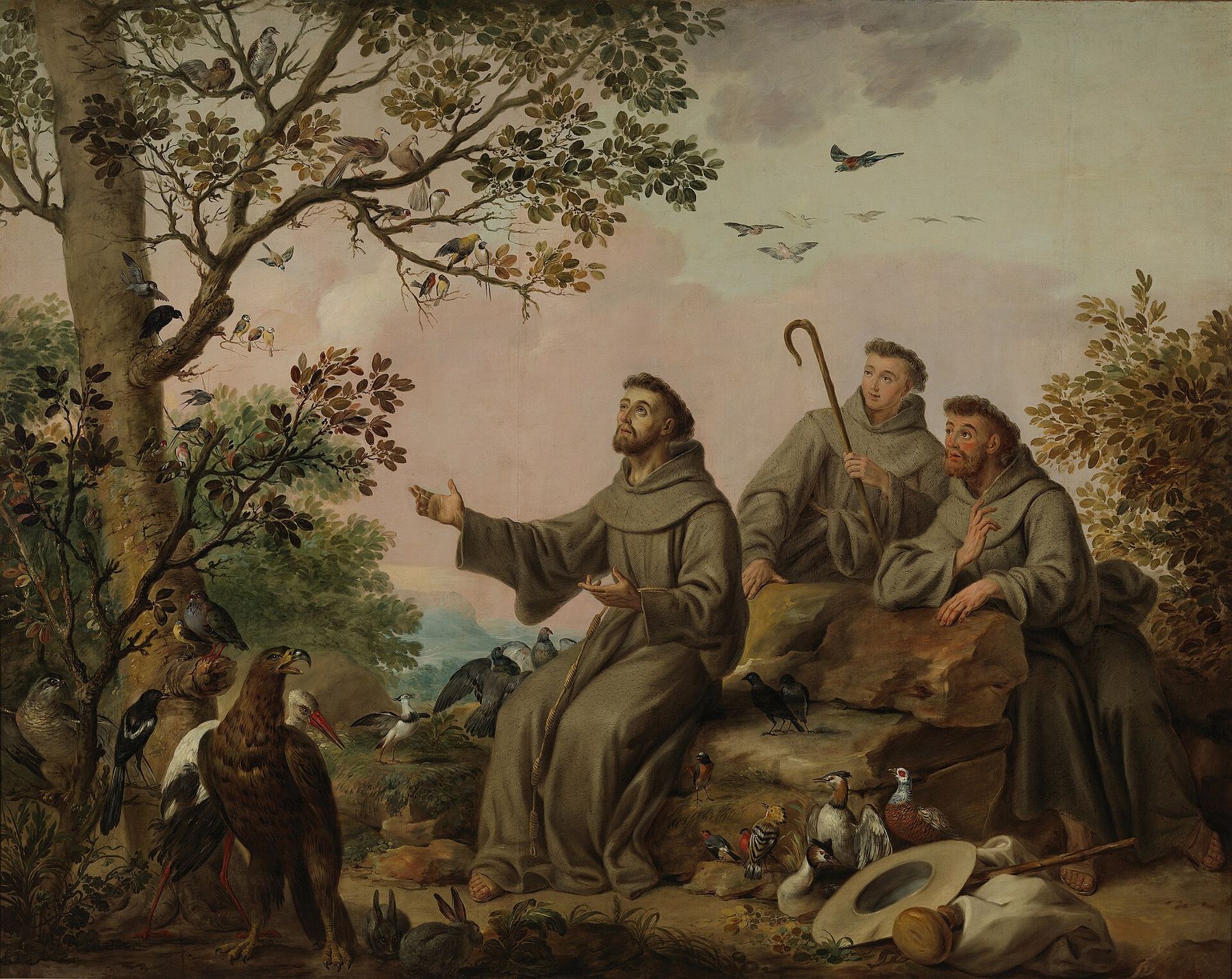
Francis preaching to the birds; Laudato Si' takes its name from his canticle to creation.
Antonio Carnicero, San Francisco predicando a las aves, 1788EcoAxes / Included ideologies / Religious and spiritual environmental ethics
Religious social teachingCatholic Integral Ecology
The teaching of Pope Francis's encyclical Laudato Si' (2015) and the documents that followed it. "Everything is connected": the ecological crisis and the social crisis are one, and the cry of the earth and the cry of the poor are the same cry. The answer is an integral ecology that joins care for creation, justice for the poor, a critique of the technocratic mindset and of consumerism, and a change of lifestyles and institutions.
- Key figures
- Pope Francis, Leonardo Boff, Pope Benedict XVI, Thomas Berry, Celia Deane-Drummond
Where it stands
- Environmental EthicsAnthropocentrismEcocentrism
- Human–Nature RelationsHuman SeparationHuman Integration
- Ecological InterventionNoninterventionActive Stewardship
- Economic PhilosophyGreen GrowthPost-Growth
- Resource OwnershipPrivate StewardshipCommons Governance
- Environmental AuthorityCentralized AuthorityLocal Autonomy
- Environmental JusticeAggregate OutcomesDistributive Justice
- Technological OutlookTechnological OptimismEcological Precaution
- Energy PhilosophyEnergy AbundanceEnergy Sufficiency
- Conservation StrategySustainable UseStrict Protection
- Human–Wildlife RelationsHuman PriorityWildlife Accommodation
- Agricultural EcologyLand SparingLand Sharing
- Global ResponsibilityNational SovereigntyInternational Ecological Obligation
- Ecological Political PriorityIncremental ReformTransformative Change
Laudato Si' is unusually explicit for a religious document on economics, technology, international obligation and justice; those values are confident. Ethics is theocentric with strong intrinsic-value language and sits near the middle.
Definition
Integral ecology has framed the Catholic Church’s environmental teaching since Laudato Si’ (2015), the first papal encyclical given over to the environment. It holds that nature and society cannot be understood or healed apart.
On this view, environmental damage and social injustice have the same roots. One is a “technocratic paradigm” that treats the world as raw material. The other is a culture of consumption and constant acceleration, which the encyclical calls “rapidification”. The poor suffer first and worst from ecological harm. The earth, “our common home”, has value and dignity of its own as God’s creation, and every creature has its own worth.
The response Francis asks for is a conversion, personal, communal and political. It means living more simply, standing with the poor and with future generations, protecting biodiversity, acting on climate and reforming the international order. The encyclical draws on Catholic social teaching, on Francis of Assisi, on Latin American liberation theology and on Eastern Orthodox teaching.
Historical development
Catholic teaching on the environment built up over decades. Paul VI issued warnings in 1971. John Paul II called for “ecological conversion” in 2001, and Benedict XVI spoke of a “human ecology” and supported reforestation. Leonardo Boff’s Cry of the Earth, Cry of the Poor (1995) joined liberation theology to ecology and gave Laudato Si’ its central phrase. Thomas Berry’s cosmological theology and Sean McDonagh’s writing also prepared the ground.
Francis issued Laudato Si’ in May 2015, ahead of the Paris climate conference. He followed it with the Synod on the Amazon (2019), Querida Amazonia (2020), the Laudato Si’ Action Platform (2021) and the apostolic exhortation Laudate Deum (2023), which made the climate message sharper. The Laudato Si’ Movement, formerly the Global Catholic Climate Movement, organises Catholics around the world. The teaching has shaped how Catholic institutions handle divestment, solidarity with Indigenous peoples and climate campaigning.
Principal claims
- Everything is connected. Ecological, social, economic and spiritual problems form one crisis and call for one response.
- The earth is a common home and a shared inheritance. The goods of creation are meant for everyone, with a preferential option for the poor.
- Every creature has value in God’s eyes, so the loss of biodiversity is a moral loss.
- The technocratic paradigm and consumerism must be resisted. Technology cannot answer a crisis of values.
- Climate change is a global problem with grave consequences. Responsibility for it is shared unequally and falls most heavily on the wealthy.
- Dialogue is needed at every level from the local to the international, along with a stronger international order.
Policy implications
The teaching supports cutting emissions with responsibility shared according to means, binding international agreements and global institutions able to enforce them. It calls for protecting biodiversity and the Amazon, defending Indigenous territories, and treating access to water as a human right. It criticises the growth model and calls for limits on consumption. It rejects carbon credits as a “ploy”, supports small producers and agroecology, backs divestment from fossil fuels and encourages education in ecological citizenship.
Internal disagreements
The Church’s reception of the encyclical split along political lines. Conservative Catholics, especially in the United States, resisted its teaching on climate and economics. Theologians debate how far it moves beyond stewardship toward kinship with creation. The Church’s teaching on population remains a point of friction with secular environmentalists.
Criticisms and controversies
Secular critics object that the Church leaves population and contraception out of its ecological teaching. Conservatives accuse the encyclical of economic naivety and of siding with the left. Some ecocentrists find it too centred on humans. Some environmentalists note the gap between the teaching and what Catholic institutions actually do.
Supporters credit the encyclical with influencing the Paris Agreement and with moving Catholic institutions around the world to act.
Relationships to other traditions
Integral ecology takes Catholic thought beyond Christian stewardship. It works closely with the climate and environmental justice movements. It agrees with degrowth in criticising growth and consumerism, with Buen Vivir and Indigenous environmental sovereignty in its teaching on the Amazon, and with Islamic amanah in its idea of trusteeship. It opposes the technocratic mindset it finds in ecomodernism and market environmentalism.
References and further reading
- Francis (2015). Laudato Si’: On Care for Our Common Home. Encyclical letter. Vatican Press.
- Francis (2023). Laudate Deum. Apostolic exhortation.
- Boff, L. (1997). Cry of the Earth, Cry of the Poor. Orbis Books. (Portuguese original 1995.)
- Deane-Drummond, C. (2017). A Primer in Ecotheology: Theology for a Fragile Earth. Cascade Books.
- Miller, V. J., ed. (2017). The Theological and Ecological Vision of Laudato Si’: Everything Is Connected. Bloomsbury T&T Clark.