
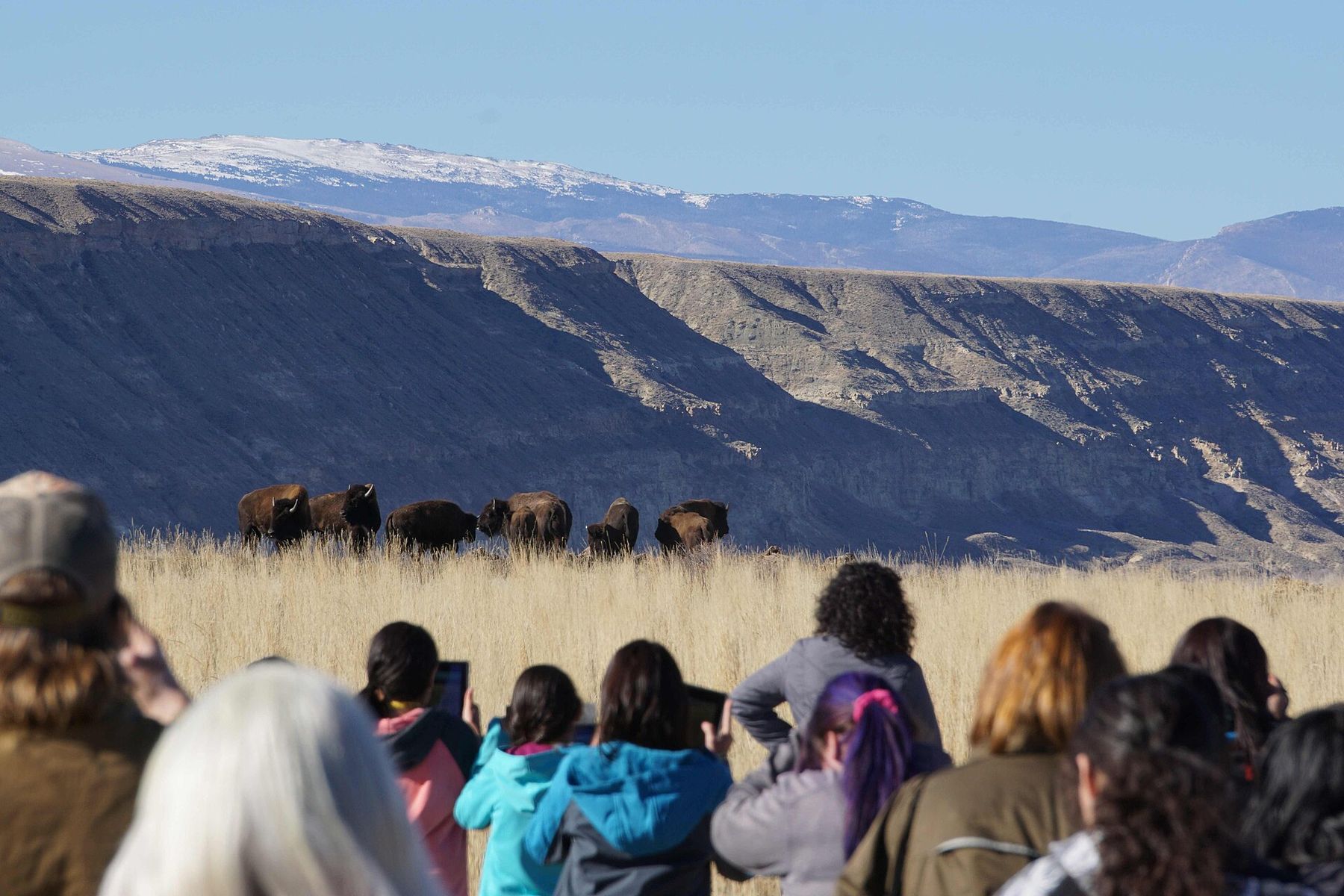
Bison returned to the Wind River Reservation, Wyoming, watched by the Eastern Shoshone and Northern Arapaho.
USFWS Mountain Prairie, Bison Release 4 (30295054944), 2016EcoAxes / Included ideologies / Indigenous, decolonial and justice-based approaches
Political movementLand Back Environmentalism
The movement led by Indigenous peoples in North America, and echoed worldwide, that demands the return of land and jurisdiction to Indigenous nations. It treats return as the foundation of justice and as the most effective way to restore ecosystems, on the evidence that lands governed by Indigenous peoples are the best conserved on earth.
- Key figures
- NDN Collective (LANDBACK campaign), Eve Tuck and K. Wayne Yang, Glen Coulthard, Leanne Betasamosake Simpson, Shiri Pasternak and Hayden King (Yellowhead Institute)
Where it stands
- Environmental EthicsAnthropocentrismEcocentrism
- Human–Nature RelationsHuman SeparationHuman Integration
- Economic PhilosophyGreen GrowthPost-Growth
- Resource OwnershipPrivate StewardshipCommons Governance
- Environmental AuthorityCentralized AuthorityLocal Autonomy
- Environmental JusticeAggregate OutcomesDistributive Justice
- Conservation StrategySustainable UseStrict Protection
- Global ResponsibilityNational SovereigntyInternational Ecological Obligation
- Ecological Political PriorityIncremental ReformTransformative Change
Land Back is defined by its positions on ownership, authority and justice, which are at the extremes; its economic and conservation positions follow from Indigenous governance and are less uniform.
Definition
Land Back demands that lands taken from Indigenous peoples be returned to them, together with the jurisdiction, government and relationships that belong with them.
As an environmental position, it holds that returning land to Indigenous government is a matter of justice and also the most effective way to protect and restore ecosystems. Indigenous nations have the knowledge, the law and the long-term commitment that colonial states and conservation organisations have lacked.
“Land Back” is at once a slogan, a campaign and a framework. Its demands range from the return of particular sites, including national parks and conservation land, to the remaking of the settler state.
Historical development
Indigenous demands for the return of land are as old as its taking. Through the twentieth century they were pressed in court cases over treaties, in land claims, in occupations such as Alcatraz (1969), Wounded Knee (1973) and Oka (1990), and in the recognition of title.
The phrase “Land Back” spread from about 2018, after Standing Rock and during the Wet’suwet’en resistance to a pipeline. NDN Collective made it a national campaign in 2020, starting with the demand to return the Black Hills, which the US Supreme Court had found in 1980 to have been taken illegally. Eve Tuck and K. Wayne Yang insisted in “Decolonization Is Not a Metaphor” (2012) that decolonisation means giving back land, not changing attitudes. The Yellowhead Institute’s Land Back Red Paper (2019) analysed the situation in Canada.
Governments, conservation groups and churches have been returning land to Indigenous nations more and more often. The returns include shared management and transfers of national parks in Australia, New Zealand, Canada and the United States.
Principal claims
- Indigenous lands were taken illegally and immorally. Giving them back is a matter of justice that does not depend on environmental arguments.
- On the evidence, Indigenous government of land is the best conservation there is. Land Back is therefore also an environmental policy.
- Conservation organisations and states that hold Indigenous land should return it, including parks created by removing Indigenous peoples.
- Jurisdiction has to be returned as well as title. Shared management without authority is not enough.
- The settler state’s claim to the land is the root of the ecological crisis on it.
Policy implications
The movement calls for public and conservation land to be returned to Indigenous nations, and for their jurisdiction over returned and traditional lands to be recognised. It wants protected areas led by Indigenous peoples, treaties renegotiated, consent required, and Indigenous governments funded. It asks conservation organisations to audit the lands they acquired through dispossession and give them back.
Internal disagreements
Supporters disagree about the state, whether to pursue return through state law or to refuse the state’s authority entirely. They differ on whether returns with conditions attached are acceptable, and on what to do about land now lived on by non-Indigenous people. They also weigh the justice argument against the environmental one. Some fear that leaning on the environmental argument makes return depend on conservation results.
Criticisms and controversies
Opponents argue that the demand is impractical on a large scale, that it would upset property and settlement, that Indigenous nations might choose to extract resources, and that good conservation results are not guaranteed. Some conservationists support return only with protective covenants attached, which Land Back advocates see as continued control.
Supporters point to the growing number of successful returns and to the evidence on conservation.
Relationships to other traditions
Land Back is the land-focused form of Indigenous environmental sovereignty and a central demand of decolonial ecology. It is the most direct challenge to fortress conservation and to any conservation that holds Indigenous land. It shares ground with rights-based conservation, community conservation and environmental justice.
References and further reading
- Tuck, E. and Yang, K. W. (2012). “Decolonization is not a metaphor.” Decolonization: Indigeneity, Education & Society 1(1), 1–40.
- Pasternak, S. and King, H. (2019). Land Back: A Yellowhead Institute Red Paper. Yellowhead Institute.
- Coulthard, G. S. (2014). Red Skin, White Masks. University of Minnesota Press.
- Simpson, L. B. (2017). As We Have Always Done: Indigenous Freedom through Radical Resistance. University of Minnesota Press.
- Estes, N. (2019). Our History Is the Future: Standing Rock versus the Dakota Access Pipeline. Verso.