
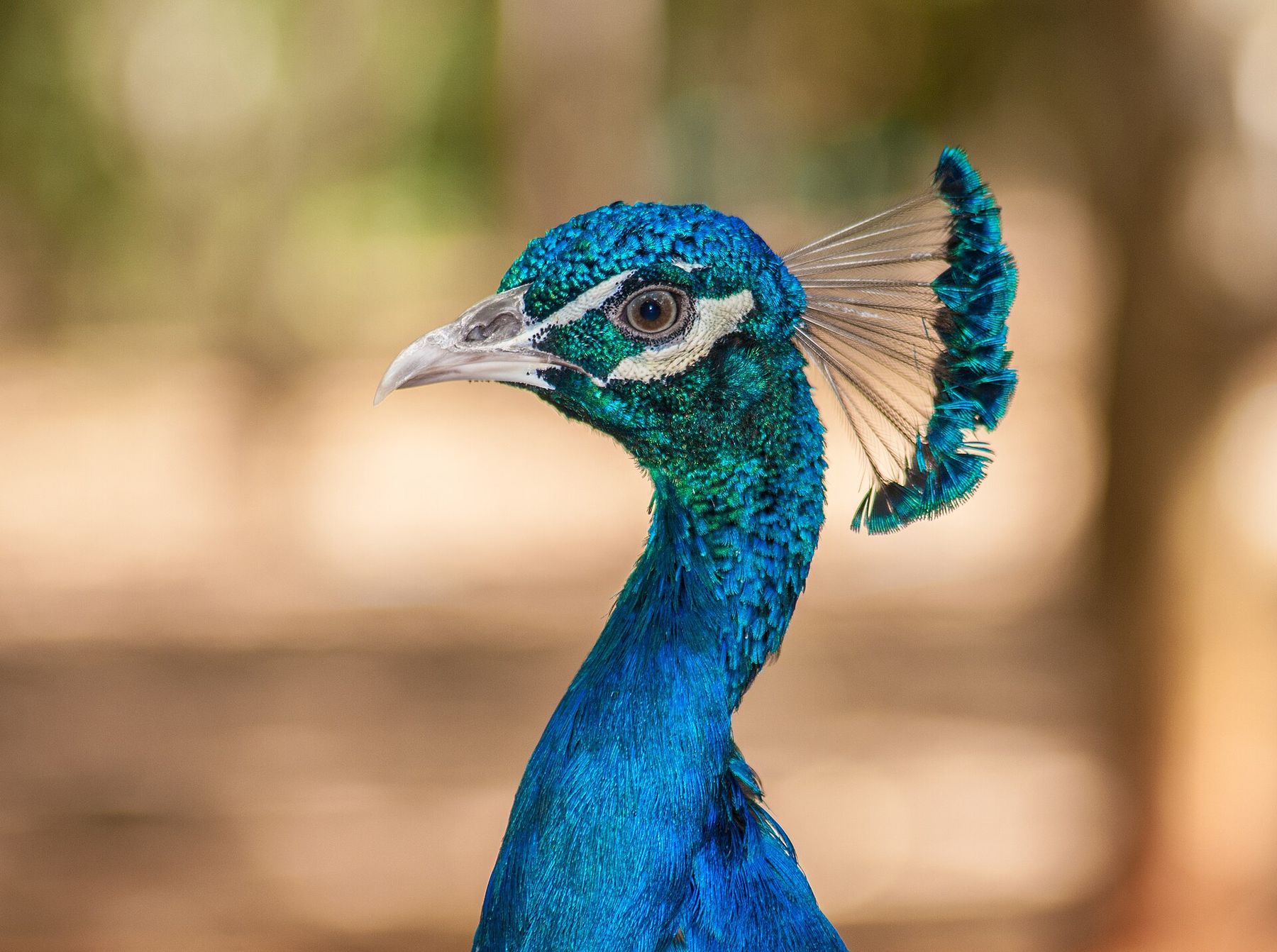
An Indian peafowl: one of the countless lives the vow of ahimsa protects.
Wilfredor, Pavo Real Venezolano, 2012EcoAxes / Included ideologies / Religious and spiritual environmental ethics
Religious ethical traditionJain Ahimsa
The Jain teaching that every living being has a soul (jiva), down to the beings with a single sense that live in earth, water, fire, air and plants, and that the highest duty is ahimsa, non-violence toward them all. With the vows of non-possession (aparigraha) and limited consumption, it is probably the most demanding ethic of restraint toward life in any world religion, and a modern environmental movement rests on it.
- Key figures
- Mahavira (tradition), L. M. Singhvi (Jain Declaration on Nature, 1990), Christopher Key Chapple, Satish Kumar, Padmanabh Jaini
Where it stands
- Environmental EthicsAnthropocentrismEcocentrism
- Human–Nature RelationsHuman SeparationHuman Integration
- Ecological InterventionNoninterventionActive Stewardship
- Economic PhilosophyGreen GrowthPost-Growth
- Technological OutlookTechnological OptimismEcological Precaution
- Energy PhilosophyEnergy AbundanceEnergy Sufficiency
- Human–Wildlife RelationsHuman PriorityWildlife Accommodation
- Agricultural EcologyLand SparingLand Sharing
- Ecological Political PriorityIncremental ReformTransformative Change
Jain ethics is explicit and extreme on non-harming, non-possession and restraint; it has little to say about political economy, governance or international institutions.
Definition
Jain ahimsa rests on three teachings. First, the universe is full of souls (jiva). They live in humans and animals, and also in plants and in the elemental beings of earth, water, fire and air, each of which has at least the sense of touch and can suffer. Second, all beings depend on one another. The Jain community’s motto, parasparopagraho jivanam, means “souls render service to one another”. Third, the first and highest vow is ahimsa, non-violence toward all of them, in thought, word and deed.
From these follow strict vegetarianism, avoiding work that harms life, and careful limits on using water and fire and on moving about. The vow of aparigraha, non-possession or non-attachment, limits consumption and accumulation. The modern ethic reads all this as a complete practice of ecological restraint, in which the religious ideal is to leave as small a mark on life as possible.
Historical development
The teachings go back to Mahavira, traditionally dated to the sixth or fifth century BCE, and to the Jain canon. Jain communities have practised vegetarianism, kept shelters for animals (panjrapoles) and lived with restraint for more than two thousand years.
The modern environmental statement came with the Jain Declaration on Nature, which L. M. Singhvi presented to Prince Philip at Buckingham Palace in 1990 for the Institute of Jainology. It set out ahimsa, interdependence and aparigraha as an environmental creed. Christopher Key Chapple’s Nonviolence to Animals, Earth, and Self in Asian Traditions (1993) and the edited volume Jainism and Ecology (2002) brought it into comparative religious ethics. Satish Kumar, a former Jain monk, carried its spirit into the Western green movement through Resurgence magazine and Schumacher College. Jain communities have started green temple, vegan and animal protection projects.
Principal claims
- Every living being has a soul and can suffer. The moral community includes plants and elemental beings.
- Non-violence toward all life is the highest duty. Harm must be kept as small as possible even when it cannot be avoided.
- Non-possession and limited consumption are religious vows. Accumulation binds the soul and harms the world.
- All souls depend on one another. That life is interconnected is a spiritual truth.
- Practising the ethic means paying careful attention to what one’s actions do to every being.
Policy implications
Jainism is a way of life more than a political programme. In public it shows up as vegetarianism and veganism, shelters for animals and attention to their welfare, opposition to hunting, slaughter and animal experiments, saving water, limiting consumption and waste, and support for environmental education. Jain thinkers have endorsed sufficiency economics and ecological restraint in general terms.
Internal disagreements
Jains disagree about how to reconcile the ascetic ideal with ordinary life, and with the community’s prominence in commerce and industry, mining and chemicals included. They differ on whether aparigraha implies a criticism of capitalism or only personal restraint, and on how far a tradition focused on individual karma and liberation can turn into collective ecological action.
Criticisms and controversies
Critics point to the gap between the ethic and the environmental footprint of a prosperous trading community. Scholars such as Anne Vallely observe that classical Jainism seeks liberation from the world, not its preservation, so eco-Jainism is a modern reinterpretation. Extending souls to elemental beings is hard to translate into secular ethics.
Supporters argue that practising ahimsa has concrete ecological effects, and that reinterpretation is how traditions stay alive.
Relationships to other traditions
Jain ethics is the most demanding of the Indian traditions of ahimsa, which it shares with Buddhist and Hindu ecological thought. It is the religious counterpart of biocentrism and of Paul Taylor’s respect for all living things. It is an ally of compassionate conservation and wildlife protection, and through Kumar a source for Western movements of sufficiency and degrowth.
References and further reading
- Singhvi, L. M. (1990). The Jain Declaration on Nature. Institute of Jainology.
- Chapple, C. K., ed. (2002). Jainism and Ecology: Nonviolence in the Web of Life. Harvard University Press.
- Chapple, C. K. (1993). Nonviolence to Animals, Earth, and Self in Asian Traditions. SUNY Press.
- Jaini, P. S. (1979). The Jaina Path of Purification. University of California Press.
- Vallely, A. (2002). “From liberation to ecology: Ethical discourses among orthodox and diaspora Jains.” In C. K. Chapple, ed., Jainism and Ecology. Harvard University Press.