
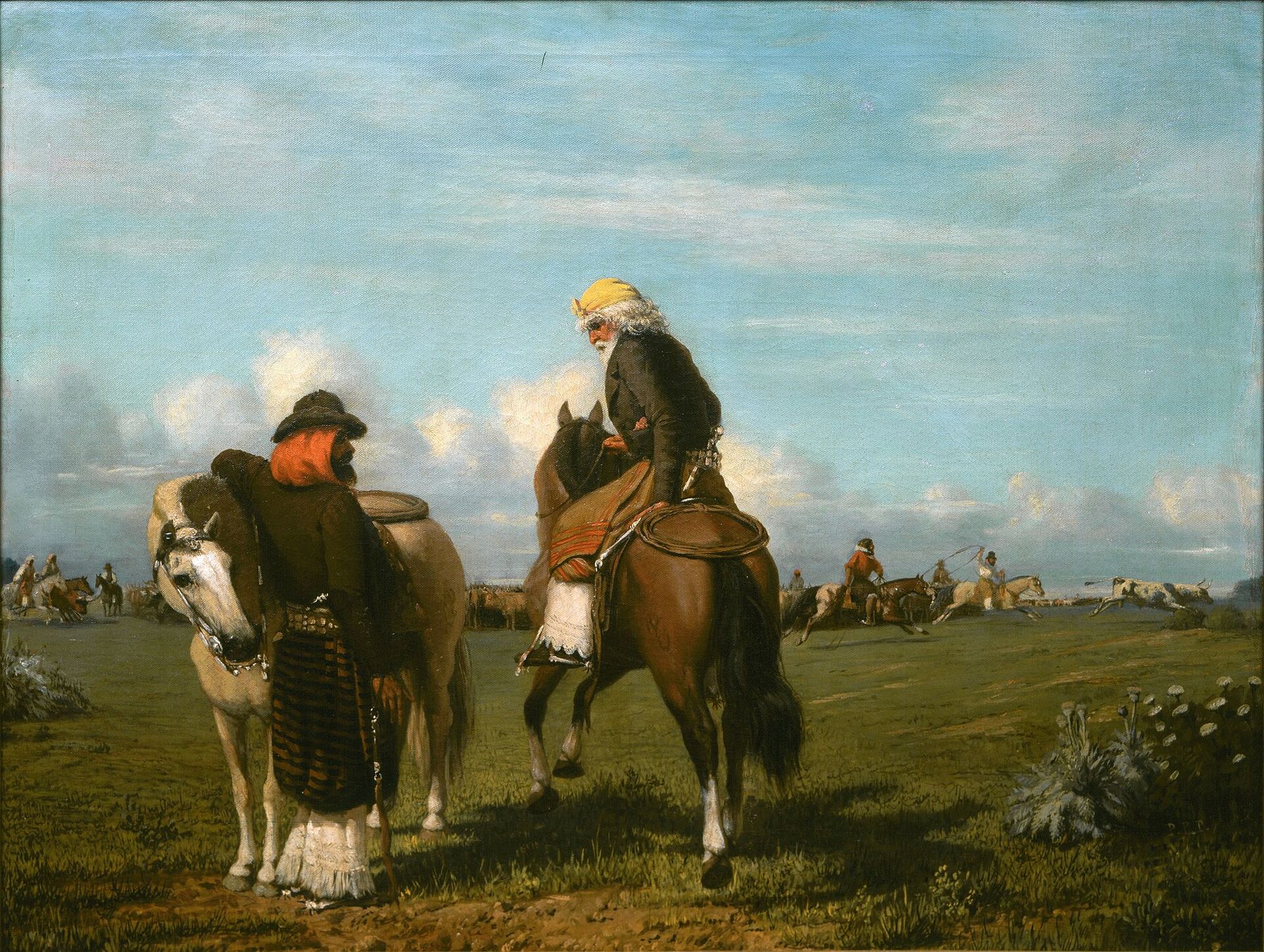
Prilidiano Pueyrredón's Los capataces, 1864: the foremen of an Argentine estancia, the inherited ranching life of the pampas.
Prilidiano Pueyrredón, Spanish: Los capataces The Overseers, 1860EcoAxes / Included ideologies / Conservative and traditionalist environmentalism
Cultural and political traditionAgrarian Conservatism
The tradition most closely tied to Wendell Berry. It holds that small farms, settled communities and careful, affectionate husbandry are the basis of healthy land and a good society, and that industrial agriculture, the global economy and constant mobility wear down soil, community and character together.
- Key figures
- Wendell Berry, Wes Jackson, Liberty Hyde Bailey, the Southern Agrarians (I'll Take My Stand, 1930), Gene Logsdon
Where it stands
- Environmental EthicsAnthropocentrismEcocentrism
- Human–Nature RelationsHuman SeparationHuman Integration
- Economic PhilosophyGreen GrowthPost-Growth
- Resource OwnershipPrivate StewardshipCommons Governance
- Environmental AuthorityCentralized AuthorityLocal Autonomy
- Environmental JusticeAggregate OutcomesDistributive Justice
- Technological OutlookTechnological OptimismEcological Precaution
- Energy PhilosophyEnergy AbundanceEnergy Sufficiency
- Conservation StrategySustainable UseStrict Protection
- Human–Wildlife RelationsHuman PriorityWildlife Accommodation
- Agricultural EcologyLand SparingLand Sharing
- Global ResponsibilityNational SovereigntyInternational Ecological Obligation
- Ecological Political PriorityIncremental ReformTransformative Change
Agrarian conservatism is explicit on agriculture, locality, small property and scepticism of technology and the global economy. Its position on systemic change is ambiguous, since it is both radical in critique and traditionalist in remedy.
Definition
Agrarian conservatism judges a society by how it treats its land. Its answer to how land should be treated is many small farms, owned by the people who work them and passed down over generations. On this view, industrial agriculture has done lasting damage to both the land and the communities that lived from it, along with the concentration of land in few hands, the drift of labour away from home and an economy run in abstractions.
The tradition is conservative in a cultural and local sense, not a party one. What it wants to keep are soil, skills, neighbourhoods and knowledge of particular places. It is as hard on corporate capitalism as it is on the state.
Historical development
The line runs from Thomas Jefferson’s ideal of the yeoman farmer to Liberty Hyde Bailey’s The Holy Earth (1915), the Southern Agrarians’ manifesto I’ll Take My Stand (1930) and a group of British rural writers. Its central modern book is Wendell Berry’s The Unsettling of America: Culture and Agriculture (1977).
Wes Jackson founded the Land Institute in 1976 to develop perennial polyculture, a kind of farming modelled on the prairie. Berry has written essays, poems and novels in the same vein for more than fifty years, and Gene Logsdon, Norman Wirzba and others have carried the work on. People from many political positions have taken it up, including the local-food movement, distributists and Christian environmentalists.
Principal claims
- Land, community and the individual person are healthy or sick together. None of them can be kept well alone.
- Good farming is a cultural and moral practice. It needs affection, knowledge of the place and patience over decades, and industrial agriculture destroys all three.
- Small ownership, local economies and settled communities make good husbandry possible.
- A technology should be judged by whether it supports that care or replaces it. Most industrial technology replaces it.
- A global economy separates what people consume from the places where it is produced, and so makes responsibility for those places impossible.
Policy implications
Agrarians support small and mid-sized family farms and food economies that are local or regional. They want limits on corporate farming and on the concentration of land ownership, and they back agroecological and perennial farming and rural institutions. They tend to oppose large energy and infrastructure projects on farmland and to distrust trade liberalisation. In conservation they generally prefer working landscapes to reserves, and regulated hunting and husbandry to strict protection.
Internal disagreements
Agrarians disagree about how far to rely on markets or on government, and about how much modern technology to accept. They also differ over the place of wilderness. A harder question is whether a programme built around returning to the land has anything to offer a world where most people live in cities.
Criticisms and controversies
Critics call the tradition nostalgic, unworkable at scale and silent about how hard rural life used to be. Ecomodernists argue that small, low-input farms would need far more land than intensive ones and would feed fewer people. Social critics point to the Southern Agrarians’ entanglement with racial hierarchy. Berry confronted that history directly in The Hidden Wound (1970).
Agrarians answer that soil loss, the decline of rural communities and the fragility of industrial food supply chains show the critique was right.
Relationships to other traditions
Agrarian conservatism is the rural core of green conservatism. It is close to the land ethic and Christian stewardship. Across the political divide it shares a distrust of industrial scale and global markets with food sovereignty, agroecology and degrowth.
References and further reading
- Berry, W. (1977). The Unsettling of America: Culture and Agriculture. Sierra Club Books.
- Twelve Southerners (1930). I’ll Take My Stand: The South and the Agrarian Tradition. Harper.
- Jackson, W. (1980). New Roots for Agriculture. Friends of the Earth.
- Bailey, L. H. (1915). The Holy Earth. Scribner.
- Wirzba, N., ed. (2003). The Essential Agrarian Reader. University Press of Kentucky.