
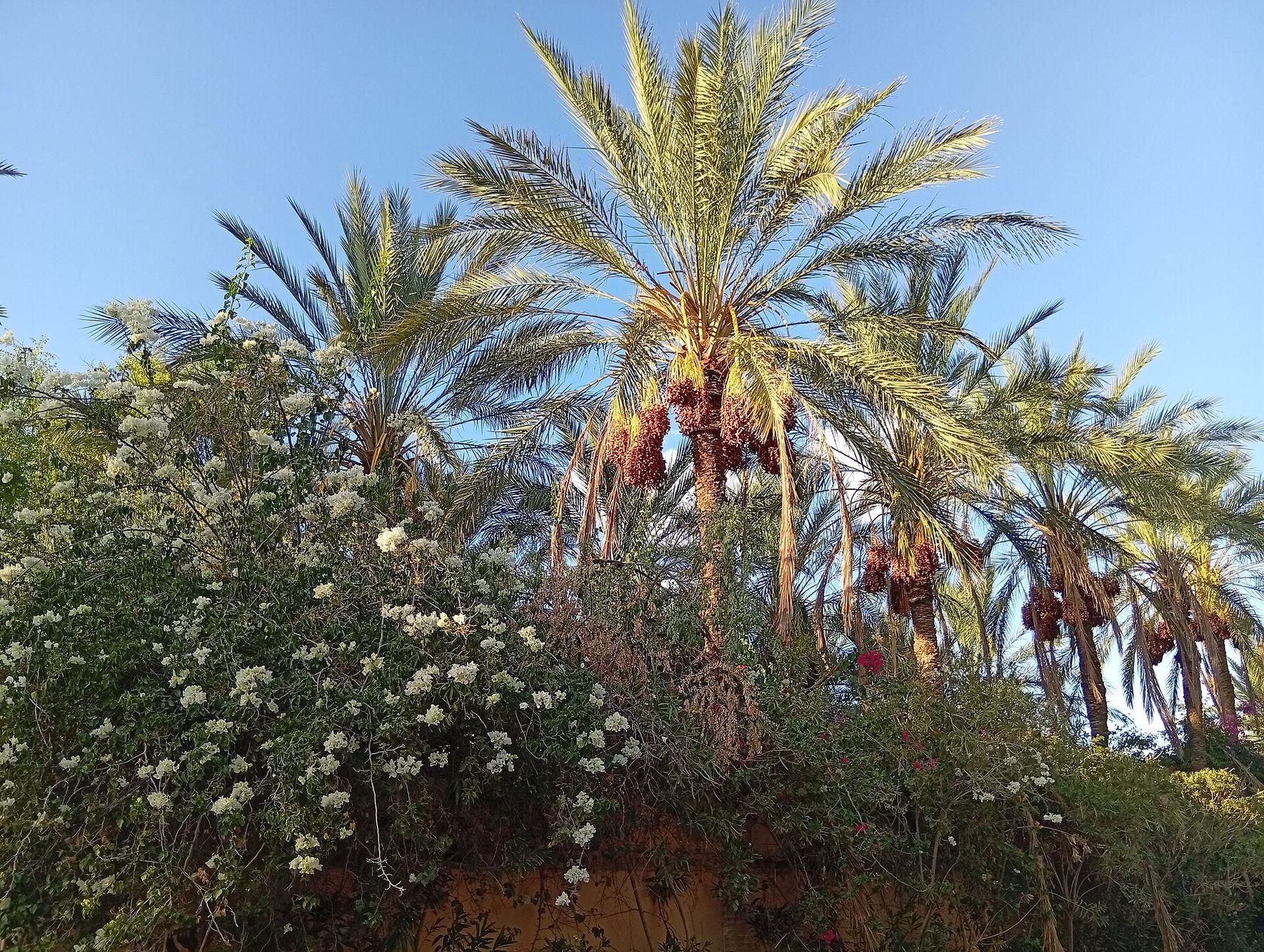
Date palms in fruit at the Tozeur oasis, Tunisia. "If the Hour comes while one of you holds a palm sapling, let him plant it" (Musnad Ahmad).
Houss 2020, Inside Tozeur Oasis 02, 2025EcoAxes / Included ideologies / Religious and spiritual environmental ethics
Religious ethical traditionIslamic Amanah
The Islamic ethic of amanah, the trust of the earth that humanity accepted (Qur'an 33:72). Honoured as ashraf al-makhluqat, the noblest of creation, people hold the earth on God's behalf and answer for it. They are bound by tawhid (the unity of creation), mizan (balance) and the bans on fasad (corruption) and israf (waste), and guided by the lands the Prophet himself protected, the hima and the sanctuary of Medina.
- Key figures
- Seyyed Hossein Nasr, Fazlun Khalid, Mawil Izzi Dien, Ibrahim Özdemir, Othman Llewellyn
Where it stands
- Environmental EthicsAnthropocentrismEcocentrism
- Human–Nature RelationsHuman SeparationHuman Integration
- Ecological InterventionNoninterventionActive Stewardship
- Economic PhilosophyGreen GrowthPost-Growth
- Resource OwnershipPrivate StewardshipCommons Governance
- Environmental AuthorityCentralized AuthorityLocal Autonomy
- Environmental JusticeAggregate OutcomesDistributive Justice
- Technological OutlookTechnological OptimismEcological Precaution
- Energy PhilosophyEnergy AbundanceEnergy Sufficiency
- Conservation StrategySustainable UseStrict Protection
- Human–Wildlife RelationsHuman PriorityWildlife Accommodation
- Agricultural EcologyLand SparingLand Sharing
- Global ResponsibilityNational SovereigntyInternational Ecological Obligation
- Ecological Political PriorityIncremental ReformTransformative Change
Read from the Qur'anic teachings of khilafah and amanah (humanity as trustee of a creation that belongs to God), mizan (balance) and the prohibition of israf (waste), and from the legal institutions of the hima (protected reserve, declared by authority), ihya al-mawat (reviving dead land) and the shared ownership of water, pasture and fire. Value lies with the Creator, so the ethic is theocentric rather than ecocentric; the bands are wide where Muslim practice and scholarship diverge.
Definition
Islamic amanah draws the care of the earth from the sources of Islam. Creation is a unity (tawhid) that belongs to God, and its creatures are signs (ayat) of God.
The Qur’an tells of a trust (amanah) that the heavens, the earth and the mountains declined and humanity accepted (33:72). People are honoured among creatures as ashraf al-makhluqat, the noblest of creation. They hold the earth on God’s behalf, not as its owners, and will answer for how they use it. Creation is made in balance (mizan), which people must not upset (55:7–9). Corrupting the earth (fasad fi al-ard) and wasteful excess (israf) are forbidden. Animals form communities like human ones (6:38), with rights that the traditions of the Prophet spell out.
The Prophet also set land aside. He reserved the hima of al-Naqi’ near Medina as common pasture. He declared Medina a sanctuary (haram), where trees were not to be cut or game hunted. And he ruled that “there is no hima except for God and His Messenger”, so that protected land belonged to the community and not to private lords. From these sources Muslim jurists developed the hima, a protected zone, and the harim, an inviolable belt around water sources and settlements. Both are far older than modern protected areas.
Historical development
The classical sources give extensive guidance on water, land, animals and waste, and the hima and harim have been practised since the Prophet’s time. The hima of the Arabian Peninsula is among the oldest conservation institutions in the world.
Seyyed Hossein Nasr’s Man and Nature (1968) was among the first works by a religious thinker of any faith to diagnose the environmental crisis as spiritual. Fazlun Khalid founded the Islamic Foundation for Ecology and Environmental Sciences in 1994, and interfaith declarations, from Assisi in 1986 onward, developed the ethic further. Mawil Izzi Dien’s The Environmental Dimensions of Islam (2000) and the work of Ibrahim Özdemir gave it scholarly form.
The Islamic Declaration on Global Climate Change (Istanbul, 2015) called on Muslims and on countries where most people are Muslim to act. Fatwas followed, on wildlife trafficking in Indonesia in 2014 and on environmental protection. Movements for green mosques, Islamic finance and sustainable Ramadan observance put the ethic into practice.
Principal claims
- The earth belongs to God. People are trustees, not owners, and they will answer for how they use it.
- Creation is in balance, and people must not corrupt or upset it.
- Waste and excess are forbidden. Moderation is a religious duty.
- Animals and other creatures form communities with rights, and must be treated with compassion.
- The poor and future generations have claims on resources. Using them rightly requires justice.
- Water in particular is held in trust by the community, and no one may monopolise it.
Policy implications
The ethic supports reviving and extending hima and harim as zones of community conservation. It calls for water justice and public control of water, measures against waste, standards for animal welfare, climate action by countries where most people are Muslim, Islamic finance that screens out environmental harm, and environmental education in religious institutions.
Internal disagreements
Muslim scholars and activists disagree about how to balance tradition with modern environmental science, and about the place of development and growth in countries where most people are Muslim. They differ on the role of the state as against communities and religious institutions, on how far animal rights extend, and on the relevance of Sufi, legal and modernist approaches.
Criticisms and controversies
Critics note the gap between the ethic and the environmental record of many countries where most people are Muslim, especially the oil states. Some argue that Islamic eco-theology is a modern idea read back into the sources. Secular environmentalists question grounding environmental ethics in religion.
Scholars within the tradition admit the gap, and argue that the sources are the strongest lever for change available in Muslim societies.
Relationships to other traditions
Islamic amanah shares the idea of trusteeship with Christian stewardship and Catholic integral ecology, and the stress on justice with environmental and climate justice. Its hima resembles the institutions of CBNRM and community conservation. It is at odds with development that puts growth first and with the human-centred utilitarianism of market environmentalism.
References and further reading
- Nasr, S. H. (1968). Man and Nature: The Spiritual Crisis of Modern Man. Allen & Unwin.
- Izzi Dien, M. (2000). The Environmental Dimensions of Islam. Lutterworth Press.
- Khalid, F. M. (2019). Signs on the Earth: Islam, Modernity and the Climate Crisis. Kube Publishing.
- Foltz, R. C., Denny, F. M. and Baharuddin, A., eds. (2003). Islam and Ecology: A Bestowed Trust. Harvard University Press.
- Islamic Declaration on Global Climate Change (2015). International Islamic Climate Change Symposium, Istanbul.