
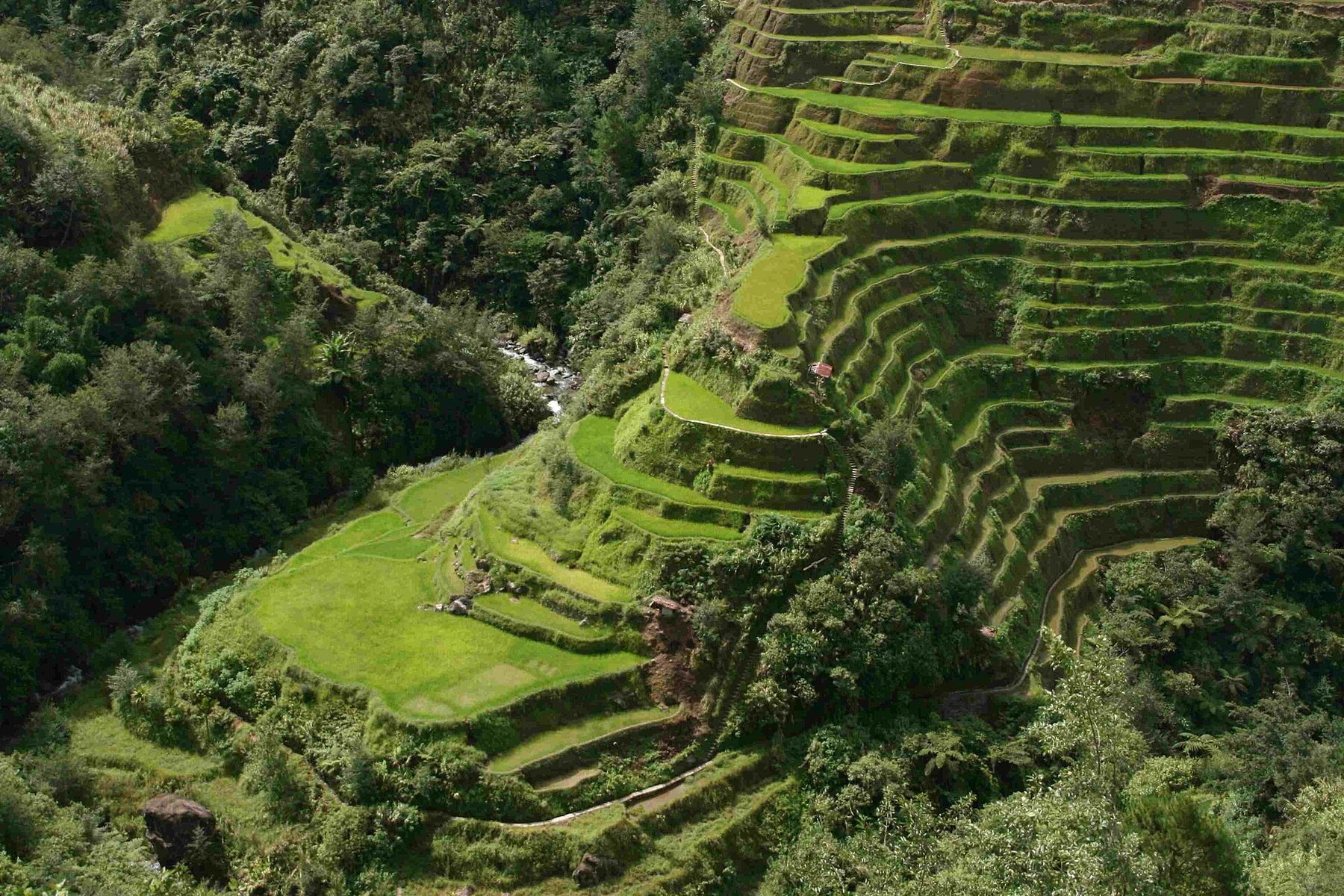
The Banaue rice terraces, Philippines, farmed for two thousand years: land worked now and kept fertile for those who come after.
Agricmarketing at en.wikipedia, Banaue Rice Terrace Close Up (2), 2008EcoAxes / Included ideologies / Liberal, reformist and market environmentalism
Policy paradigm and international frameworkSustainable Development
The framework set out by the Brundtland Commission in 1987 and built into the Rio process and the Sustainable Development Goals. Development should meet the needs of the present without compromising the ability of future generations to meet their own, joining economic growth, social fairness and environmental protection through international cooperation.
- Key figures
- Gro Harlem Brundtland (chair, WCED), Jeffrey Sachs, Maurice Strong, Mahbub ul Haq, Amartya Sen (as resource)
Where it stands
- Environmental EthicsAnthropocentrismEcocentrism
- Human–Nature RelationsHuman SeparationHuman Integration
- Economic PhilosophyGreen GrowthPost-Growth
- Resource OwnershipPrivate StewardshipCommons Governance
- Environmental AuthorityCentralized AuthorityLocal Autonomy
- Environmental JusticeAggregate OutcomesDistributive Justice
- Technological OutlookTechnological OptimismEcological Precaution
- Energy PhilosophyEnergy AbundanceEnergy Sufficiency
- Conservation StrategySustainable UseStrict Protection
- Agricultural EcologyLand SparingLand Sharing
- Global ResponsibilityNational SovereigntyInternational Ecological Obligation
- Ecological Political PriorityIncremental ReformTransformative Change
Sustainable development is a consensus framework, so its values are moderate by design except on international cooperation, equity and reform, where it is explicit.
Definition
Sustainable development is “development that meets the needs of the present without compromising the ability of future generations to meet their own needs”. That is the definition given by the World Commission on Environment and Development, the Brundtland Commission, in Our Common Future (1987).
It rests on three pillars, economic, social and environmental, and on the claim that reducing poverty and protecting the environment support each other. It has organised international environmental governance from the Rio Earth Summit of 1992 to the 2030 Agenda and its seventeen Sustainable Development Goals (2015).
Historical development
The concept was designed to reconcile two sides. Industrialised countries brought environmental concerns to the Stockholm Conference of 1972. Countries in the global South put development first and saw environmentalism as a threat to growth.
The IUCN’s World Conservation Strategy (1980) used the phrase, and the Brundtland Commission defined it. The Rio summit of 1992 produced the Rio Declaration, Agenda 21, the conventions on climate and biodiversity, and the principle of “common but differentiated responsibilities”. The Millennium Development Goals (2000) and the Sustainable Development Goals (2015) turned it into a global programme with measured targets. Jeffrey Sachs’s The Age of Sustainable Development (2015) is a typical statement. Critics from degrowth, political ecology and the environmentalism of the poor have questioned it throughout.
Principal claims
- Economic development, social fairness and environmental protection depend on each other and have to be pursued together.
- Poverty is both a cause and a result of environmental damage, so development is part of the solution.
- Present and future generations both have claims, and policy must balance them.
- Rich and poor countries share responsibility for global environmental problems, but not in equal measure.
- Growth is needed, especially in poor countries, but what grows has to change toward efficient use of resources and greater fairness.
Policy implications
Sustainable development works through integrated national strategies, international treaties and finance, development aid tied to environmental goals, environmental impact assessment, participation of the groups affected, and the transfer of technology. The Sustainable Development Goals set targets on poverty, health, water, energy, cities, climate, oceans and land. Most official versions take green growth as their economic model.
Internal disagreements
Supporters disagree about “weak” and “strong” sustainability, which turns on whether capital made by people can stand in for natural capital. They weigh growth differently within the framework. They argue over whether the Goals hang together, given the tensions between growth and ecological targets, and over the balance between national sovereignty and international obligation.
Criticisms and controversies
Critics from degrowth and ecological economics argue that “sustainable development” contradicts itself and lets growth carry on under a green banner. Political ecologists say it takes the politics out of conflicts over resources. Advocates of the environmentalism of the poor say it was written by elites and for them. Deep ecologists say it is human-centred through and through.
Supporters note that it is the only framework almost every country has agreed to, and that it has driven measurable progress on poverty, water and health.
Relationships to other traditions
Sustainable development is the international, institutional form of green liberalism and green growth, and it takes in ecological modernisation. It borrows the language of climate justice in “common but differentiated responsibilities”. It defines itself against degrowth, post-development and deep ecology.
References and further reading
- World Commission on Environment and Development (1987). Our Common Future. Oxford University Press.
- United Nations (2015). Transforming Our World: The 2030 Agenda for Sustainable Development. A/RES/70/1.
- Sachs, J. D. (2015). The Age of Sustainable Development. Columbia University Press.
- Rio Declaration on Environment and Development (1992). A/CONF.151/26.
- Neumayer, E. (2003). Weak versus Strong Sustainability, 2nd ed. Edward Elgar.