
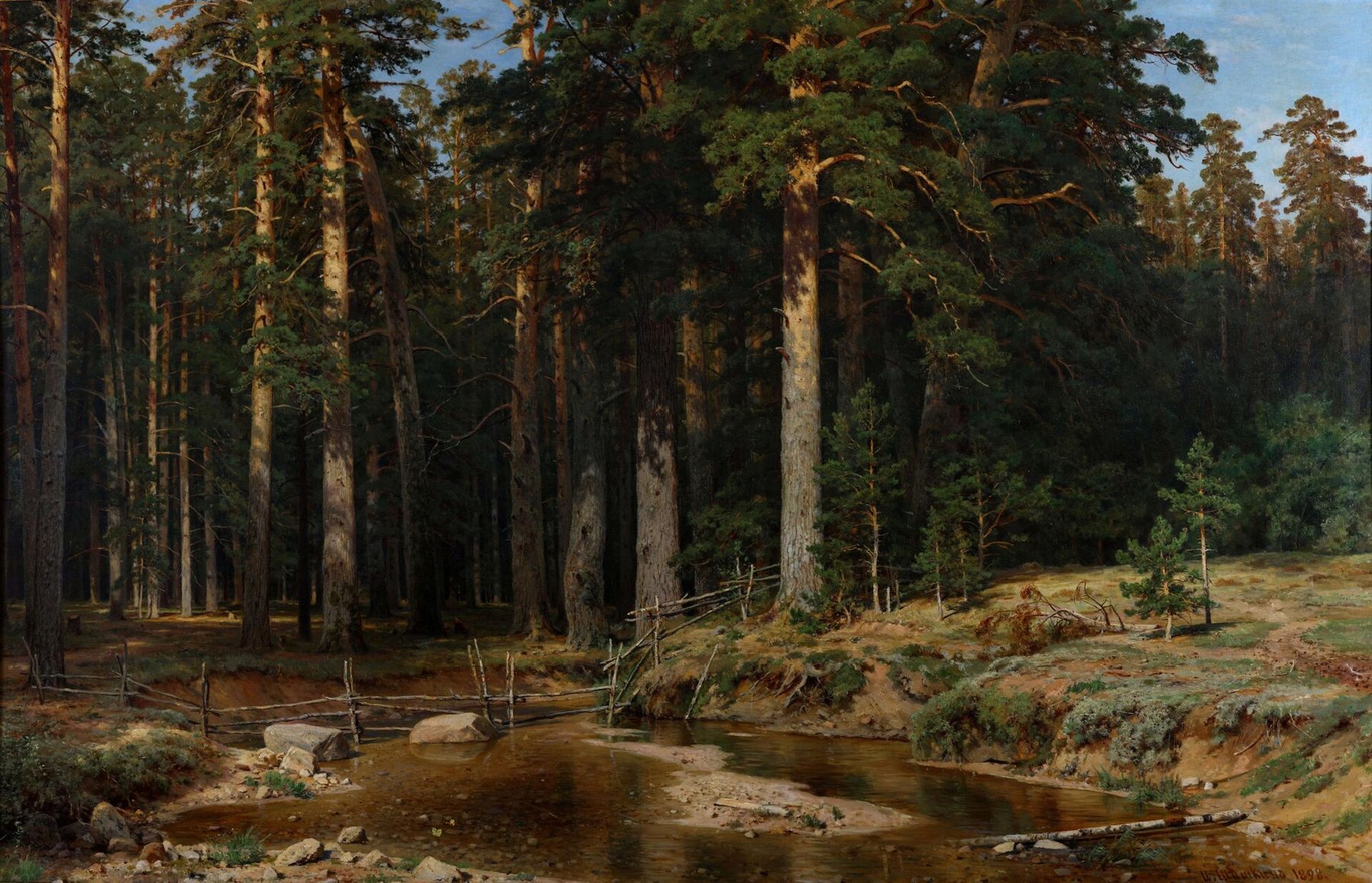
Shishkin's Ship Grove, pines grown for the navy: forests managed for use.
Ivan Shishkin, Ship Grove, 1898EcoAxes / Included ideologies / Classical environmental philosophies
Resource-management philosophy and political movementConservationism
The "wise use" tradition. Public agencies should manage natural resources scientifically, for "the greatest good of the greatest number for the longest time", keeping up their yield so that they are neither used up nor locked away.
- Key figures
- Gifford Pinchot, Theodore Roosevelt, George Perkins Marsh, W. J. McGee, Samuel P. Hays (historian)
Where it stands
- Environmental EthicsAnthropocentrismEcocentrism
- Human–Nature RelationsHuman SeparationHuman Integration
- Ecological InterventionNoninterventionActive Stewardship
- Economic PhilosophyGreen GrowthPost-Growth
- Resource OwnershipPrivate StewardshipCommons Governance
- Environmental AuthorityCentralized AuthorityLocal Autonomy
- Technological OutlookTechnological OptimismEcological Precaution
- Conservation StrategySustainable UseStrict Protection
- Human–Wildlife RelationsHuman PriorityWildlife Accommodation
- Ecological Political PriorityIncremental ReformTransformative Change
Conservationism is a developed programme of public, expert, utilitarian management, so most axes can be scored. Positions on justice, energy, agriculture and international obligation are not characteristic.
Definition
Conservationism, in the sense that became standard in the United States around 1900, treats forests, water, soil, minerals and wildlife as resources to be managed scientifically for continued use. Trained professionals in public agencies do the managing, so that the resources serve “the greatest good of the greatest number for the longest time.”
The outlook is utilitarian, centred on human needs and run by managers. Professional forestry, range management, fisheries science and wildlife management all grew out of it.
Historical development
George Perkins Marsh’s Man and Nature (1864) recorded the destruction of forests and watersheds around the Mediterranean and warned that America would go the same way. Gifford Pinchot, trained in European forestry, became the first chief of the US Forest Service in 1905, under Theodore Roosevelt. Together they made conservation a national political programme, with national forests, irrigation schemes, regulated grazing and the first wildlife laws. Pinchot set out the creed in The Fight for Conservation (1910).
The quarrel with John Muir’s preservationists over the damming of Hetch Hetchy valley fixed the two camps. The historian Samuel Hays described the movement as “the gospel of efficiency”, an expression of the Progressive Era’s faith in expertise and planning. Abroad, the same philosophy shaped colonial forest departments and the sustained-yield models of twentieth-century fisheries and forestry.
Principal claims
- Natural resources are a public inheritance. They should be used, neither wasted nor held back.
- Use must be sustained, which means harvesting no faster than the resource renews.
- The right managers are trained experts who apply science in the public interest, shielded from short-term private greed and local pressure.
- Planning can reconcile the many uses of land: timber, water, grazing, recreation and wildlife.
- Development, including dams and roads, is a legitimate aim of conservation when it serves the many.
Policy implications
Conservationism supports public ownership or regulation of forests, rangeland and watersheds, harvesting at sustained yield, professional agencies, game laws and licensed hunting, and large public works for water and power. It takes active intervention in ecosystems for granted. Historically that included killing predators.
Internal disagreements
Conservationists disagree about whether “multiple use” is a real balance or a cover for extraction. They differ on how to absorb ecological findings that undercut simple sustained-yield models, and on how much weight recreation and wildlife deserve against timber and water. Among its modern heirs, a further question is how much control to hand to states and communities.
Criticisms and controversies
Preservationists charged that conservationism left no room for the value of nature itself. Ecologists charged that its sustained-yield models ignored how ecosystems change, and they failed badly in fisheries. Political ecologists and historians have shown that colonial conservation took land and resources from local users in the name of scientific management. Free-market critics argue that public agencies end up serving the industries they regulate.
Defenders point to the public forests, to the recovery of many game species, and to the tradition’s success in building long-term thinking into institutions.
Relationships to other traditions
Conservationism is the historic opposite of preservationism. It is the ancestor of sustainable-use conservation, of sustainable development and of much of environmental economics. Aldo Leopold’s land ethic grew out of it and then beyond it, and kept its managerial side. Conservation conservatism, the tradition of hunters and anglers, is its popular descendant.
References and further reading
- Pinchot, G. (1910). The Fight for Conservation. Doubleday, Page & Co.
- Marsh, G. P. (1864). Man and Nature; or, Physical Geography as Modified by Human Action. Scribner.
- Hays, S. P. (1959). Conservation and the Gospel of Efficiency: The Progressive Conservation Movement, 1890–1920. Harvard University Press.
- Reiger, J. F. (1975). American Sportsmen and the Origins of Conservation. Winchester Press.