
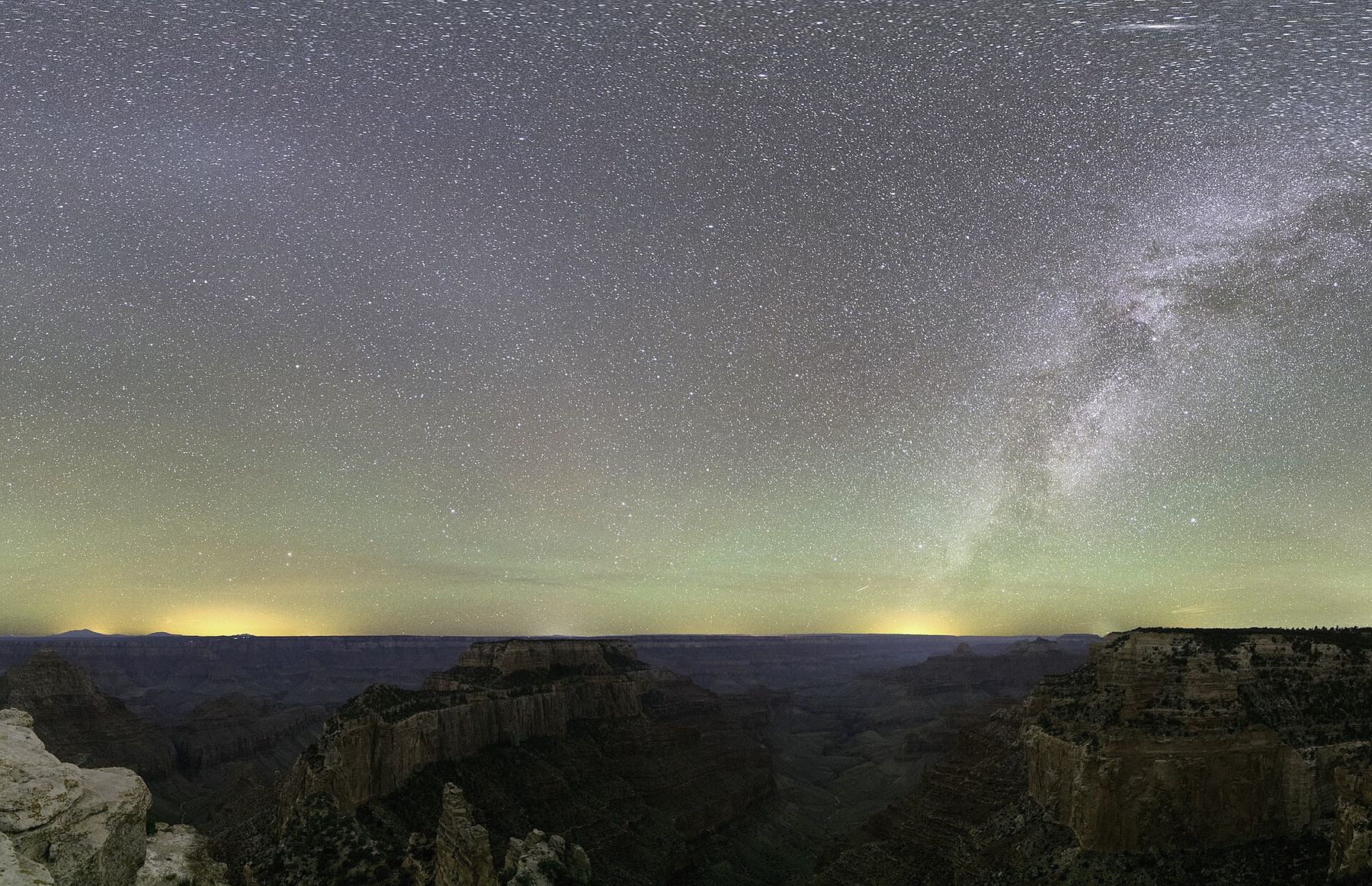
The Milky Way over the Grand Canyon.
NPS/Jeremy M. White, Milky Way Over Grand Canyon National Park (26699128610), 2015EcoAxes / Included ideologies / Religious and spiritual environmental ethics
Spiritual orientation and movementEco-Spirituality
A broad, mostly informal movement that finds the sacred in nature itself: in the earth, the cosmos and the web of life. It draws on Indigenous traditions, Romanticism, process theology, Gaia theory, neopaganism and the "new cosmology". It holds that the ecological crisis is at bottom a spiritual crisis of disconnection, to be healed through reverence, ritual and a renewed sense of belonging to the living earth.
- Key figures
- Thomas Berry, Matthew Fox, Starhawk, Joanna Macy, Brian Swimme
Where it stands
- Environmental EthicsAnthropocentrismEcocentrism
- Human–Nature RelationsHuman SeparationHuman Integration
- Ecological InterventionNoninterventionActive Stewardship
- Economic PhilosophyGreen GrowthPost-Growth
- Environmental AuthorityCentralized AuthorityLocal Autonomy
- Technological OutlookTechnological OptimismEcological Precaution
- Energy PhilosophyEnergy AbundanceEnergy Sufficiency
- Conservation StrategySustainable UseStrict Protection
- Human–Wildlife RelationsHuman PriorityWildlife Accommodation
- Agricultural EcologyLand SparingLand Sharing
- Ecological Political PriorityIncremental ReformTransformative Change
Eco-spirituality is firm on the sacredness and intrinsic value of nature and on the critique of consumer civilisation; its political positions are those of its mostly progressive adherents and carry wider bands.
Definition
Eco-spirituality goes by several names, including “nature spirituality”, “earth-based spirituality” and, in Bron Taylor’s analysis, “dark green religion”. It covers spiritual outlooks for which nature itself is sacred. The earth may be seen as a living whole, Gaia. The cosmos may be seen as an unfolding story in which humans take part. The web of life may be seen as a community of beings who deserve reverence.
The movement runs across and beyond the organised religions. Its sources include Indigenous spiritualities, which it draws on often controversially, and Romantic and Transcendentalist nature writing. They include process and creation-centred theology (Thomas Berry, Matthew Fox), Goddess spirituality and neopaganism (Starhawk), and Buddhist and Daoist teaching. They also include the scientific cosmology of Big History and Gaia theory, given spiritual meaning by writers such as Brian Swimme.
Its diagnosis is that the ecological crisis is a crisis of consciousness, a forgetting that we belong. Its practice is reverence, ritual, contemplation and the growth of an “ecological self”.
Historical development
The line runs through Henry David Thoreau, John Muir and the Romantics, Aldo Leopold’s land ethic and Rachel Carson’s sense of wonder. In the counterculture of the 1960s and 1970s several strands met: Lynn White’s call in 1967 for a new religion of nature, James Lovelock’s Gaia hypothesis (1972), the rise of neopaganism and Goddess spirituality (Starhawk’s The Spiral Dance, 1979) and deep ecology.
Thomas Berry’s The Dream of the Earth (1988) and The Universe Story (with Swimme, 1992) gave the movement its “new cosmology”. Matthew Fox’s creation spirituality, Joanna Macy’s “work that reconnects”, which combines Buddhism with systems thinking, and the Forum on Religion and Ecology, founded by Mary Evelyn Tucker and John Grim in 1996, carried it into religious studies and work between faiths. Bron Taylor’s Dark Green Religion (2010) studied it as a worldwide phenomenon that includes surfers, radical environmentalists, scientists and the general public. It influenced the Earth Charter (2000) and the rights-of-nature movement.
Principal claims
- Nature is sacred. The earth and its life have worth in themselves and deserve reverence.
- Humans belong to the community of the earth and are not above it. The feeling of separation is the root of destruction.
- The ecological crisis is spiritual. Technique alone cannot cure it. It needs a change of consciousness and of relationship.
- Ritual, contemplation, wonder and direct experience of nature are ways of knowing and of healing.
- The scientific story of the cosmos and of evolution is itself a sacred story.
Policy implications
Eco-spirituality is not a policy movement, and its followers hold a range of political views. Taken together they tend to support protecting wild and sacred places, the rights of nature, limits on consumption and growth, local and community life, protection for animals, and a cultural turn toward reverence. They distrust technological fixes and what they see as the domination built into industrial civilisation.
Internal disagreements
Followers disagree about organised religion, whether to work within it, alongside it or against it. Borrowing from Indigenous spiritualities is contested, and Indigenous critics have condemned it. There is tension between personal transformation and political action, and between pantheist or animist beliefs and the scientific cosmology some adherents embrace. Some ask whether spirituality centred on Gaia and the earth risks a new nature mysticism, a form with troubling political precedents.
Criticisms and controversies
Secular environmentalists dismiss eco-spirituality as mysticism that achieves nothing politically. Theologians in the Abrahamic religions warn of pantheism and idolatry. Indigenous scholars condemn its borrowing. Social ecologists and ecofeminists have criticised its potential for misanthropy and for romanticising “nature” over people. Historians point to the nature mysticism of some reactionary movements.
Defenders argue that no environmentalism has succeeded without a change in values, and that reverence is the oldest form of care.
Relationships to other traditions
Eco-spirituality is the spiritual side of deep ecology and ecological holism. It draws on Buddhist and Daoist sources and, controversially, on Indigenous ones. It shares ecofeminism’s critique of domination and Catholic integral ecology’s sense that creation is sacred. It is the opposite of ecomodernism’s view of nature as a set of tools, and at odds with the Abrahamic stewardship traditions about where the sacred lies.
References and further reading
- Taylor, B. (2010). Dark Green Religion: Nature Spirituality and the Planetary Future. University of California Press.
- Berry, T. (1988). The Dream of the Earth. Sierra Club Books.
- Swimme, B. and Berry, T. (1992). The Universe Story. HarperSanFrancisco.
- Starhawk (1979). The Spiral Dance: A Rebirth of the Ancient Religion of the Great Goddess. Harper & Row.
- Macy, J. and Brown, M. Y. (2014). Coming Back to Life: The Updated Guide to the Work that Reconnects. New Society Publishers.
- Tucker, M. E. and Grim, J., eds. (2001). Religion and Ecology: Can the Climate Change? Special issue, Daedalus 130(4).