
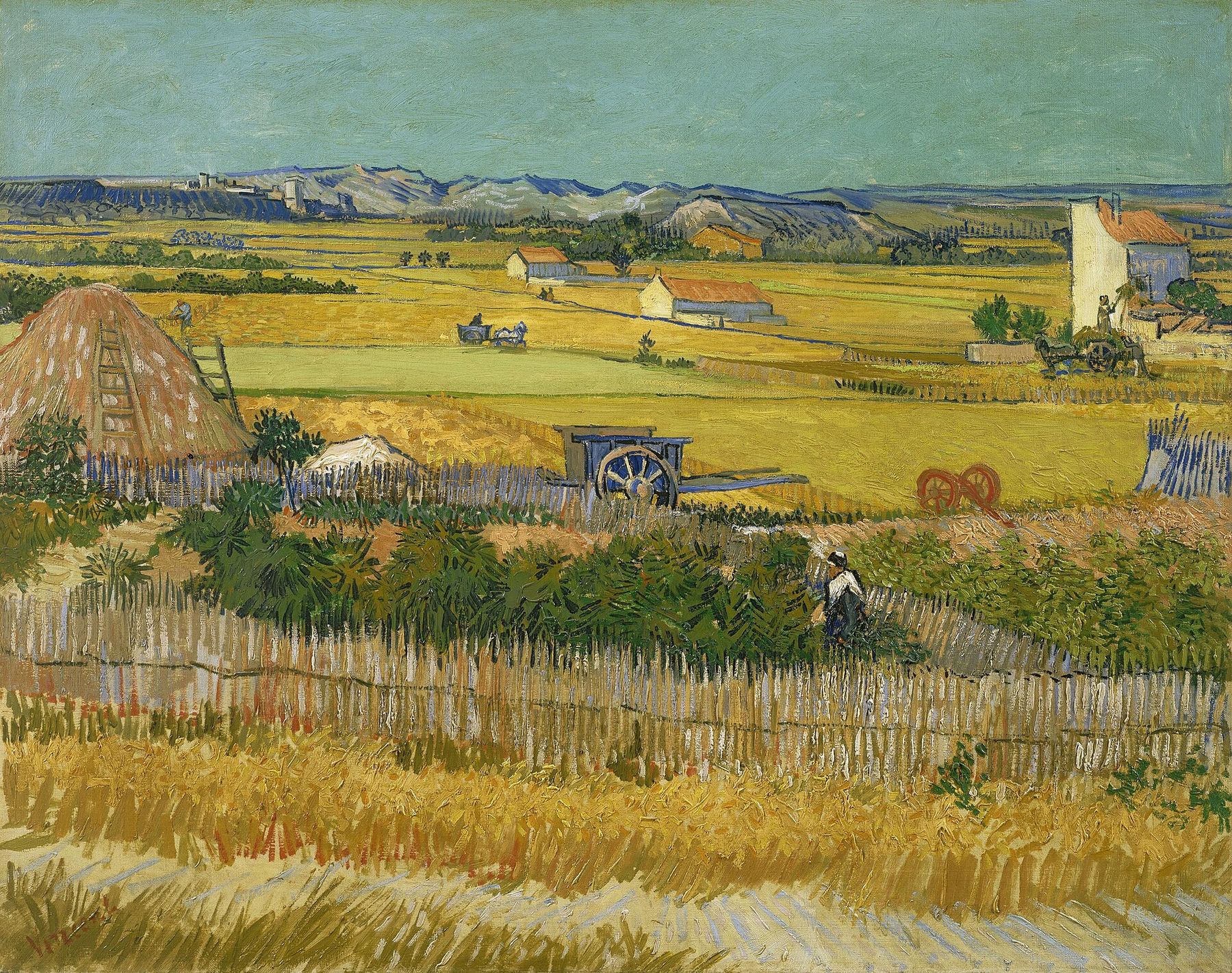
Van Gogh's harvest at La Crau: small farms working their own land.
Vincent van Gogh, Dutch: De oogst The harvest, 1888EcoAxes / Included ideologies / Indigenous, decolonial and justice-based approaches
Social movement and policy frameworkFood Sovereignty
The right of peoples to healthy, culturally appropriate food produced by ecologically sound and sustainable methods, and their right to decide their own food and farming systems. The peasant movement La Vía Campesina has advanced it since 1996, tied to agroecology, land reform and the defence of seeds, commons and small producers against corporate agriculture.
- Key figures
- La Vía Campesina, the Nyéléni Declaration (2007), Raj Patel, Annette Desmarais, Miguel Altieri and Peter Rosset (agroecology)
Where it stands
- Environmental EthicsAnthropocentrismEcocentrism
- Human–Nature RelationsHuman SeparationHuman Integration
- Economic PhilosophyGreen GrowthPost-Growth
- Resource OwnershipPrivate StewardshipCommons Governance
- Environmental AuthorityCentralized AuthorityLocal Autonomy
- Environmental JusticeAggregate OutcomesDistributive Justice
- Technological OutlookTechnological OptimismEcological Precaution
- Energy PhilosophyEnergy AbundanceEnergy Sufficiency
- Agricultural EcologyLand SparingLand Sharing
- Global ResponsibilityNational SovereigntyInternational Ecological Obligation
- Ecological Political PriorityIncremental ReformTransformative Change
Food sovereignty is explicit on agriculture, land, local control, justice and the rejection of corporate and biotechnological agriculture; its international position balances solidarity with a demand for national and local control over food systems.
Definition
The Nyéléni Declaration of 2007 defines food sovereignty as “the right of peoples to healthy and culturally appropriate food produced through ecologically sound and sustainable methods, and their right to define their own food and agriculture systems.”
It differs from food security, which asks only whether people have enough to eat and can be satisfied by corporate, industrial and imported supply. Food sovereignty asks who produces food, how, on whose land and under whose control. Its answer is small producers, using agroecology, on land they hold securely, under democratic local and national control, with seeds, water and knowledge treated as commons.
Historical development
La Vía Campesina is an international movement of peasants, small farmers, landless people, rural women and Indigenous communities, founded in 1993. It introduced the idea at the World Food Summit in Rome in 1996, against the push to liberalise trade. The Nyéléni Forum in Mali in 2007 brought hundreds of organisations together and produced the declaration that defines the movement.
Ecuador, Bolivia, Venezuela, Nepal, Mali and Senegal have since written food sovereignty into their constitutions or laws. It shaped the UN Declaration on the Rights of Peasants (2018), and it has become the political framework for the science of agroecology developed by Miguel Altieri, Peter Rosset and others.
Principal claims
- Food is a right and part of a culture. It is more than a commodity.
- Small agroecological producers feed most of the world, and they do it more sustainably than industrial agriculture.
- Land, seeds, water and knowledge should be held in common or by those who work them. Land reform is central.
- Corporate control of farm inputs, trade and retail has to be resisted, along with the biotechnology and chemical intensification that serve it.
- Peoples and nations have the right to protect their food systems from dumping and from trade rules that undermine them.
- Women produce much of the world’s food. They must have rights to land and a central place in the movement.
Policy implications
Food sovereignty calls for land reform and secure tenure, support for agroecology and local markets, and public buying from small producers. It wants control of seeds kept with farmers, and opposes patents on living things and genetically modified crops. It wants protection from dumping, limits on corporate concentration, public investment in rural infrastructure, and peasants’ rights recognised in international law.
Internal disagreements
Supporters disagree about how far to work with the state and how far to keep the movement independent. They embrace local and fair markets and resist global ones, but where to draw that line is argued over. They weigh national sovereignty against local community control, and differ on how strictly to reject biotechnology and what role urban and consumer movements should play.
Criticisms and controversies
Critics argue that small-scale agroecology cannot feed eight billion people, that framing food in national and local terms can shelter protectionism, that peasant farming is often harder than its portrait suggests, and that rejecting biotechnology gives up real gains. Agricultural economists dispute its claims about productivity.
Supporters cite evidence on how much small farms produce, on the environmental costs of industrial agriculture and on the resilience of diverse farming systems.
Relationships to other traditions
Food sovereignty is the farming programme of the decolonial family and the environmentalism of the poor, close to Buen Vivir, Indigenous environmental sovereignty and ecofeminism. Across the political divide it meets agrarian conservatism on small farms and local economies, and degrowth on scale. It is the opposite of ecomodernism’s intensive farming and land sparing.
References and further reading
- Nyéléni Forum for Food Sovereignty (2007). Declaration of Nyéléni.
- Patel, R. (2009). “Food sovereignty.” Journal of Peasant Studies 36(3), 663–706.
- Wittman, H., Desmarais, A. A. and Wiebe, N., eds. (2010). Food Sovereignty: Reconnecting Food, Nature and Community. Fernwood.
- Rosset, P. and Altieri, M. (2017). Agroecology: Science and Politics. Fernwood.
- United Nations (2018). Declaration on the Rights of Peasants and Other People Working in Rural Areas. A/RES/73/165.