
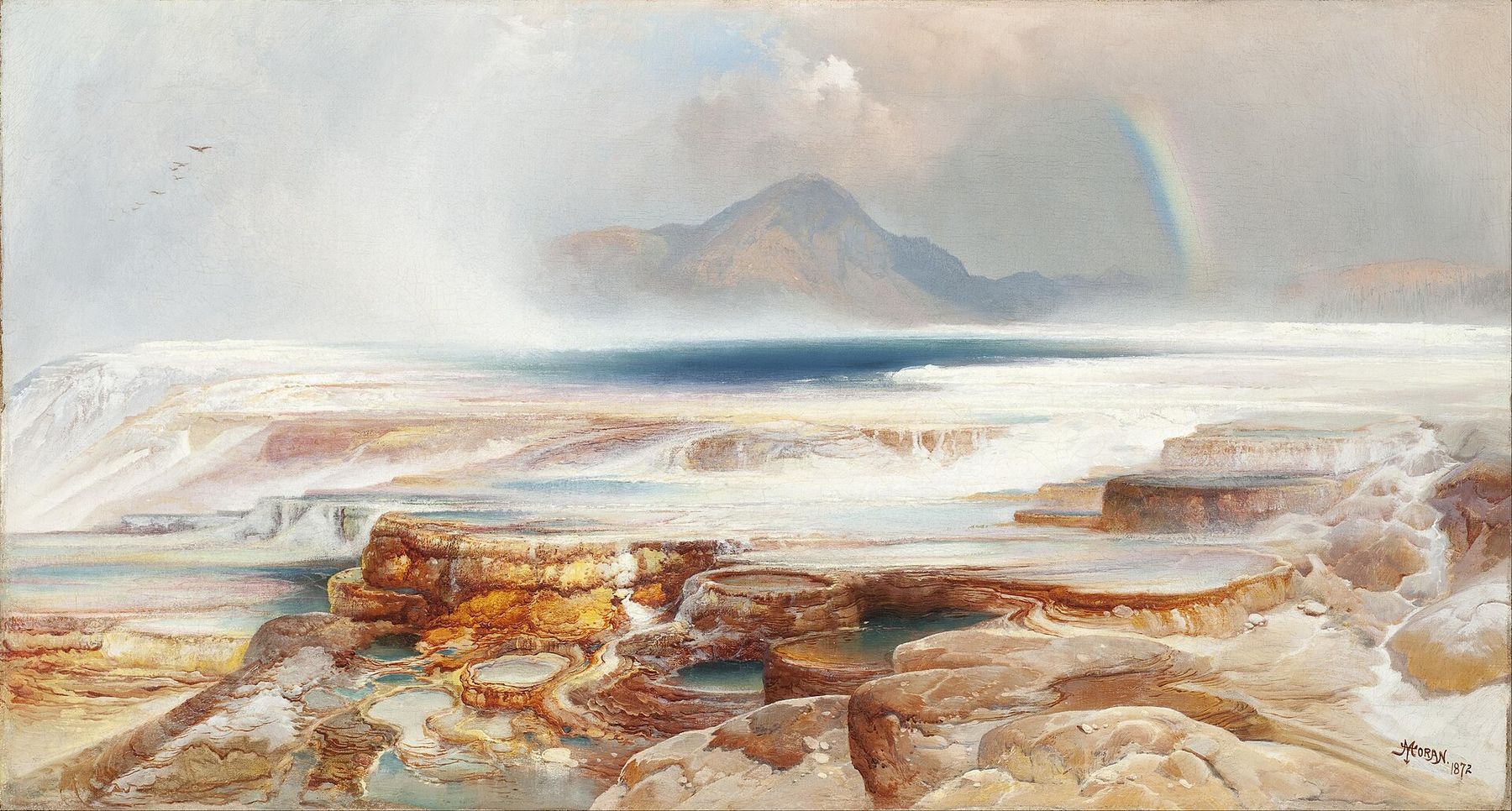
Moran's Yellowstone, the first national park, later closed to the Shoshone, Bannock and Crow who used it.
Thomas Moran, Hot Springs of the Yellowstone, 1872EcoAxes / Included ideologies / Conservation philosophies and practice
Conservation model (largely a critics' label)Fortress Conservation
The model of conservation that protects nature by keeping people out. Strictly protected areas are enforced by rangers and law, and the people who live in or next to them are removed or barred, on the belief that human use and wildlife cannot coexist. The name comes mostly from critics. Its defenders speak of strict protection or "nature needs half".
- Key figures
- John Muir (as antecedent), Dan Brockington (who named it), Bernhard Grzimek, Michael Soulé, E. O. Wilson (Half-Earth)
Where it stands
- Environmental EthicsAnthropocentrismEcocentrism
- Human–Nature RelationsHuman SeparationHuman Integration
- Ecological InterventionNoninterventionActive Stewardship
- Economic PhilosophyGreen GrowthPost-Growth
- Resource OwnershipPrivate StewardshipCommons Governance
- Environmental AuthorityCentralized AuthorityLocal Autonomy
- Environmental JusticeAggregate OutcomesDistributive Justice
- Conservation StrategySustainable UseStrict Protection
- Human–Wildlife RelationsHuman PriorityWildlife Accommodation
- Agricultural EcologyLand SparingLand Sharing
- Global ResponsibilityNational SovereigntyInternational Ecological Obligation
- Ecological Political PriorityIncremental ReformTransformative Change
Fortress conservation is defined by strict protection, human exclusion and centralised enforcement; its positions on growth and international obligation are those of the state and NGO conservation establishment and carry wide bands.
Definition
Fortress conservation protects biodiversity through strictly protected areas: national parks, reserves and sanctuaries. People may not live in them, harvest from them or use them for most purposes, and their boundaries are enforced by law, fences and armed rangers. The premise is that wildlife and ecosystems survive only where people are kept out. The archetype is the Yellowstone model, exported across the colonial and postcolonial world.
Critics gave it the name, Dan Brockington most prominently, in Fortress Conservation (2002). It is used here as the name of a real and still dominant practice, and using it does not endorse the critique. Its present-day advocates, who avoid the word, argue for strictly protecting 30 or even 50 per cent of the earth.
Historical development
The model begins with Yellowstone (1872) and Yosemite, both created by removing or confining Indigenous peoples, and with the colonial game reserves of Africa and Asia. There, hunting was reserved for Europeans and local use was turned into the crime of poaching.
After independence, African states and international NGOs expanded the park systems. They included the WWF, founded in 1961, and the Frankfurt Zoological Society under Bernhard Grzimek, whose Serengeti Shall Not Die (1959) is the model’s manifesto. From the 1980s, conservation biology gave it a scientific base, with Michael Soulé insisting on large, connected, strictly protected reserves. E. O. Wilson’s Half-Earth (2016) and the “Nature Needs Half” movement proposed extending it to half the planet. The target of protecting 30 per cent by 2030, adopted at the Kunming–Montreal conference in 2022, is its diplomatic form.
A large critical literature documents the removal of millions of people and the violence of enforcement. It includes Brockington’s work, Mark Dowie’s Conservation Refugees (2009) and Rosaleen Duffy’s research on militarised conservation.
Principal claims
- Biodiversity needs large areas free of human use. At scale, ecological integrity and human settlement cannot coexist.
- Protected areas have demonstrably saved species and habitats that would otherwise have been lost.
- Enforcement is necessary because poaching, encroachment and extraction are real pressures, and often organised.
- Nature has value apart from human use, which justifies setting land aside.
- Half the earth, or at least 30 per cent, must be strictly protected to stop the extinction crisis.
Policy implications
The model calls for more strictly protected areas, strong enforcement against poaching including armed rangers, and limits on or removal of settlement and harvesting inside reserves. It uses buffer zones, management by the state or by NGOs, international funding for protected areas and bans on the wildlife trade.
Internal disagreements
Defenders of strict protection disagree about how much to compensate or involve the communities that have been moved. They differ on whether tourism and trophy hunting should pay for reserves, on whether militarised enforcement is acceptable, and on whether 30 or 50 per cent is the right target.
Criticisms and controversies
The case against it is long. Fortress conservation moved and impoverished Indigenous and local peoples, creating “conservation refugees”, and turned subsistence into a crime. It entrenched colonial patterns of landholding and relied on violence, including documented killings and abuse. It often failed on its own terms, too, where the excluded communities had no stake in a reserve’s survival.
The evidence is contested. Strictly protected areas have saved a great deal, and lands governed by Indigenous peoples have saved as much or more. Defenders argue that the alternative to protection is loss, and that reforms such as rights and benefit sharing can be made without giving up strict protection.
Relationships to other traditions
Fortress conservation is the institutional form of wilderness preservation and preservationism. It is allied with wildlife protection and with planetary stewardship’s 30-by-30 target. It is the declared opponent of community conservation, convivial conservation, rights-based conservation, CBNRM, Indigenous environmental sovereignty and Land Back, and the main target of political ecology.
References and further reading
- Brockington, D. (2002). Fortress Conservation: The Preservation of the Mkomazi Game Reserve, Tanzania. James Currey.
- Dowie, M. (2009). Conservation Refugees: The Hundred-Year Conflict between Global Conservation and Native Peoples. MIT Press.
- Wilson, E. O. (2016). Half-Earth: Our Planet’s Fight for Life. Liveright.
- Duffy, R. (2014). “Waging a war to save biodiversity: The rise of militarized conservation.” International Affairs 90(4), 819–834.
- Grzimek, B. and Grzimek, M. (1959). Serengeti Shall Not Die. Ullstein.
- Spence, M. D. (1999). Dispossessing the Wilderness: Indian Removal and the Making of the National Parks. Oxford University Press.