
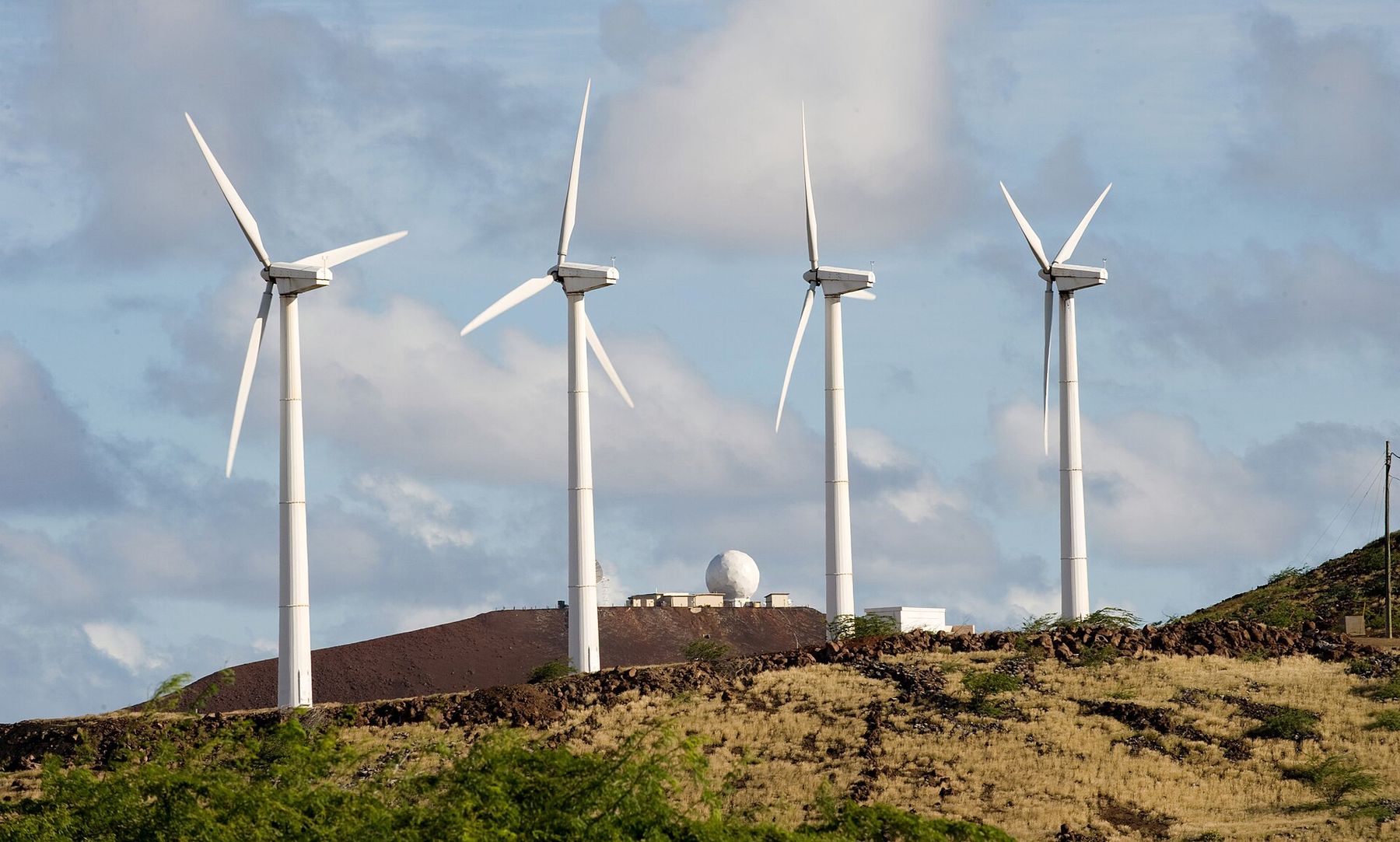
Wind turbines above Ascension Island: clean power as a public service.
US Air Force photo by Lance Chung, Ascension island turbines, 2009EcoAxes / Included ideologies / Left and socialist ecologies
Political programmeGreen Social Democracy
The social democratic and democratic socialist programme best known through Green New Deal proposals. It would use the state to drive a fast, publicly led move to clean energy and infrastructure, expand public ownership and services, and tie climate policy to jobs, equality and justice, inside a democracy and without necessarily giving up growth.
- Key figures
- Naomi Klein, Kate Aronoff, Alyssa Battistoni, Daniel Aldana Cohen, Thea Riofrancos
Where it stands
- Environmental EthicsAnthropocentrismEcocentrism
- Economic PhilosophyGreen GrowthPost-Growth
- Resource OwnershipPrivate StewardshipCommons Governance
- Environmental AuthorityCentralized AuthorityLocal Autonomy
- Environmental JusticeAggregate OutcomesDistributive Justice
- Technological OutlookTechnological OptimismEcological Precaution
- Energy PhilosophyEnergy AbundanceEnergy Sufficiency
- Conservation StrategySustainable UseStrict Protection
- Agricultural EcologyLand SparingLand Sharing
- Global ResponsibilityNational SovereigntyInternational Ecological Obligation
- Ecological Political PriorityIncremental ReformTransformative Change
A state-led programme: its positions on public investment, ownership, justice and clean-energy abundance are explicit; it is deliberately ambiguous on growth, scoring above the centre on post-growth because it rejects growth as the goal while expecting a green boom.
Definition
Ecological democratic socialism uses the power of a democratic state to carry out a fast ecological transition. Its programme has several parts. The state invests heavily in renewable energy, grids, transport, housing and ecological restoration. Energy and other strategic sectors come under public ownership or control. A job guarantee and a “just transition” protect workers in fossil fuel industries. Public services expand and wealth is redistributed. All of this is tied to climate targets and to environmental justice for the communities on the front line.
The Green New Deal is the best-known form, both the version proposed in the United States (H. Res. 109, 2019) and its European variants.
Historical development
The phrase “Green New Deal” appeared in 2007–08, used by groups in Britain and by Thomas Friedman in the United States, and the UN Environment Programme took it up in 2009, all in a broadly Keynesian sense. After 2018 the Sunrise Movement, Representative Alexandria Ocasio-Cortez and Senator Ed Markey made it more radical. Their 2019 resolution paired cutting emissions with a job guarantee, public healthcare and provisions for justice.
Naomi Klein argued in This Changes Everything (2014) and On Fire (2019) that acting on climate means confronting neoliberalism. Kate Aronoff, Alyssa Battistoni, Daniel Aldana Cohen and Thea Riofrancos sketched the socialist version in A Planet to Win (2019). Ann Pettifor and Robert Pollin designed the macroeconomics. Parties and governments in Europe and Latin America have adopted versions, usually toned down.
Principal claims
- The climate crisis needs mobilisation on the scale of a wartime economy, and only the state can organise and pay for that.
- Public investment and public ownership must lead the transition. Carbon prices alone cannot.
- Climate policy has to bring people material benefits, such as jobs, housing and healthcare, if it is to win and keep democratic support.
- Justice for front-line, Indigenous and working-class communities is part of the programme from the start.
- Plentiful clean energy and infrastructure, publicly provided, can raise living standards while cutting emissions.
- Wealthy countries owe climate finance and technology to the rest of the world.
Policy implications
The programme includes public green investment banks, publicly owned renewable energy and grids, a federal job guarantee, retrofitted buildings and public transport. It funds a just transition, sets strong standards of environmental justice, pursues a green industrial policy and pays international climate finance.
Internal disagreements
Supporters disagree about growth. Most Green New Deal designs assume a green boom, and degrowth socialists dissent. They differ on nuclear power and carbon capture, and on how much to rely on markets inside public frameworks. They also ask whether a state strong enough to carry out the mobilisation would stay democratic.
Criticisms and controversies
The right objects to the cost, to state overreach and to tying social policy to climate. Ecomodernists object to its hostility to nuclear power and carbon pricing. Degrowth thinkers and ecosocialists argue that a green boom in the North repeats the growth model and the extraction it depends on, now for lithium and copper. Climate justice critics in the global South warn that green industrial policy in rich countries can turn into green protectionism.
Supporters answer that it is the only climate politics that has built a mass following.
Relationships to other traditions
Ecological democratic socialism sits between green liberalism and ecosocialism. It goes beyond green liberalism in public ownership and ambition, and stops short of ecosocialism’s post-growth programme and its abolition of capital. It shares climate justice’s commitment to fair distribution, and ecomodernism’s enthusiasm for plentiful clean energy, although most versions reject ecomodernism’s stress on markets and nuclear power.
References and further reading
- Klein, N. (2014). This Changes Everything: Capitalism vs. the Climate. Simon & Schuster.
- Aronoff, K., Battistoni, A., Cohen, D. A. and Riofrancos, T. (2019). A Planet to Win: Why We Need a Green New Deal. Verso.
- Pettifor, A. (2019). The Case for the Green New Deal. Verso.
- H. Res. 109, 116th Congress (2019). “Recognizing the duty of the Federal Government to create a Green New Deal.”
- Pollin, R. (2015). Greening the Global Economy. MIT Press.