
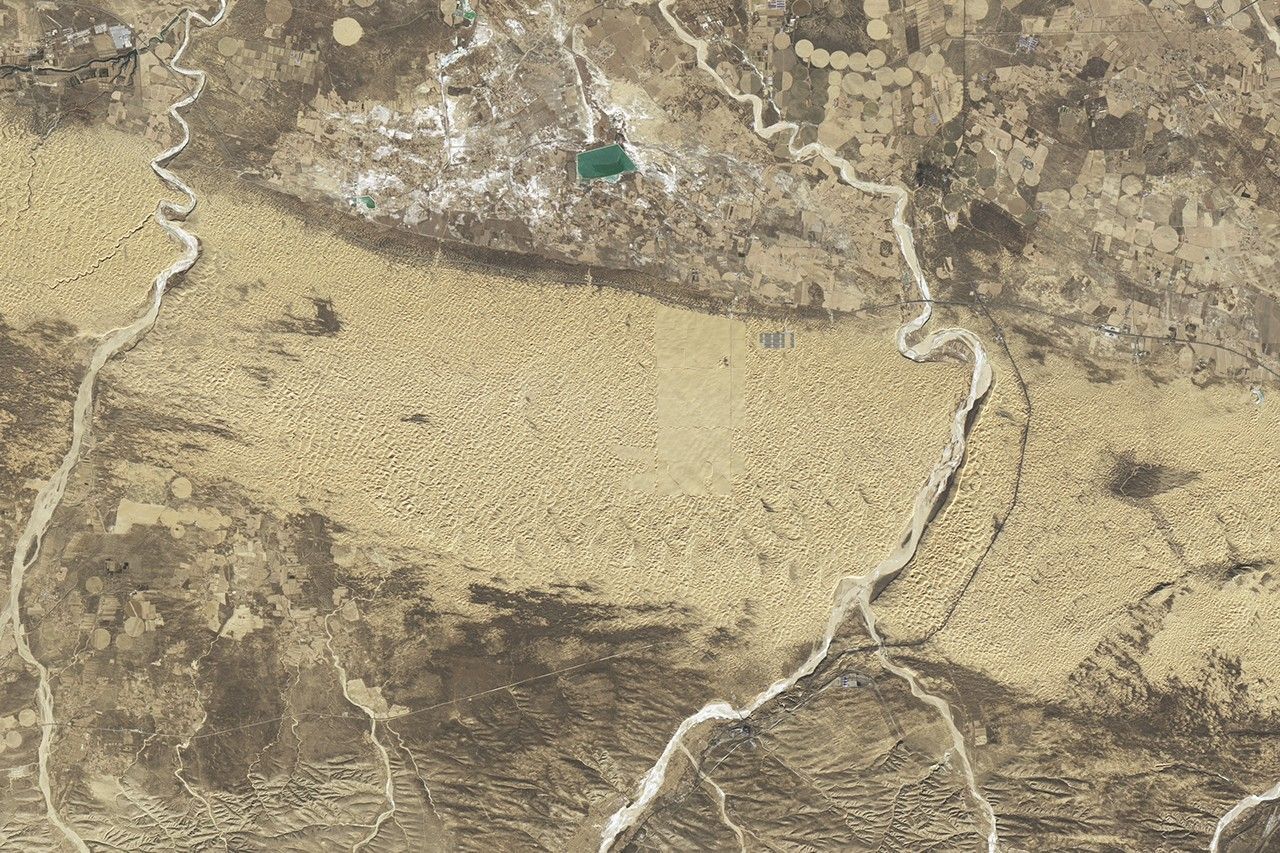
A solar farm laid across the Kubuqi Desert, Inner Mongolia: China's state-led clean-energy build-out, seen from orbit.
NASA Earth Observatory images by Michala Garrison, using Landsat data , Building a Great Solar Wall in China (153759 - 20171220 lrg), 2017EcoAxes / Included ideologies / Technological and modernist environmentalism
State doctrine and development modelEcological Civilisation
The doctrine of shengtai wenming, written into China's constitution in 2018 and central to Xi Jinping's thought. A strong state that plans ahead should lead society into a new stage of civilisation in which economic growth and ecological protection go together. Its tools are huge investment in clean technology, tree planting and restoration, binding ecological "red lines", and the principle that "lucid waters and lush mountains are invaluable assets".
- Key figures
- Xi Jinping, Pan Yue, Ye Qianji, the Communist Party of China (Seventeenth to Twentieth Congresses), Arthur Hanson and Jiang Kejun (as analysts)
Where it stands
- Environmental EthicsAnthropocentrismEcocentrism
- Human–Nature RelationsHuman SeparationHuman Integration
- Ecological InterventionNoninterventionActive Stewardship
- Economic PhilosophyGreen GrowthPost-Growth
- Resource OwnershipPrivate StewardshipCommons Governance
- Environmental AuthorityCentralized AuthorityLocal Autonomy
- Environmental JusticeAggregate OutcomesDistributive Justice
- Technological OutlookTechnological OptimismEcological Precaution
- Energy PhilosophyEnergy AbundanceEnergy Sufficiency
- Conservation StrategySustainable UseStrict Protection
- Human–Wildlife RelationsHuman PriorityWildlife Accommodation
- Agricultural EcologyLand SparingLand Sharing
- Global ResponsibilityNational SovereigntyInternational Ecological Obligation
- Ecological Political PriorityIncremental ReformTransformative Change
Its firmest commitments are to central state direction, active large-scale management and restoration of ecosystems, and technological development of clean energy and industry. It treats growth and protection as compatible, places land and resources under public ownership, and supports strict protection through ecological red lines. Its positions on justice and international obligation carry wide bands.
Definition
Ecological civilisation (shengtai wenming) is the environmental doctrine of the People’s Republic of China. It treats protecting the environment as the next stage of development, not a brake on it. After agricultural and industrial civilisation comes a civilisation in which prosperity, social stability and a healthy environment are achieved together.
The state carries it out. Through five-year plans, binding targets, reorganised ministries and the assessment of officials by their environmental results, it steers investment into renewable energy, electric vehicles, tree planting, pollution control and ecosystem restoration. It also draws ecological “red lines” around land that may not be developed. Xi Jinping first used the slogan “lucid waters and lush mountains are invaluable assets” (lüshui qingshan jiushi jinshan yinshan) in Zhejiang in 2005. It sums up the doctrine’s premise that a protected environment is itself a form of wealth.
Historical development
Chinese ecologists such as Ye Qianji used the term in the 1980s. In the mid-2000s Pan Yue, then deputy director of the State Environmental Protection Administration, promoted it as a criticism of growth at any cost. The Communist Party adopted it at its Seventeenth Congress in 2007, and the Eighteenth Congress in 2012 made it one of the five pillars of national development. In 2018 it was written into the constitution, and a Ministry of Ecology and Environment was created at the same time.
Since then the doctrine has driven China’s “war on pollution”, its system of national parks, the world’s largest tree-planting programmes, from the Three-North Shelterbelt to the Saihanba forest, and the fast growth of its solar, wind, battery and electric-vehicle industries. China has also promoted the idea abroad. It hosted the UN biodiversity conference COP15 in 2021–22 under the theme “Ecological Civilisation: Building a Shared Future for All Life on Earth”.
Principal claims
- Economic development and environmental protection can and must go together. A protected environment is a source of wealth.
- A strong state that can plan over decades and enforce its decisions is the best driver of ecological change.
- Engineering ecosystems on a large scale, through tree planting, restoration and water management, can repair the damage done by industrialisation.
- Leading the world in clean energy and industry is an environmental goal and a national one.
- Some areas must be closed to development by binding ecological red lines.
- Ecological civilisation draws on Marxism and on Chinese traditions of harmony between people and nature.
Policy implications
The doctrine underlies binding targets for energy intensity, emissions and forest cover, and the assessment of local officials on environmental performance. It supports ecological compensation payments between regions, a national carbon market, and red lines that cover around a quarter of China’s land. It drives national parks, vast programmes of tree planting and desert control, and state support for clean technology industries. China’s pledge to reach carbon neutrality by 2060 is presented as part of building an ecological civilisation.
Internal disagreements
Inside China, the debate is about which should win when growth and protection conflict, about how fast to move away from coal, and about whether to enforce environmental goals through campaigns and orders from above or through law and public participation. Scholars disagree about whether the doctrine owes more to Marxism, to Confucian and Daoist tradition, or to Western ecological modernisation.
Criticisms and controversies
Critics such as Yifei Li and Judith Shapiro call the model “authoritarian environmentalism”. It mobilises quickly, they argue, but tends toward coercive campaigns, sudden factory closures and the relocation of rural and nomadic people, and its environmental gains serve state power more than they serve ecosystems. Ecologists question how many trees planted in dry regions survive and how much water they use. Observers note that China is still the world’s largest emitter of greenhouse gases and a major consumer of resources from other countries.
Supporters point to the sharp fall in urban air pollution, the scale of China’s clean energy build-out and its restoration programmes as results that few democracies have matched.
Relationships to other traditions
Ecological civilisation shares eco-authoritarianism’s confidence in a strong central state. It differs from the 1970s version in treating growth and technology as allies. Its faith in clean technology and decoupling links it to ecomodernism and green growth, and its management on a large scale links it to planetary stewardship and restoration-centred conservation. Traditions that put local autonomy, Indigenous rights or democratic participation first oppose it.
References and further reading
- Pan, Y. (2006). Environmental culture and national renaissance. China Dialogue.
- Hansen, M. H., Li, H. and Svarverud, R. (2018). Ecological civilization: interpreting the Chinese past, projecting the global future. Global Environmental Change, 53, 195–203.
- Li, Y. and Shapiro, J. (2020). China Goes Green: Coercive Environmentalism for a Troubled Planet. Cambridge: Polity.
- Geall, S. and Ely, A. (2018). Narratives and pathways towards an ecological civilization in contemporary China. The China Quarterly, 236, 1175–1196.
- Hanson, A. (2019). Ecological Civilization in the People’s Republic of China. Manila: Asian Development Bank.
- Goron, C. (2018). Ecological civilisation and the political limits of a Chinese concept of sustainability. China Perspectives, 2018/4, 39–52.