
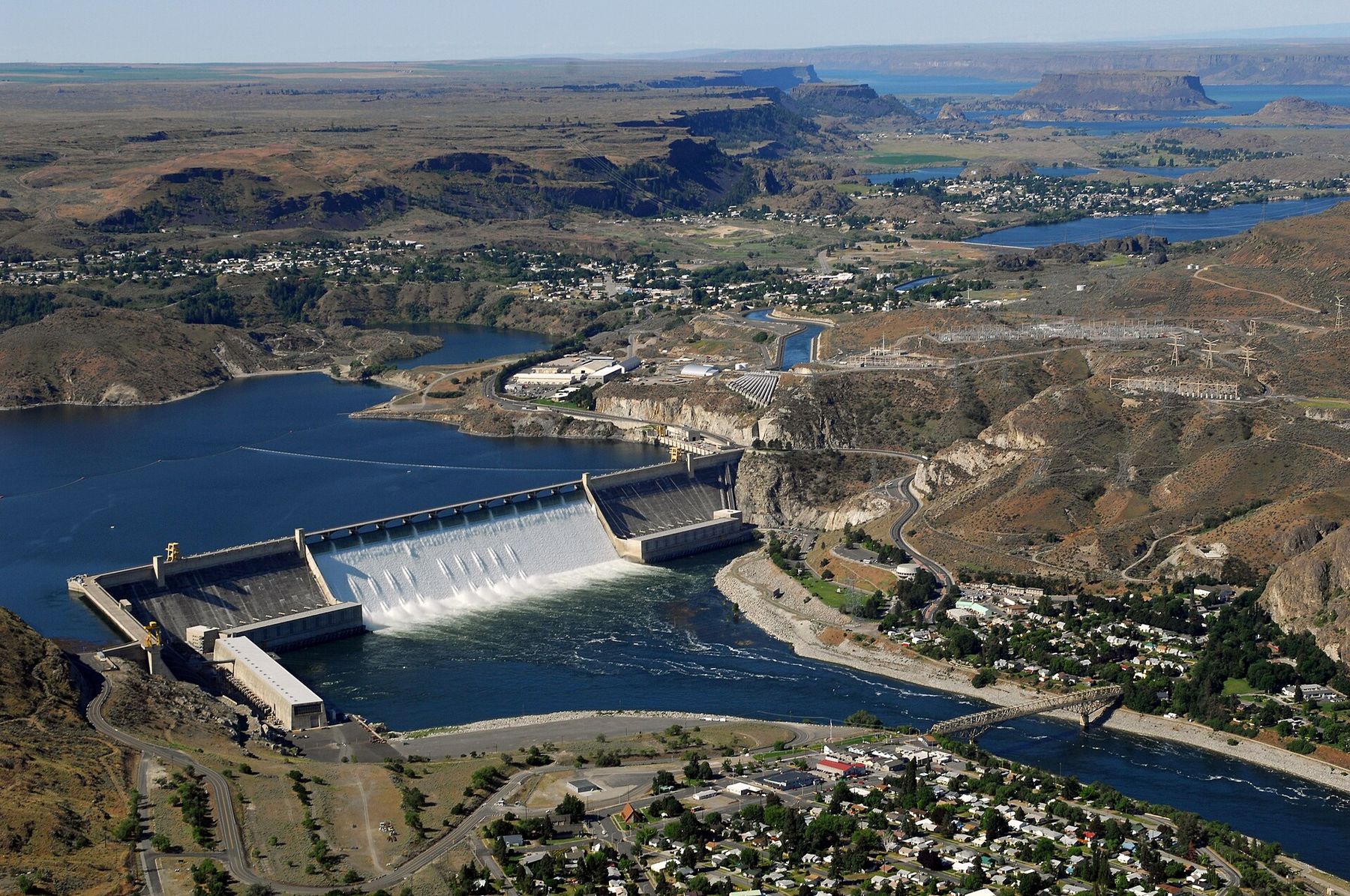
Grand Coulee Dam on the Columbia: abundant clean power concentrated in one place.
United States Bureau of Reclamation, Grand Coulee Dam aerial, 2016EcoAxes / Included ideologies / Technological and modernist environmentalism
Political and environmental philosophyEcomodernism
The position set out in An Ecomodernist Manifesto (2015). Humanity can protect nature by decoupling from it: by concentrating farming, energy and settlement on a small footprint through technology, nuclear power and genetically engineered crops included, so that the rest of the planet can be left wild. A "good Anthropocene" of prosperity for all and restored ecosystems is possible through modernisation, without restraint. It is the most developed form of technological environmentalism.
- Key figures
- Ted Nordhaus, Michael Shellenberger, Stewart Brand, Mark Lynas, Linus Blomqvist
Where it stands
- Environmental EthicsAnthropocentrismEcocentrism
- Human–Nature RelationsHuman SeparationHuman Integration
- Ecological InterventionNoninterventionActive Stewardship
- Economic PhilosophyGreen GrowthPost-Growth
- Resource OwnershipPrivate StewardshipCommons Governance
- Environmental AuthorityCentralized AuthorityLocal Autonomy
- Environmental JusticeAggregate OutcomesDistributive Justice
- Technological OutlookTechnological OptimismEcological Precaution
- Energy PhilosophyEnergy AbundanceEnergy Sufficiency
- Conservation StrategySustainable UseStrict Protection
- Human–Wildlife RelationsHuman PriorityWildlife Accommodation
- Agricultural EcologyLand SparingLand Sharing
- Global ResponsibilityNational SovereigntyInternational Ecological Obligation
- Ecological Political PriorityIncremental ReformTransformative Change
The manifesto takes explicit stands on decoupling, intensification, nuclear energy, growth, land sparing and institutions. Its wildlife and international positions are less developed and carry wide bands.
Definition
Ecomodernism holds that the way to protect nature is to use less of it. Human activity should be concentrated through high-yield farming, dense cities, nuclear power and other dense energy sources, and efficient industry. Human demands on land and sea would then shrink even as prosperity grew, leaving more room for wild nature.
Its key idea is “decoupling”, both relative and absolute, of human wellbeing from environmental impact. Its main method is “intensification”, and its goal is a “good Anthropocene”. It rejects the idea that ecological limits mean limits on human flourishing. It embraces technologies much of the environmental movement has opposed, and it defends modernisation, including continued growth and more energy for poor countries, as the path to both human and ecological good.
Historical development
Ecomodernism has several sources. Ted Nordhaus and Michael Shellenberger founded the Breakthrough Institute and attacked the environmental movement’s politics of limits in their essay “The Death of Environmentalism” (2004) and their book Break Through (2007). Stewart Brand’s Whole Earth Discipline (2009) urged greens to embrace cities, nuclear power and genetic engineering. Ben Phalan and colleagues did research on land sparing. Erle Ellis and Emma Marris developed an ecology for the Anthropocene, Marris in Rambunctious Garden (2011).
Eighteen authors signed An Ecomodernist Manifesto in April 2015, which brought the position together. It has shaped arguments about energy policy, especially nuclear power. Degrowth thinkers, political ecologists and deep ecologists have all attacked it.
Principal claims
- Human wellbeing and environmental impact can be decoupled, and are being decoupled already. Intensification spares land and sea.
- Modern technologies protect nature. They include nuclear fission, advanced renewables, genetically engineered crops, synthetic fertiliser, desalination and fish farming.
- Economic growth and urbanisation, especially in poor countries, are good for the environment as well as morally necessary.
- Wild nature should be protected for its own sake and for ours, in large areas spared by intensification elsewhere.
- Environmentalism built on limits is wrong, and it defeats itself politically. A politics of abundance is needed.
- The state and public investment have central roles in developing and spreading these technologies.
Policy implications
Ecomodernists support nuclear power and innovation in energy, intensive high-yield farming with modern inputs and biotechnology, urbanisation and dense settlement, and fish farming. They want energy access expanded in poor countries, large wild areas protected, public research and industrial policy for clean technology, and research into geoengineering.
Internal disagreements
Ecomodernists disagree about renewables and nuclear power. The Breakthrough circle has doubted renewables more than many other ecomodernists. They differ on how much weight wild nature’s own value deserves, and on how to handle fairness and the communities displaced by intensive farming or by protected areas. They also split over market liberalism, which some embrace and others reject in favour of innovation led by the state.
Criticisms and controversies
Degrowth thinkers and ecological economists argue that absolute decoupling on the scale required has never been observed, and that the manifesto’s optimism rests on efficiency gains that rebound and on impacts moved to other countries. Political ecologists argue that land sparing pushes smallholders off their land, and that the “good Anthropocene” is a technocratic fantasy of the North. Deep ecologists and conservation biologists argue that separating people from nature in this way is neither desirable nor possible. Critics of nuclear power dispute its economics and its safety.
Supporters point to the history of intensive farming sparing land, and to the low emissions of electricity grids that rely heavily on nuclear power.
Relationships to other traditions
Ecomodernism is the bolder descendant of ecological modernisation and green growth, and a relative of bright green environmentalism and natural capitalism. It shares eco-accelerationism’s politics of abundance and rejects its opposition to capitalism. It is the declared opposite of degrowth, agrarian conservatism, food sovereignty, anarcho-primitivism and the precautionary tradition. Its land sparing makes it an unexpected ally of wilderness preservation on the Conservation Strategy dimension, while the two are opposed on Human–Nature Relations.
References and further reading
- Asafu-Adjaye, J. et al. (2015). An Ecomodernist Manifesto. www.ecomodernism.org.
- Shellenberger, M. and Nordhaus, T. (2007). Break Through: From the Death of Environmentalism to the Politics of Possibility. Houghton Mifflin.
- Brand, S. (2009). Whole Earth Discipline: An Ecopragmatist Manifesto. Viking.
- Marris, E. (2011). Rambunctious Garden: Saving Nature in a Post-Wild World. Bloomsbury.
- Caradonna, J. et al. (2015). A Degrowth Response to An Ecomodernist Manifesto. Resilience.org. (The principal critique.)
- Hamilton, C. (2015). “The theodicy of the ‘good Anthropocene.’” Environmental Humanities 7(1), 233–238.