
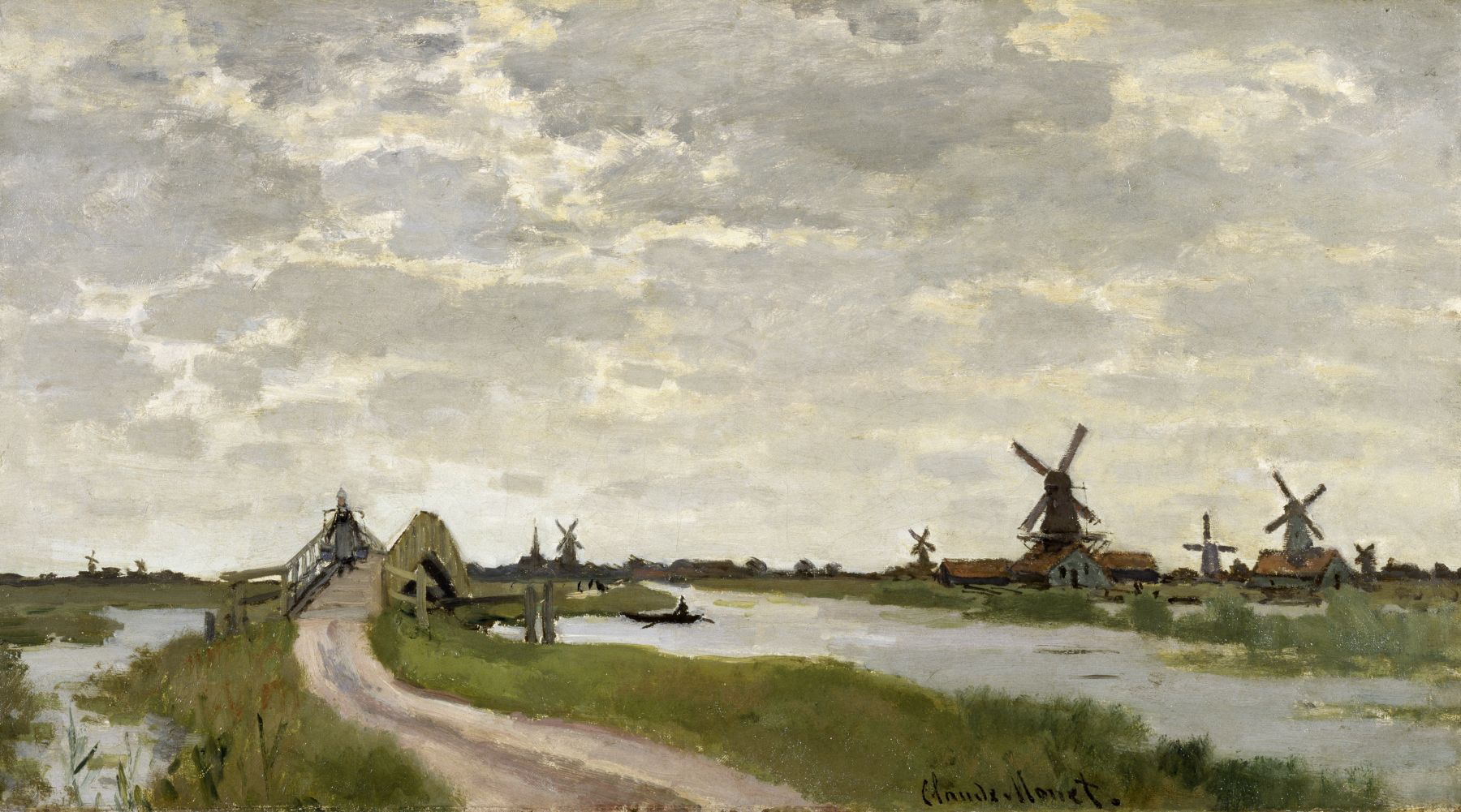
Monet's Zaandam windmills: prosperity powered by the wind.
Claude Monet, Windmills Near Zaandam, 1871EcoAxes / Included ideologies / Liberal, reformist and market environmentalism
Economic policy paradigmGreen Growth
The policy framework promoted by the OECD, the World Bank and UNEP from around 2009. The economy can keep growing while pressure on the environment falls, through investment in clean technology, putting prices on environmental costs, and innovation, so that protecting the environment drives growth instead of holding it back. Its theory is ecological modernisation, which holds that modern economies can be rebuilt so that growth and environmental improvement go together. In business it takes the form of corporate sustainability: ESG investing, net-zero and "nature positive" pledges, and the triple bottom line, on the view that companies will deliver sustainability because it pays.
- Key figures
- OECD, World Bank, UN Environment Programme, Michael Jacobs (as analyst), Nicholas Stern
Where it stands
- Environmental EthicsAnthropocentrismEcocentrism
- Economic PhilosophyGreen GrowthPost-Growth
- Resource OwnershipPrivate StewardshipCommons Governance
- Environmental AuthorityCentralized AuthorityLocal Autonomy
- Environmental JusticeAggregate OutcomesDistributive Justice
- Technological OutlookTechnological OptimismEcological Precaution
- Energy PhilosophyEnergy AbundanceEnergy Sufficiency
- Agricultural EcologyLand SparingLand Sharing
- Global ResponsibilityNational SovereigntyInternational Ecological Obligation
- Ecological Political PriorityIncremental ReformTransformative Change
Green growth is defined by its position on growth, technology and reform; its governance and justice positions are moderate and institutionally pragmatic.
Definition
Green growth holds that economic growth and environmental sustainability can go together and can even reinforce each other. With the right prices, rules, infrastructure and innovation, economies can keep growing while emissions, pollution and resource use fall. The transition itself, in clean energy, efficient buildings, new materials and restored ecosystems, becomes a source of growth, jobs and competitiveness.
It is less a philosophy than a programme, adopted by international institutions and many governments. It is degrowth’s main rival in arguments about the economics of sustainability.
Historical development
The phrase spread with South Korea’s national strategy of 2008 and with the response to the financial crisis of that year, when “green stimulus” was proposed as serving recovery and climate goals at once. The OECD’s Towards Green Growth (2011), UNEP’s Towards a Green Economy (2011) and the World Bank’s Inclusive Green Growth (2012) made it the orthodoxy of development and economic institutions. The Global Green Growth Institute was founded in 2012 to promote it. The Stern Review (2006) had already argued that acting on climate would cost far less than not acting. Since 2015 the Paris Agreement, the European Green Deal and much national industrial policy have been framed in terms of green growth.
Principal claims
- Growth can be absolutely decoupled from environmental harm, given the right policy and technology.
- Environmental damage is a market failure to be corrected with prices and regulation. It is no reason to stop growing.
- Investing in clean technology and infrastructure brings growth, jobs and innovation.
- Developing countries can and should grow in ways that are low in carbon and efficient in resources, with international finance and technology.
- Natural capital should be measured and accounted for alongside the capital people produce.
Policy implications
Green growth supports carbon pricing, the removal of fossil fuel subsidies, green public investment and industrial policy, and support for innovation. It includes accounting for natural capital, standards and labelling, development finance for green infrastructure, and trade in environmental goods. In farming it favours sustainable intensification.
Internal disagreements
Supporters disagree about how much to rely on prices as opposed to public investment, and about nuclear power, carbon capture and biofuels. They debate whether “inclusive” green growth pays enough attention to who gains and who loses, and how to respond to evidence that decoupling so far has been only relative, and partly an illusion.
Criticisms and controversies
Degrowth thinkers and ecological economists argue that the absolute decoupling required has never been seen at the scale and speed needed, that rebound effects eat up efficiency gains, and that the framework puts off the question of limits. Environmental justice critics see green growth as extraction continuing under a new name, now for the minerals the transition needs. Conservationists point out that it says almost nothing about biodiversity and land.
Supporters answer that emissions have fallen in a growing number of economies while GDP has risen, and that no other framing wins political majorities.
Relationships to other traditions
Green growth is the policy face of ecological modernisation and the economic programme of sustainable development. It shares its optimism with ecomodernism, which goes further on nuclear power and intensive farming, and with natural capitalism. It is the declared opposite of degrowth and steady-state economics.
References and further reading
- OECD (2011). Towards Green Growth. OECD Publishing.
- World Bank (2012). Inclusive Green Growth: The Pathway to Sustainable Development. World Bank.
- UNEP (2011). Towards a Green Economy: Pathways to Sustainable Development and Poverty Eradication. UNEP.
- Stern, N. (2007). The Economics of Climate Change: The Stern Review. Cambridge University Press.
- Jacobs, M. (2012). “Green growth: Economic theory and political discourse.” Grantham Research Institute Working Paper 92.