
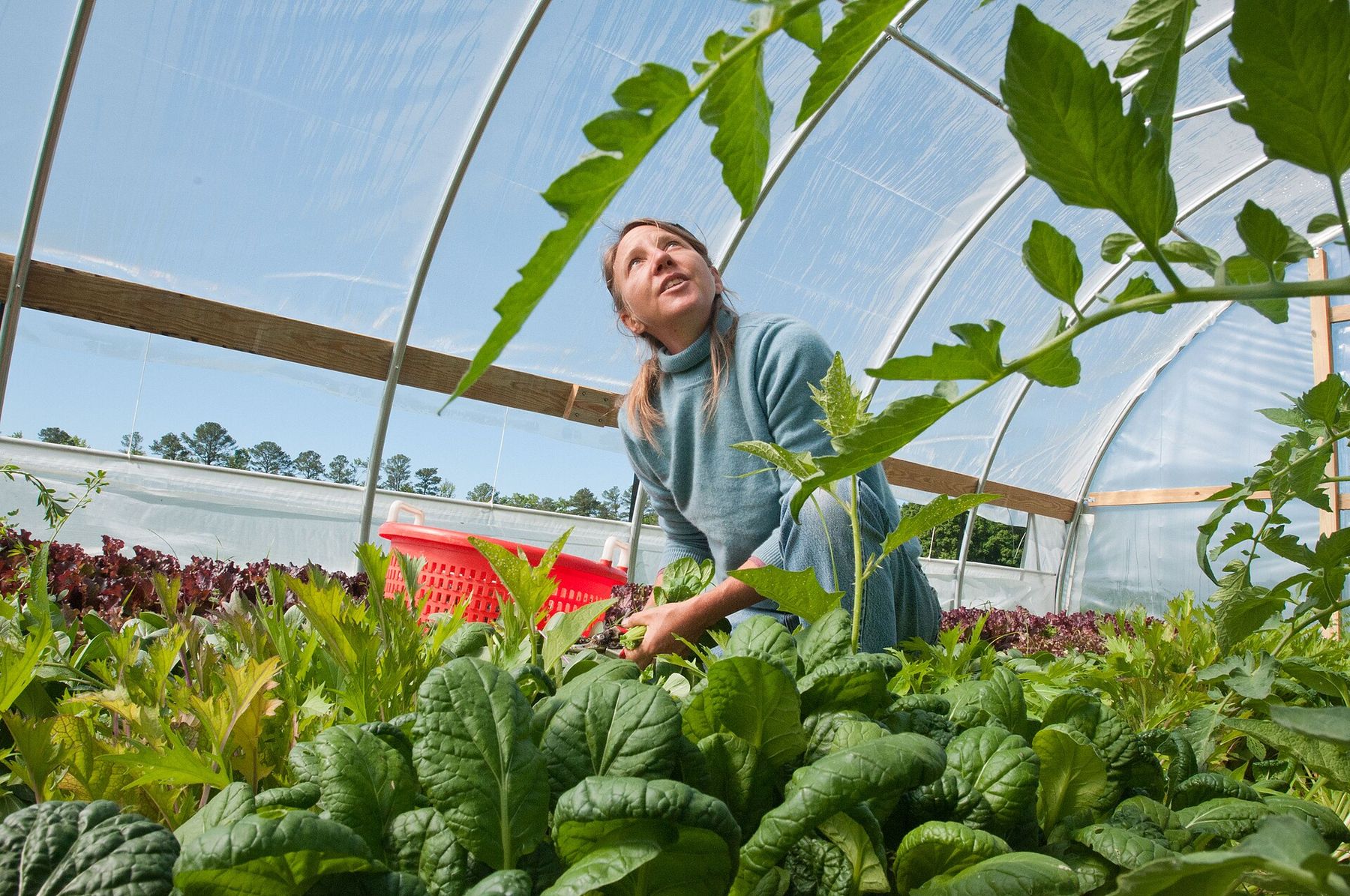
Fall Line Farms, a cooperative in Virginia: food grown for need, owned and run by those who work it.
U.S. Department of Agriculture Lance Cheung/Visual Information Photogr, Fall Line Farms; cooperative, co-op; Richmond, VA (51071037583), 2011EcoAxes / Included ideologies / Left and socialist ecologies
Political ideologyEcosocialism
A political tradition holding that capitalism's drive to accumulate is the root cause of ecological destruction, and that sustainability requires a democratic, planned, socially owned economy built around human needs and ecological limits. Its theoretical core is eco-Marxism, which reads the ecological crisis through Marx's idea of a "metabolic rift" between capitalist society and nature.
- Key figures
- Joel Kovel, Michael Löwy, John Bellamy Foster, James O'Connor, Ian Angus
Where it stands
- Environmental EthicsAnthropocentrismEcocentrism
- Human–Nature RelationsHuman SeparationHuman Integration
- Economic PhilosophyGreen GrowthPost-Growth
- Resource OwnershipPrivate StewardshipCommons Governance
- Environmental AuthorityCentralized AuthorityLocal Autonomy
- Environmental JusticeAggregate OutcomesDistributive Justice
- Technological OutlookTechnological OptimismEcological Precaution
- Energy PhilosophyEnergy AbundanceEnergy Sufficiency
- Conservation StrategySustainable UseStrict Protection
- Global ResponsibilityNational SovereigntyInternational Ecological Obligation
- Ecological Political PriorityIncremental ReformTransformative Change
Ecosocialism is a programme with explicit positions on ownership, growth, justice and systemic change. Its positions on governance (democratic planning at which scale?), technology and energy are contested within the tradition and carry wide bands.
Definition
Ecosocialism holds that ecological crisis and social injustice share a cause in capitalism. Capitalism has to keep expanding to survive, and it pushes its costs onto workers, the poor and the natural world. The remedy is a democratic socialism reorganised around ecological limits. That means social ownership of the means of production, democratic planning of investment, production for need instead of profit, and less wasteful and destructive output.
Ecosocialism differs from earlier socialisms in rejecting productivism, the assumption that socialism means ever more industrial output. It differs from mainstream environmentalism in holding that the system itself is the problem, and that regulating it is not enough.
Historical development
The word came into use in the 1970s and 1980s, especially in the green left of West Germany and France. It took sharper shape through James O’Connor’s journal Capitalism Nature Socialism, founded in 1988, and his theory of the “second contradiction of capitalism”, in which capital undermines the natural and social conditions it needs in order to produce. Joel Kovel and Michael Löwy’s Ecosocialist Manifesto (2001) and the Belém Ecosocialist Declaration (2009) tried to set out a shared platform.
John Bellamy Foster’s Marx’s Ecology (2000) and Kohei Saito’s Karl Marx’s Ecosocialism (2017) recovered an ecological Marx, centred on the “metabolic rift” that capitalist agriculture opens between society and nature. In the 2010s ecosocialist ideas reached mainstream politics through the climate justice movement and Green New Deal proposals.
Principal claims
- Capitalism must accumulate, which makes a lasting ecological balance impossible inside it.
- Ecological destruction and the exploitation of labour are one process seen from two sides.
- Private ownership of land, energy and productive capacity has to give way to social ownership and democratic planning.
- Production should be reorganised around use and need. In rich countries especially, that means producing much less, not more.
- The transition has to be democratic, and it has to put first the workers and communities the present system harms most.
- Technology is never neutral. It has to be redesigned for ecological ends, not simply scaled up.
Policy implications
Ecosocialists want public ownership of energy, transport and finance, democratic economic planning, and large public investment in low-carbon infrastructure. They want limits on destructive industries, redistribution, livelihoods guaranteed without depending on growth, strong environmental justice protections, and international solidarity, including climate reparations. They generally support both strict protection of some ecosystems and lived-in, worker-run productive landscapes elsewhere.
Internal disagreements
Ecosocialists disagree about growth. Löwy, Kovel and Saito in his later work hold a degrowth position, while some Green New Deal advocates think green growth is compatible with public ownership. They differ on the scale of planning, whether national, international, or decentralised to cities. They argue about the role of markets in a socialist economy, about nuclear power and large-scale technology, and about whether reforms inside capitalism are stepping stones or distractions.
Criticisms and controversies
Critics point to the environmental record of twentieth-century state socialism, which ecosocialists disown as productivist and undemocratic. Ecomodernists and market environmentalists argue that planning cannot match the innovation and efficiency of markets. Some on the left who doubt degrowth argue that ecosocialism has to promise abundance to win support. Social ecologists and anarchists reject any central state. Liberals question whether a change on the scale proposed could stay democratic.
Relationships to other traditions
Ecosocialism overlaps heavily with eco-Marxism, its theoretical core, and in most versions with degrowth, its economic programme. It shares the distributive commitments of climate justice and environmental justice, and ecofeminism’s analysis of domination. It differs from social ecology and green anarchism about the state, from ecological democratic socialism about growth, and from ecomodernism about nearly everything.
References and further reading
- Kovel, J. (2002). The Enemy of Nature: The End of Capitalism or the End of the World? Zed Books.
- Löwy, M. (2015). Ecosocialism: A Radical Alternative to Capitalist Catastrophe. Haymarket.
- Foster, J. B. (2000). Marx’s Ecology: Materialism and Nature. Monthly Review Press.
- O’Connor, J. (1998). Natural Causes: Essays in Ecological Marxism. Guilford Press.
- Saito, K. (2017). Karl Marx’s Ecosocialism: Capital, Nature, and the Unfinished Critique of Political Economy. Monthly Review Press.
- Kovel, J. and Löwy, M. (2001). “An Ecosocialist Manifesto.”