
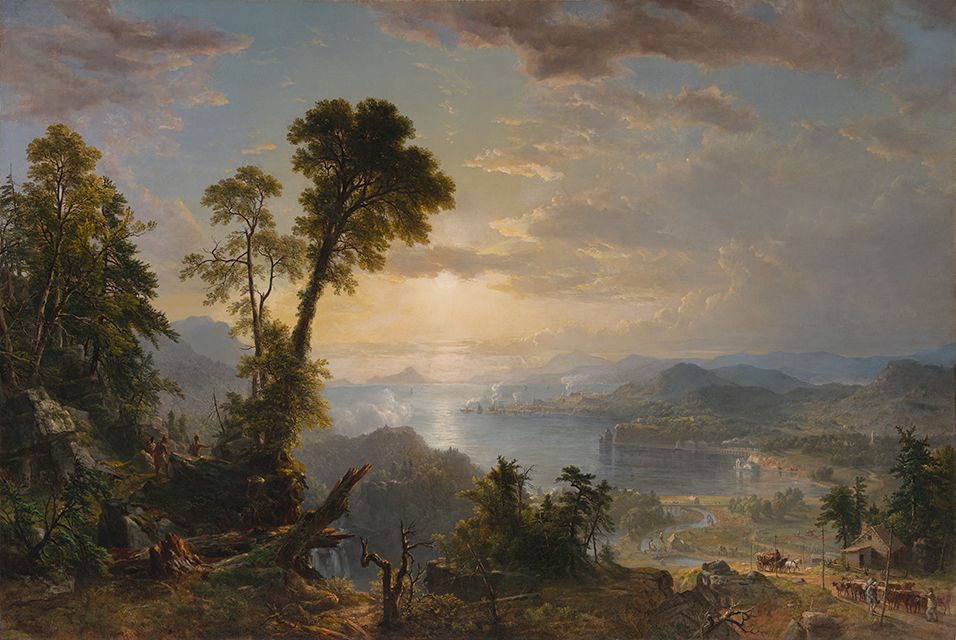
Durand's Progress, 1853: civilisation advancing through a landscape it hopes to keep.
Asher Brown Durand, Progress (The Advance of Civilization), 1853EcoAxes / Included ideologies / Liberal, reformist and market environmentalism
Political ideologyGreen Liberalism
The view that liberal principles, meaning individual freedom, equal rights, democracy, the rule of law and a regulated market economy, can and should be extended to protect the environment, including the interests of future generations, through strong public institutions and international cooperation.
- Key figures
- Marcel Wissenburg, Andrew Dobson (as analyst), Derek Bell, Brian Barry (on intergenerational justice), John Rawls (as resource)
Where it stands
- Environmental EthicsAnthropocentrismEcocentrism
- Human–Nature RelationsHuman SeparationHuman Integration
- Economic PhilosophyGreen GrowthPost-Growth
- Resource OwnershipPrivate StewardshipCommons Governance
- Environmental AuthorityCentralized AuthorityLocal Autonomy
- Environmental JusticeAggregate OutcomesDistributive Justice
- Technological OutlookTechnological OptimismEcological Precaution
- Energy PhilosophyEnergy AbundanceEnergy Sufficiency
- Conservation StrategySustainable UseStrict Protection
- Global ResponsibilityNational SovereigntyInternational Ecological Obligation
- Ecological Political PriorityIncremental ReformTransformative Change
Green liberalism is a position about institutions and principles rather than a programme, so most values are moderate with wide bands; its commitment to reform within liberal democracy and to international law is firm.
Definition
Green liberalism tries to show that liberalism, properly understood, requires protecting the environment, and to build environmental politics on liberal foundations. Those foundations are the equal freedom of persons, including persons not yet born, and a state that stays neutral between different ideas of the good life, limited by the principle that no one may harm others. They also include democratic deliberation, property rights limited by the rights of others, and a market economy regulated to prevent environmental harm.
It rejects two opposite claims: that liberalism is by nature hostile to ecology, and that ecology requires giving up liberal institutions.
Historical development
Early green political theory, in the 1970s and 1980s, was mostly hostile to liberalism, which it saw as individualist, tied to growth and centred on humans. Marcel Wissenburg answered in Green Liberalism: The Free and the Green Society (1998). A liberalism in the line of John Rawls, he argued, could take in sustainability through a “restraint principle” that protects the options of future generations.
Brian Barry’s work on justice between generations, Derek Bell’s on liberal neutrality and environmental value, and Andrew Dobson’s on “ecological citizenship” developed the position. So did the practice of liberal democracies, which produced most of the world’s environmental law. Green liberal parties, and the green wings of liberal parties in Europe and elsewhere, carry it in politics.
Principal claims
- The principle that one may not harm others covers environmental harm, including harm to future generations and harm across borders.
- Justice requires each generation to leave the next one adequate environmental options.
- Environmental goals should be pursued through law, democratic institutions, regulated markets and international agreements. Coercion and abandoning pluralism are ruled out.
- The state may protect nature for reasons that citizens with different worldviews can accept. It need not officially adopt ecocentrism, although citizens are free to.
- Economic growth is neither a goal in itself nor an enemy. Environmental limits should shape it.
Policy implications
Green liberals support environmental laws and independent agencies, carbon pricing and regulation, and protected areas held in public trust. They back environmental rights, including the rights to information and to take part in decisions, along with international treaties and courts, development aid, and constitutional protections for future generations. They usually support strict protection of important ecosystems alongside a regulated economy.
Internal disagreements
Green liberals disagree about how far liberal neutrality lets the state act on nature’s intrinsic value. They differ on whether private property or public ownership protects land better, on how to balance national regulation against international authority, and on how much growth the restraint principle allows.
Criticisms and controversies
Radical greens argue that liberalism’s commitment to individual preferences and to growth leaves it unable to accept the limits ecology demands. Eco-authoritarians say liberal democracy is too slow. Market environmentalists say it regulates too much. Critics focused on justice say it treats fairness as an afterthought.
Green liberals answer that liberal democracies have the best environmental records there are, and that the alternatives have worse ones.
Relationships to other traditions
Green liberalism is the political home of sustainable development, environmental economics and ecological modernisation, and it overlaps with environmental pragmatism and preservationism. It defines itself against ecosocialism, eco-authoritarianism and deep ecology. It is the reformist neighbour of ecological democratic socialism.
References and further reading
- Wissenburg, M. (1998). Green Liberalism: The Free and the Green Society. UCL Press.
- Dobson, A. (2007). Green Political Thought, 4th ed. Routledge.
- Bell, D. (2002). “How can political liberals be environmentalists?” Political Studies 50(4), 703–724.
- Barry, B. (1999). “Sustainability and intergenerational justice.” In A. Dobson, ed., Fairness and Futurity. Oxford University Press.