
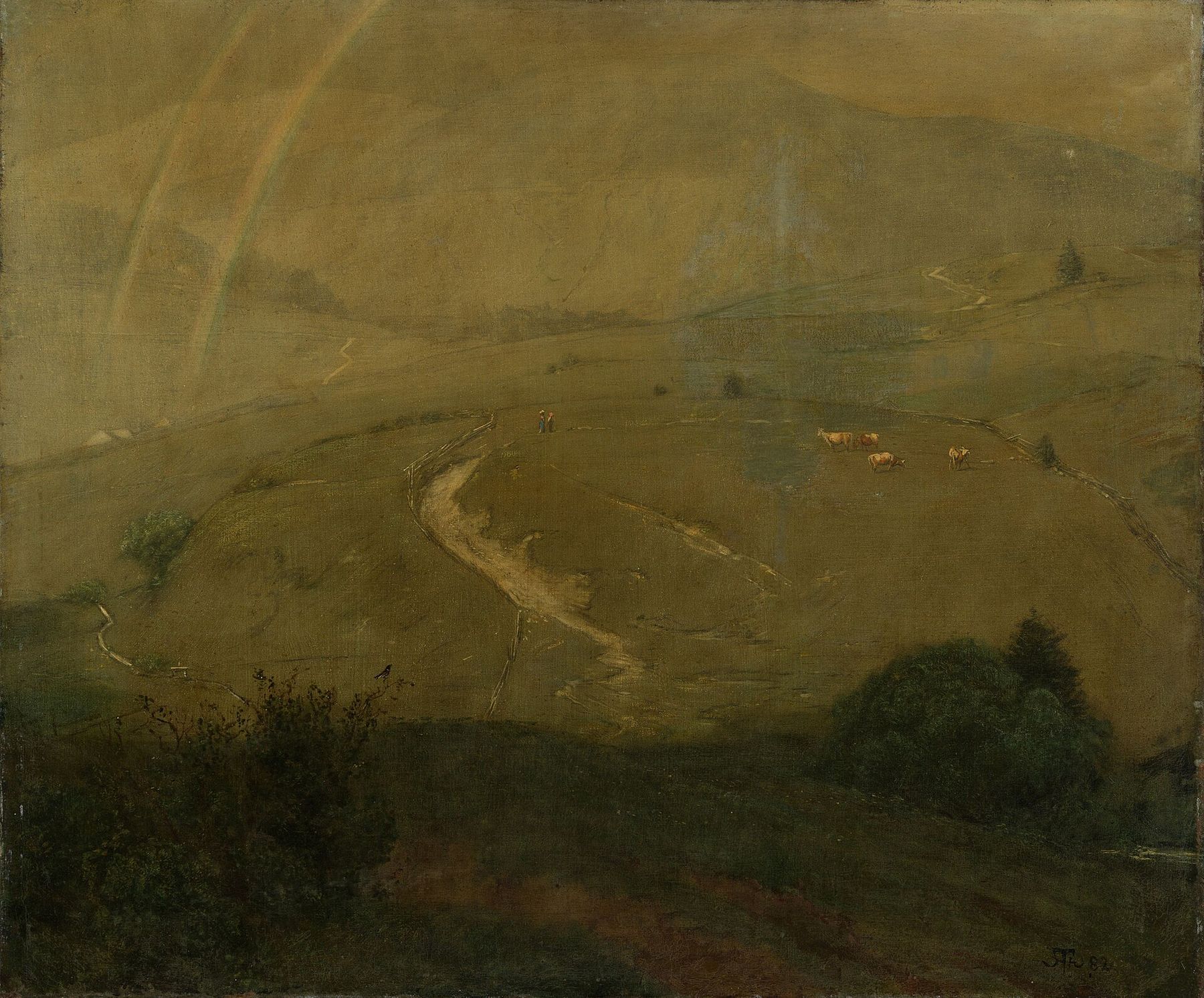
Hans Thoma's Black Forest, beloved of the völkisch movement whose "blood and soil" fused landscape with race.
Hans Thoma, German: Regen im Schwarzwald, 1882EcoAxes / Included ideologies / Conservative and traditionalist environmentalism
Political ideology (historical and extremist)Ecofascism
The fusion of ecological concern with fascist politics. It holds that the natural order needs a people defined by race or ethnicity, rooted in its own soil and ruled by authoritarian leaders, and it presents population reduction, closed borders and the subordination of the individual to the nation as ecological necessities. It is included so that the range of views is complete. It is described here, not endorsed.
- Key figures
- Richard Walther Darré and Nazi-era conservation (historical), Pentti Linkola, Savitri Devi, contemporary "eco-fascist" online movements, Janet Biehl and Peter Staudenmaier (as analysts)
Where it stands
- Environmental EthicsAnthropocentrismEcocentrism
- Human–Nature RelationsHuman SeparationHuman Integration
- Economic PhilosophyGreen GrowthPost-Growth
- Resource OwnershipPrivate StewardshipCommons Governance
- Environmental AuthorityCentralized AuthorityLocal Autonomy
- Environmental JusticeAggregate OutcomesDistributive Justice
- Technological OutlookTechnological OptimismEcological Precaution
- Energy PhilosophyEnergy AbundanceEnergy Sufficiency
- Conservation StrategySustainable UseStrict Protection
- Global ResponsibilityNational SovereigntyInternational Ecological Obligation
- Ecological Political PriorityIncremental ReformTransformative Change
Ecofascism's positions on authority, justice, sovereignty and systemic change are at the extremes; its ethics is a racialised holism, its economics anti-liberal and autarkic. The profile describes the ideology so that distance from it can be reported. It is not treated as a legitimate option.
Definition
Ecofascism joins ecological concern to the core of fascism. That core is a nation conceived as an organism, defined by ethnicity or race and bound to its land (“blood and soil”). It includes authoritarian rule and the subordination of the individual to the collective. It also names enemies, such as immigrants, minorities and “overpopulated” peoples, and presents their exclusion or elimination as a requirement of ecological balance.
Its present-day form combines panic about population in the tradition of Malthus, misanthropic readings of deep ecology, and white nationalist politics. Mass murderers have invoked it in their manifestos. The word is also used loosely, and wrongly, as an insult for any authoritarian or misanthropic environmentalism.
Historical development
Nazi Germany had a real conservationist strand. It included Richard Walther Darré’s “blood and soil” agrarianism, the Reich Nature Protection Law of 1935, experiments in organic farming, and programmes of reforestation and landscape planning, which Frank Uekötter documented in The Green and the Brown (2006). Historians disagree about how deep the regime’s environmentalism went. Uekötter shows both real policy and how quickly it was dropped for war.
Janet Biehl and Peter Staudenmaier analysed the link between völkisch nature mysticism and racial politics in the Nazi era in Ecofascism: Lessons from the German Experience (1995), written as a warning to the green movement. After the war Savitri Devi combined a nature worship coloured by Hinduism with the worship of Hitler. The Finnish writer Pentti Linkola argued openly for authoritarian rule, mass reduction of the population and an end to democracy, in the name of nature.
From the 2010s, “eco-fascist” currents in far-right online subcultures have claimed environmental motives for exclusion and violence. The manifestos of the Christchurch and El Paso attackers, both in 2019, invoked them.
Principal claims
- Nature is an order of hierarchy and struggle, and human societies should mirror it.
- A people belongs to a soil. Ecological health requires ethnic rootedness and the exclusion of outsiders.
- Overpopulation, blamed on other peoples, is the main ecological problem. It is to be solved by closed borders, refusing aid and, at the extreme, mass death.
- Liberal democracy, humanism and equality are decadent and ruin the environment. Authoritarian leadership is natural.
- Industrial modernity should be rejected for an agrarian, hierarchical and organic order. Some versions want the state to harness it instead.
Policy implications
Ecofascism calls for closed borders, refusal of aid and of climate finance, coercive population control aimed at other peoples, and authoritarian government. It ties farming and landscape programmes to ethnic identity. In historical practice all of this was subordinated to war and conquest.
Internal disagreements
Its forms differ between the historical and the contemporary, between agrarian rejection of modernity and a technological state, and in how openly racist they are. They also differ over deep ecology, which ecofascists quote selectively and which most deep ecologists repudiate.
Criticisms and controversies
Every other tradition in this library rejects ecofascism, including the academic advocates of eco-authoritarianism and the founders of deep ecology. The historical record shows that Nazi environmentalism was shallow and easily discarded, and that the regime’s policies were an ecological catastrophe. The movement’s present form is a vehicle for racial violence.
The main scholarly controversy is how far the environmental movement’s own history, in population politics and the exclusion of people from wilderness, prepared the ground. Biehl and Staudenmaier raised the question, and so have historians of conservation.
Relationships to other traditions
Ecofascism is the racialised extreme of eco-authoritarianism and environmental nationalism. It feeds on deep ecology’s language of intrinsic value and on anarcho-primitivism’s rejection of modernity, and all of them oppose it. It stands furthest of all from the traditions built on justice, the decolonial traditions, and the liberal, socialist and religious traditions.
References and further reading
- Biehl, J. and Staudenmaier, P. (1995). Ecofascism: Lessons from the German Experience. AK Press.
- Uekötter, F. (2006). The Green and the Brown: A History of Conservation in Nazi Germany. Cambridge University Press.
- Bramwell, A. (1985). Blood and Soil: Richard Walther Darré and Hitler’s “Green Party”. Kensal Press.
- Linkola, P. (2009). Can Life Prevail? Arktos. (Primary source; read critically.)
- Hughes, B., Jones, D. and Amarasingam, A. (2022). “Ecofascism: An examination of the far-right/ecology nexus in the online space.” Terrorism and Political Violence 34(5), 997–1023.