
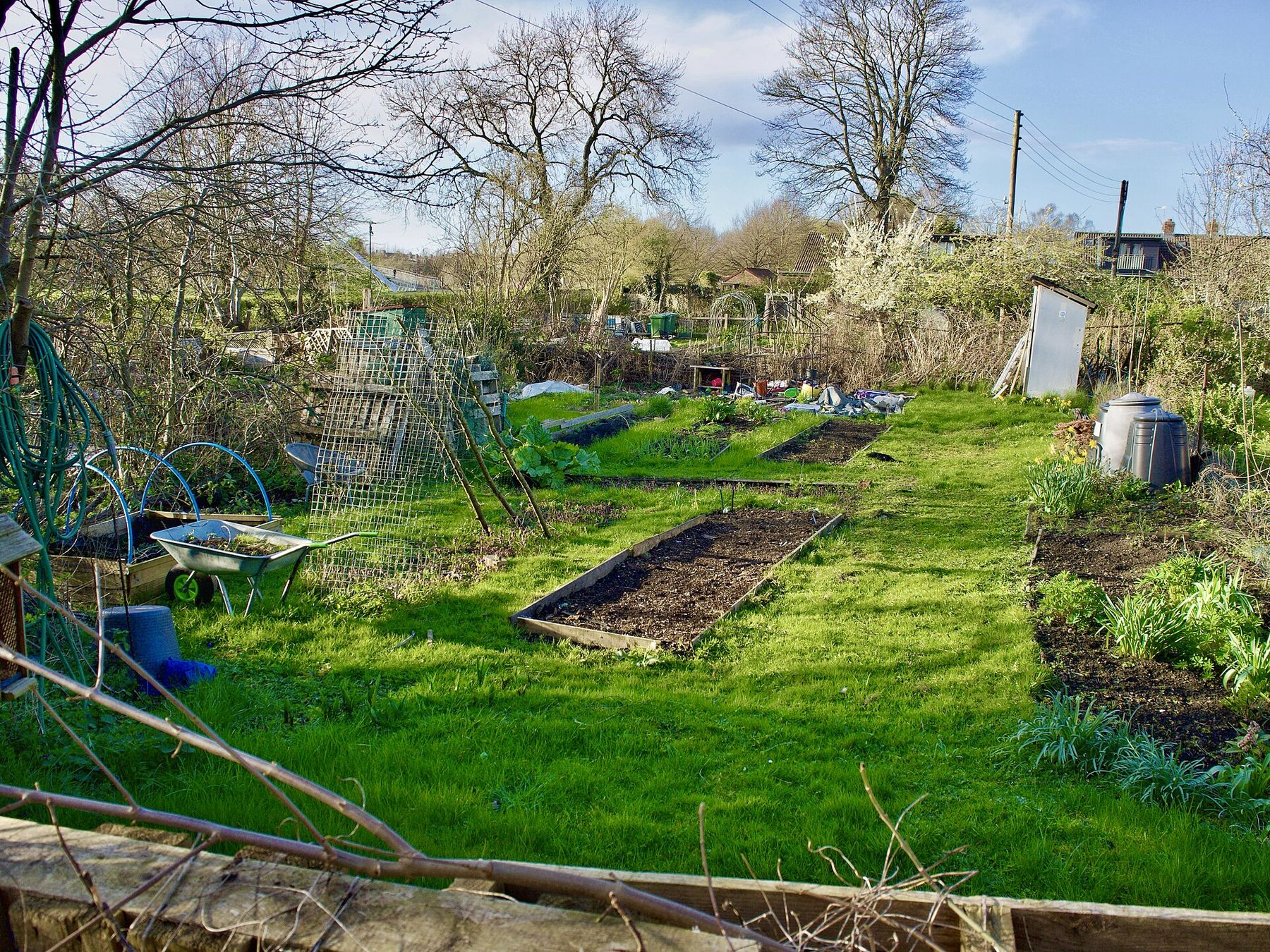
Allotments at Fulford Cross, York: land shared out and tended by neighbours, the local self-management social ecology argues for.
Malcolmxl5, Fulford Cross allotments Mar26 02, 2026EcoAxes / Included ideologies / Left and socialist ecologies
Political philosophySocial Ecology
Murray Bookchin's philosophy that humanity's domination of nature grows out of people's domination of one another. An ecological society must therefore be directly democratic, decentralised and without hierarchy, built from a confederation of municipalities and an economy owned by the community.
- Key figures
- Murray Bookchin, Janet Biehl, Dan Chodorkoff, Abdullah Öcalan (as adapter, in democratic confederalism)
Where it stands
- Environmental EthicsAnthropocentrismEcocentrism
- Human–Nature RelationsHuman SeparationHuman Integration
- Ecological InterventionNoninterventionActive Stewardship
- Economic PhilosophyGreen GrowthPost-Growth
- Resource OwnershipPrivate StewardshipCommons Governance
- Environmental AuthorityCentralized AuthorityLocal Autonomy
- Environmental JusticeAggregate OutcomesDistributive Justice
- Technological OutlookTechnological OptimismEcological Precaution
- Energy PhilosophyEnergy AbundanceEnergy Sufficiency
- Agricultural EcologyLand SparingLand Sharing
- Ecological Political PriorityIncremental ReformTransformative Change
Social ecology's governance, ownership and systemic positions are explicit and central. Its ethics is "second nature" humanism rather than ecocentrism, scored near the middle; Bookchin's enthusiasm for liberatory technology sets it toward optimism.
Definition
Social ecology is the political and philosophical tradition founded by Murray Bookchin (1921–2006). It holds that ecological problems are at root social problems. The idea of dominating nature arose from people dominating one another, in hierarchies of age, sex, class and state. Ecological harmony therefore cannot be separated from dissolving hierarchy.
Its political programme, which Bookchin called “libertarian municipalism” and later “communalism”, is direct democracy in face-to-face assemblies, joined in confederations across regions, with the economy under the control of the municipality.
Historical development
Bookchin wrote one of the first books about the ecological crisis, Our Synthetic Environment (1962), under the name Lewis Herber. In Post-Scarcity Anarchism (1971) he argued that technology could free people for an ecological, decentralised society. The Ecology of Freedom (1982) is his major statement. It traces the history of hierarchy from early organic societies through the state, and offers a vision of “free nature” in which humanity, as “nature rendered self-conscious”, completes natural evolution instead of fighting it.
In the late 1980s Bookchin attacked deep ecology as mystical and misanthropic, a quarrel that split the radical environmental movement. In his last years he developed communalism. After his death Abdullah Öcalan and the Kurdish movement in Rojava adopted his ideas, in modified form, as “democratic confederalism”.
Principal claims
- Humanity’s domination of nature comes from social domination. Human nature and technology as such are not the cause.
- “First nature”, the natural world, and “second nature”, human society, are continuous. Humanity is nature become self-conscious, and it can help nature flourish.
- Hierarchy is the problem, including the state and capitalism. The answer is direct democracy and confederation.
- The economy should belong to the municipality, the whole community, instead of to the state or to workers’ cooperatives alone.
- Suitable, “liberatory” technology and decentralised renewable energy can support an ecological society.
- Ethics rests on evolution’s tendency toward more complexity, more subjectivity and more freedom. Biocentric equality is the wrong foundation.
Policy implications
Social ecology calls for face-to-face democratic assemblies with real power, confederations to coordinate between them in place of the nation-state, and municipal ownership of the means of production. It favours decentralised farming and energy, ecological technology, and joining town and country together. It supports communities managing their own ecosystems actively and democratically, and it distrusts both wilderness that excludes people and central agencies.
Internal disagreements
Social ecologists disagree about whether social ecology is a form of anarchism. Bookchin eventually said it was not. They differ on whether to stand in municipal elections, on how confederations should handle disagreement, on social ecology’s relationship with Marxism, and on how its humanist ethics fits with the value of non-human nature.
Criticisms and controversies
Deep ecologists accused Bookchin of a human-centred faith in reason and of hostility to wilderness. Anarchists disliked his later turn to municipal elections. Marxists found his analysis of hierarchy idealist. Critics in general doubt that confederated municipalities could manage problems on the scale of the climate. Bookchin’s combative style drove away many allies.
Supporters point to Rojava and to the continuing municipalist movement as proof that the model can be put into practice.
Relationships to other traditions
Social ecology is the intellectual source of much green anarchism and municipalism. It is a relative of ecosocialism that rejects the state, a sharp critic of deep ecology, and an influence on community conservation and on thinking about appropriate technology. It shares an analysis of domination with ecofeminism.
References and further reading
- Bookchin, M. (1982). The Ecology of Freedom: The Emergence and Dissolution of Hierarchy. Cheshire Books.
- Bookchin, M. (1971). Post-Scarcity Anarchism. Ramparts Press.
- Bookchin, M. (1990). Remaking Society: Pathways to a Green Future. South End Press.
- Biehl, J. (2015). Ecology or Catastrophe: The Life of Murray Bookchin. Oxford University Press.
- Bookchin, M. (1987). “Social ecology versus deep ecology.” Green Perspectives 4–5.