
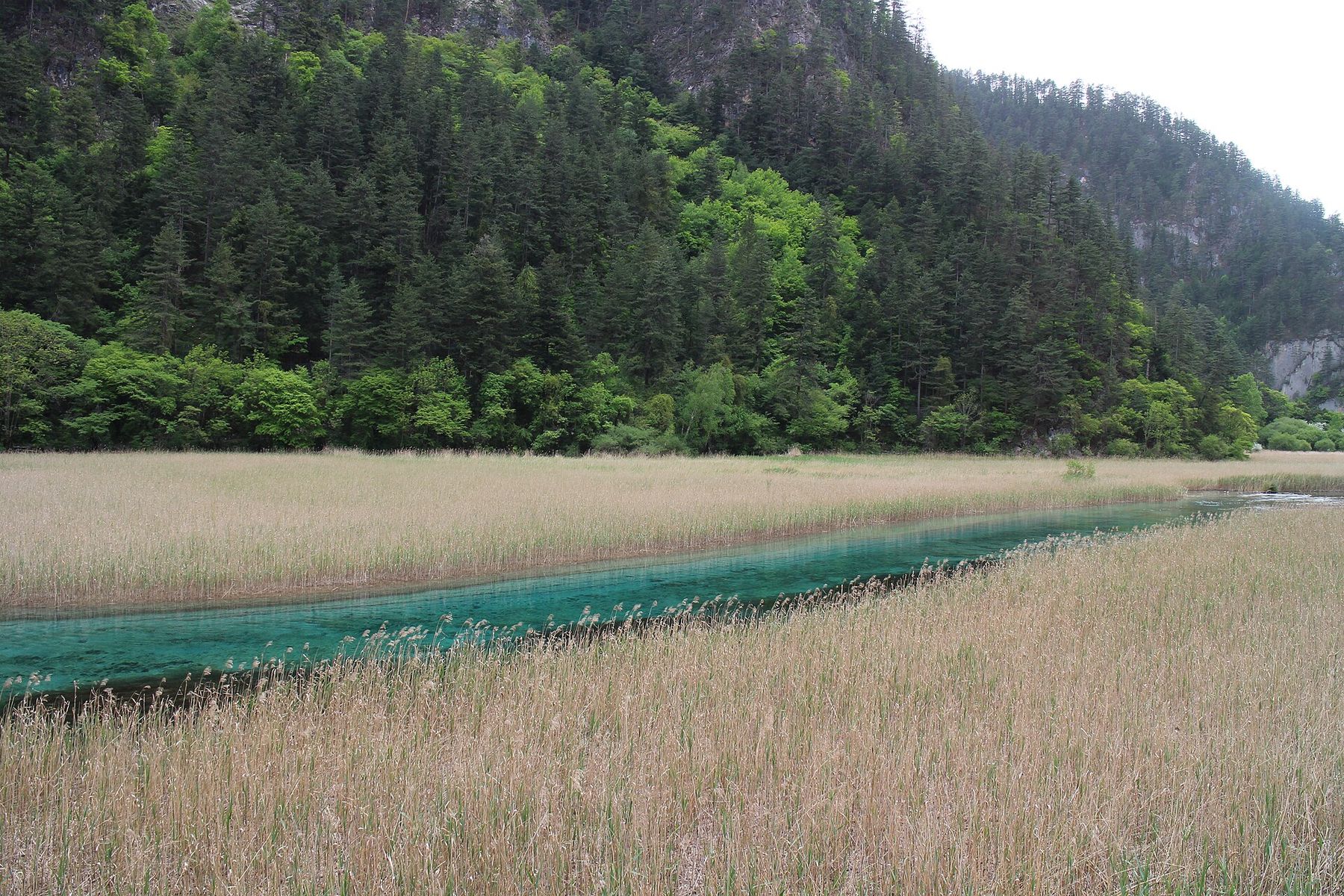
Reed Lake in the Jiuzhaigou Valley, Sichuan: ziran, things being so of themselves.
Suicasmo, Reed Lake (Jiuzhaigou Valley) 20260511-5, 2026EcoAxes / Included ideologies / Religious and spiritual environmental ethics
Philosophical and religious traditionDaoist Ziran
Daoism, from the Daodejing and the Zhuangzi to the later religious tradition, read as an ecological philosophy. It teaches non-interference (wuwei), naturalness (ziran), harmony with the Dao that runs through heaven and earth, few desires, and the worth of the small and the yielding. Western environmental philosophers have developed this reading since the 1960s, and in China so have Daoist institutions and the official language of "ecological civilisation".
- Key figures
- Laozi and Zhuangzi (tradition), Joseph Needham, Roger Ames, N. J. Girardot, James Miller and Liu Xiaogan, Martin Palmer
Where it stands
- Environmental EthicsAnthropocentrismEcocentrism
- Human–Nature RelationsHuman SeparationHuman Integration
- Ecological InterventionNoninterventionActive Stewardship
- Economic PhilosophyGreen GrowthPost-Growth
- Environmental AuthorityCentralized AuthorityLocal Autonomy
- Technological OutlookTechnological OptimismEcological Precaution
- Energy PhilosophyEnergy AbundanceEnergy Sufficiency
- Conservation StrategySustainable UseStrict Protection
- Human–Wildlife RelationsHuman PriorityWildlife Accommodation
- Agricultural EcologyLand SparingLand Sharing
- Ecological Political PriorityIncremental ReformTransformative Change
Daoist philosophy is explicit on non-interference, naturalness, limitation of desire and the small scale; its institutional positions are inferred and the "ecological civilisation" appropriation complicates them.
Definition
Daoist ziran builds an ecological ethic from the classical texts, the Daodejing attributed to Laozi and the Zhuangzi, and from religious Daoism.
Its central ideas are these. The Dao is the way or process of nature, which people should follow and not resist. Ziran is naturalness or spontaneity, the state of things allowed to be themselves. Wuwei is non-action or non-interference, the art of acting without forcing. Desire and clever knowledge disturb natural simplicity and should be limited. The soft, yielding, low and small are worth more than the hard, assertive and great. The ideal ruler is a sage who governs by not governing, over a small community living close to the land.
Modern readers find in these teachings a philosophy of ecological humility, restraint and letting things be, and a criticism of the urge to master nature.
Historical development
Joseph Needham presented Daoism as an organic philosophy of nature that anticipated ecology, in Science and Civilisation in China (from 1956). From the 1960s Western environmental philosophers, including people around deep ecology, turned to the Daodejing and the Zhuangzi for an alternative to the mechanical Western view of nature. Arne Naess cited Daoism, and Roger Ames and others gave the reading philosophical rigour. The Harvard volume Daoism and Ecology (Girardot, Miller and Liu, 2001) weighed the sources critically. James Miller’s China’s Green Religion (2017) argued for a Daoist ecological sense of self.
In China, the Chinese Daoist Association issued ecological declarations, the first at Qinling in 2006, and an eight-year plan with the Alliance of Religions and Conservation, and Daoist temples have run green projects. The official idea of “ecological civilisation” (shengtai wenming), promoted since 2007 and written into the constitution in 2018, draws openly on the Daoist and Confucian harmony of humans and nature. Critics view that use with suspicion.
Principal claims
- Nature follows its own way. People should move with it and not try to master it.
- Interfering, forcing and governing too much produce disorder. The best action is the least.
- Desire, accumulation and the pursuit of knowledge for power disturb natural harmony and should be limited.
- The small, simple and local are better than the large, complex and centralised.
- Everything has its own nature and value, and the human point of view has no special standing. This is the relativism of the Zhuangzi.
Policy implications
Daoist philosophy is not a programme. Applied, it favours restraint in development, protection of wild and sacred places such as Daoist mountains, simple living, decentralised and minimal government, and doubt about large technological projects. In its present institutional form in China it supports environmental education and conservation run from temples.
Internal disagreements
Scholars disagree about whether classical Daoism is environmentalist at all, or whether that is a modern Western reading. They differ on how the philosophical texts relate to the alchemical and liturgical traditions of religious Daoism. The Chinese state’s use of Daoist harmony in “ecological civilisation” divides opinion. Some Daoist environmentalists welcome it. Critics see it as greenwashing for a government that puts development first and rules from the top.
Criticisms and controversies
Sinologists argue that the ecological reading projects modern ideas onto ancient texts, and that Daoist “nature” is not the nature of ecologists. Political critics point to the use of Daoist and Confucian harmony to justify state-led development and control. The quietist reading of wuwei has been attacked as advice to do nothing in a crisis.
Defenders argue that the texts’ criticism of domination, and their ethic of restraint, speak directly to the ecological situation.
Relationships to other traditions
Daoist philosophy is a major source of deep ecology and eco-spirituality. It resembles Buddhist ethics in rejecting craving, and anarcho-primitivism and green anarchism in preferring small communities to the state. It shares appropriate technology’s preference for the small, and it supports wilderness preservation’s hands-off approach. It stands against ecomodernism, against the active management of planetary stewardship, and against every environmentalism that seeks to master nature.
References and further reading
- Girardot, N. J., Miller, J. and Liu, X., eds. (2001). Daoism and Ecology: Ways within a Cosmic Landscape. Harvard University Press.
- Miller, J. (2017). China’s Green Religion: Daoism and the Quest for a Sustainable Future. Columbia University Press.
- Ames, R. T. (1986). “Taoism and the nature of nature.” Environmental Ethics 8(4), 317–350.
- Needham, J. (1956). Science and Civilisation in China, vol. 2: History of Scientific Thought. Cambridge University Press.
- Palmer, M. and Finlay, V. (2003). Faith in Conservation: New Approaches to Religions and the Environment. World Bank.