
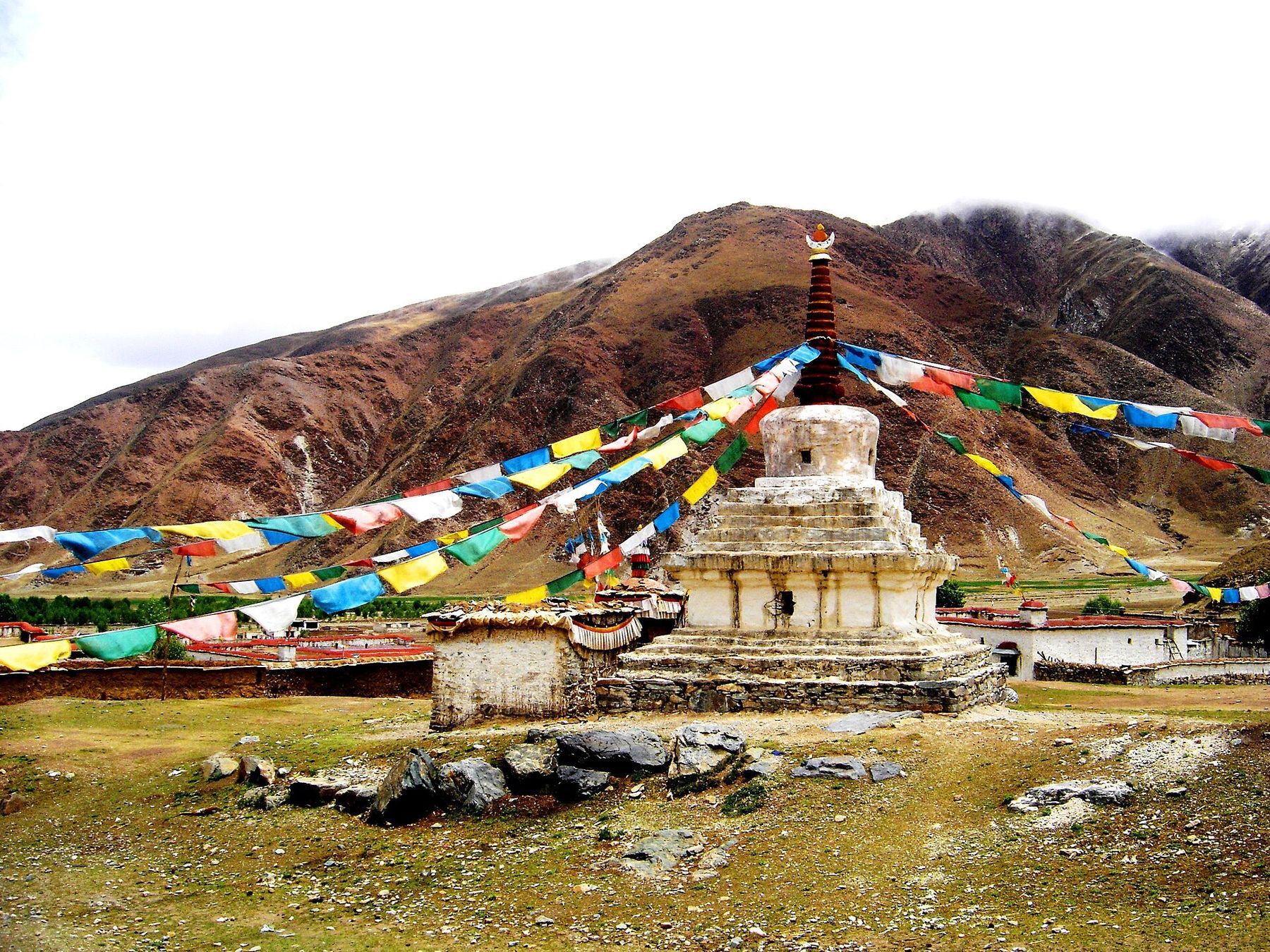
A stupa hung with prayer flags in a Tibetan valley.
Original uploader was Evan Snider, Tibetan Village Stupa, 2006EcoAxes / Included ideologies / Religious and spiritual environmental ethics
Religious ethical traditionBuddhist Interdependence
The modern development of Buddhist teaching into an environmental ethic and movement. It draws on dependent origination (interdependence), compassion for all sentient beings, non-harming, non-attachment and the critique of craving. It runs from the engaged Buddhism of Thich Nhat Hanh and the Dalai Lama to Thailand's forest monks who ordain trees, and to Buddhist economics in the line of Schumacher and P. A. Payutto.
- Key figures
- Thich Nhat Hanh, the 14th Dalai Lama, Joanna Macy, Sulak Sivaraksa, Stephanie Kaza
Where it stands
- Environmental EthicsAnthropocentrismEcocentrism
- Human–Nature RelationsHuman SeparationHuman Integration
- Ecological InterventionNoninterventionActive Stewardship
- Economic PhilosophyGreen GrowthPost-Growth
- Resource OwnershipPrivate StewardshipCommons Governance
- Environmental AuthorityCentralized AuthorityLocal Autonomy
- Environmental JusticeAggregate OutcomesDistributive Justice
- Technological OutlookTechnological OptimismEcological Precaution
- Energy PhilosophyEnergy AbundanceEnergy Sufficiency
- Conservation StrategySustainable UseStrict Protection
- Human–Wildlife RelationsHuman PriorityWildlife Accommodation
- Agricultural EcologyLand SparingLand Sharing
- Global ResponsibilityNational SovereigntyInternational Ecological Obligation
- Ecological Political PriorityIncremental ReformTransformative Change
Read from pratityasamutpada (dependent origination), compassion for all sentient beings and the first precept against taking life, the middle way, and right livelihood, which Schumacher drew on for 'Buddhist economics'. Engaged Buddhism adds tree ordinations that protect forests and an emphasis on transforming desire as much as institutions. Its firmest commitments are to animals and to restraint in consumption.
Definition
Buddhist eco-dharma grounds care for the natural world in core Buddhist teachings. The first is dependent origination (pratītyasamutpāda), the interdependence of everything that exists. If all things arise together, the line between self and world is an illusion. The second is the first precept, non-harming (ahiṁsā), together with compassion (karuṇā) for all sentient beings, which brings animals into moral concern. The third is the teaching that suffering comes from craving, which makes consumerism a spiritual problem as well as an ecological one. The ideals of contentment and the middle way support an economics of sufficiency.
In its modern form eco-dharma is both a philosophy and a practice. It includes meditation on “interbeing”, the protection of forests and animals, and active work for a sustainable and compassionate society.
Historical development
Buddhist texts teach about the treatment of animals, plants and water, and monastic rules protect trees and other living things. A systematic environmental ethic, though, is modern.
Early sources include Thich Nhat Hanh’s teaching of “interbeing” and his engaged Buddhism from the 1960s, and Gary Snyder’s Buddhist ecological poems and essays (Turtle Island, 1974). E. F. Schumacher’s essay “Buddhist Economics” (1966, later in Small Is Beautiful) and P. A. Payutto’s Buddhist Economics (1992) founded an economics of sufficiency. Joanna Macy combined Buddhism, systems theory and deep ecology in what she calls “the work that reconnects”.
In Thailand from the late 1980s, “ecology monks” ordained trees to protect forests from logging, and Sulak Sivaraksa linked ecology with social justice. The Dalai Lama has spoken for universal responsibility and climate action since the 1980s. Two collections consolidated the field: the Harvard volume Buddhism and Ecology (1997) and Dharma Rain (Kaza and Kraft, 2000). Eco-dharma movements carry it on today.
Principal claims
- Everything is interdependent. Harming the world harms oneself, and the separate self is an illusion to be seen through.
- Every sentient being deserves compassion. Harming animals breaks the first precept.
- Craving and consumerism are the roots of suffering and of ecological destruction. Contentment is the cure.
- Right livelihood and an economy of sufficiency are better than growth and accumulation.
- Mindfulness and meditation sharpen ecological awareness. They are not a retreat from action.
Policy implications
Eco-dharma is more a way of life than a policy programme. In practice it supports forest protection, vegetarianism and animal welfare, limits on consumption, conservation by communities and monasteries, and campaigning on climate and biodiversity. Sufficiency economics has entered official policy in Thailand and in Bhutan, whose philosophy of Gross National Happiness draws on it.
Internal disagreements
The historian Ian Harris has questioned whether traditional Buddhism was environmentalist at all, or whether “green Buddhism” is a modern Western invention. Practitioners also debate how detachment from the world fits with engagement in it, and how individual practice relates to changing social structures. Because Buddhist ethics centres on sentient beings, it says less directly about plants and ecosystems, and how far concern should reach there is disputed.
Criticisms and controversies
Some scholars argue that classical Buddhism was ambivalent about nature and that eco-Buddhism reads modern concerns into it. Critics point to the environmental record of countries where most people are Buddhist. Social justice critics find the focus on personal change too weak as politics.
Defenders answer that traditions grow, and that applying the teachings on interdependence and compassion to ecology is a faithful use of them.
Relationships to other traditions
Buddhist eco-dharma is a major source of deep ecology, through Macy, Snyder and Arne Naess’s own debts, and of eco-spirituality. It is the religious ground of Schumacher’s appropriate technology and Buddhist economics, and a close relative of Jain and Hindu dharmic ecology. It sides with compassionate conservation on sentient beings and with degrowth on sufficiency.
References and further reading
- Tucker, M. E. and Williams, D. R., eds. (1997). Buddhism and Ecology: The Interconnection of Dharma and Deeds. Harvard University Press.
- Kaza, S. and Kraft, K., eds. (2000). Dharma Rain: Sources of Buddhist Environmentalism. Shambhala.
- Nhat Hanh, T. (2008). The World We Have: A Buddhist Approach to Peace and Ecology. Parallax Press.
- Payutto, P. A. (1994). Buddhist Economics: A Middle Way for the Market Place. Buddhadhamma Foundation.
- Darlington, S. M. (2012). The Ordination of a Tree: The Thai Buddhist Environmental Movement. SUNY Press.
- Harris, I. (1995). “Getting to grips with Buddhist environmentalism: A provisional typology.” Journal of Buddhist Ethics 2, 173–190. (The principal critique.)