
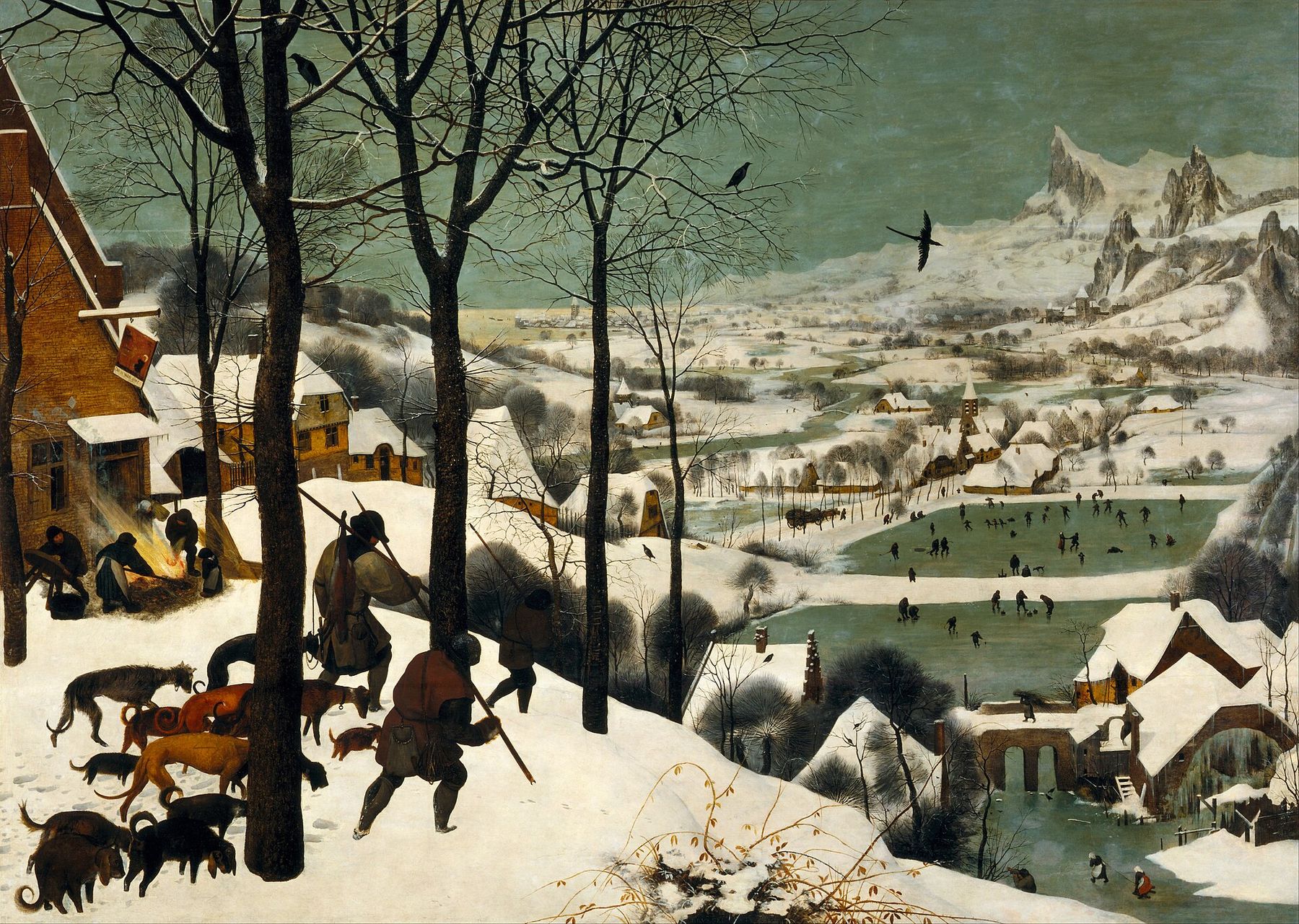
Bruegel's winter village: people and wild nature living in one landscape.
Pieter Brueghel the Elder, Polish: Myśliwi na śniegu monthly cycle, scene: The Hunters in the Snow (winter), 1565EcoAxes / Included ideologies / Indigenous, decolonial and justice-based approaches
Conservation proposal and critical frameworkConvivial Conservation
Bram Büscher and Robert Fletcher's proposal for conservation after capitalism. It rejects both fortress conservation and the market-based "new conservation". Protected areas that shut people out become "promoted areas" that welcome them, tourism and offsets give way to a conservation basic income and direct democratic control, and the goal is people and nature living together.
- Key figures
- Bram Büscher, Robert Fletcher, Ivan Illich (conviviality), the Convivial Conservation Centre
Where it stands
- Environmental EthicsAnthropocentrismEcocentrism
- Human–Nature RelationsHuman SeparationHuman Integration
- Ecological InterventionNoninterventionActive Stewardship
- Economic PhilosophyGreen GrowthPost-Growth
- Resource OwnershipPrivate StewardshipCommons Governance
- Environmental AuthorityCentralized AuthorityLocal Autonomy
- Environmental JusticeAggregate OutcomesDistributive Justice
- Technological OutlookTechnological OptimismEcological Precaution
- Conservation StrategySustainable UseStrict Protection
- Human–Wildlife RelationsHuman PriorityWildlife Accommodation
- Global ResponsibilityNational SovereigntyInternational Ecological Obligation
- Ecological Political PriorityIncremental ReformTransformative Change
Convivial conservation is a programme with explicit positions on integration, post-capitalism, justice, governance and the critique of protected areas; its views on intervention and technology are less developed.
Definition
Convivial conservation is the proposal Bram Büscher and Robert Fletcher set out in The Conservation Revolution (2020) for a conservation beyond capitalism. It rejects the two dominant models. One is “mainstream” or fortress conservation, which protects nature by keeping people out. The other is the “new conservation”, which would save nature by making it pay, through ecosystem services, offsets and tourism. Both, the authors argue, accept the capitalist economy whose growth drives the loss of biodiversity.
In their place the authors propose a set of shifts. Protected areas become promoted areas, open to residents and visitors and governed democratically. The aim moves from saving nature to celebrating human and non-human nature together, from tourists who look on to visitors who take part, and from spectacular environmentalism to the everyday kind. Control passes from private experts to ordinary people acting together. A “conservation basic income” pays for it, as part of a wider move to an economy that no longer depends on growth or on capitalism. The name borrows Ivan Illich’s idea of “conviviality”, living well together.
Historical development
The proposal grew out of the authors’ critiques, from political ecology, of conservation based on markets, sometimes called “neoliberal conservation”. It also responded to two other debates. Peter Kareiva and others launched the argument over “new conservation” in 2012. E. O. Wilson and the “Nature Needs Half” movement proposed setting aside half the earth, which the authors criticised as fortress thinking on a planetary scale.
The Conservation Revolution framed conservation’s choice as one between “neoprotectionism” and “new conservation”, and offered convivial conservation as a third way. A 2019 article in Conservation and Society had already set out its elements. The Convivial Conservation Centre and related projects have since tried it out in practice, including in southern Africa and Europe.
Principal claims
- Capitalism drives the loss of biodiversity. Human presence as such does not. Conservation that accepts capitalism cannot succeed.
- Protected areas that exclude people are unjust, and on the scale that half-earth proposes they could not work.
- Nature should be governed as a commons by the people who live with it, with democratic participation at every level.
- People who live with wildlife should be paid for it without conditions, through a conservation basic income. Markets in ecosystem services are the wrong tool.
- Human and non-human nature should be brought together. “Wild” and “cultivated” are the wrong categories.
- Conservation has to go hand in hand with degrowth and a wider change in the economy.
Policy implications
The programme turns protected areas into promoted areas where residents have rights, introduces a conservation basic income and builds democratic institutions to govern landscapes. It ends the removal of people for conservation, limits tourism and offsets, and moves conservation money to communities. It supports coexistence with wildlife and a transition to an economy that does not depend on growth.
Internal disagreements
The proposal is recent and has few practitioners, so many questions are open. How would strict protection of the most sensitive places fit a model of promoted areas? How would people live safely alongside dangerous wildlife? How would the basic income be paid for before the post-capitalist transition it assumes has happened?
Criticisms and controversies
Conservation biologists argue that the proposal underrates the need for places free of human pressure, and that its evidence on coexistence is thin. Critics from both mainstream and new conservation call it utopian, because it depends on an economic transformation nobody expects soon. Some practitioners of community conservation see it as a radical restatement of what they already do.
The authors answer that the alternatives have failed and that they offer a direction, not a blueprint.
Relationships to other traditions
Convivial conservation is the radical, post-capitalist form of community conservation. It draws on political ecology, degrowth, ecosocialism and decolonial ecology. It is openly opposed to fortress conservation and to market-based conservation, and critical of half-earth and of much rewilding.
References and further reading
- Büscher, B. and Fletcher, R. (2020). The Conservation Revolution: Radical Ideas for Saving Nature Beyond the Anthropocene. Verso.
- Büscher, B. and Fletcher, R. (2019). “Towards convivial conservation.” Conservation and Society 17(3), 283–296.
- Illich, I. (1973). Tools for Conviviality. Harper & Row.
- Kareiva, P., Marvier, M. and Lalasz, R. (2012). “Conservation in the Anthropocene: Beyond solitude and fragility.” Breakthrough Journal 2. (The “new conservation” the proposal responds to.)