
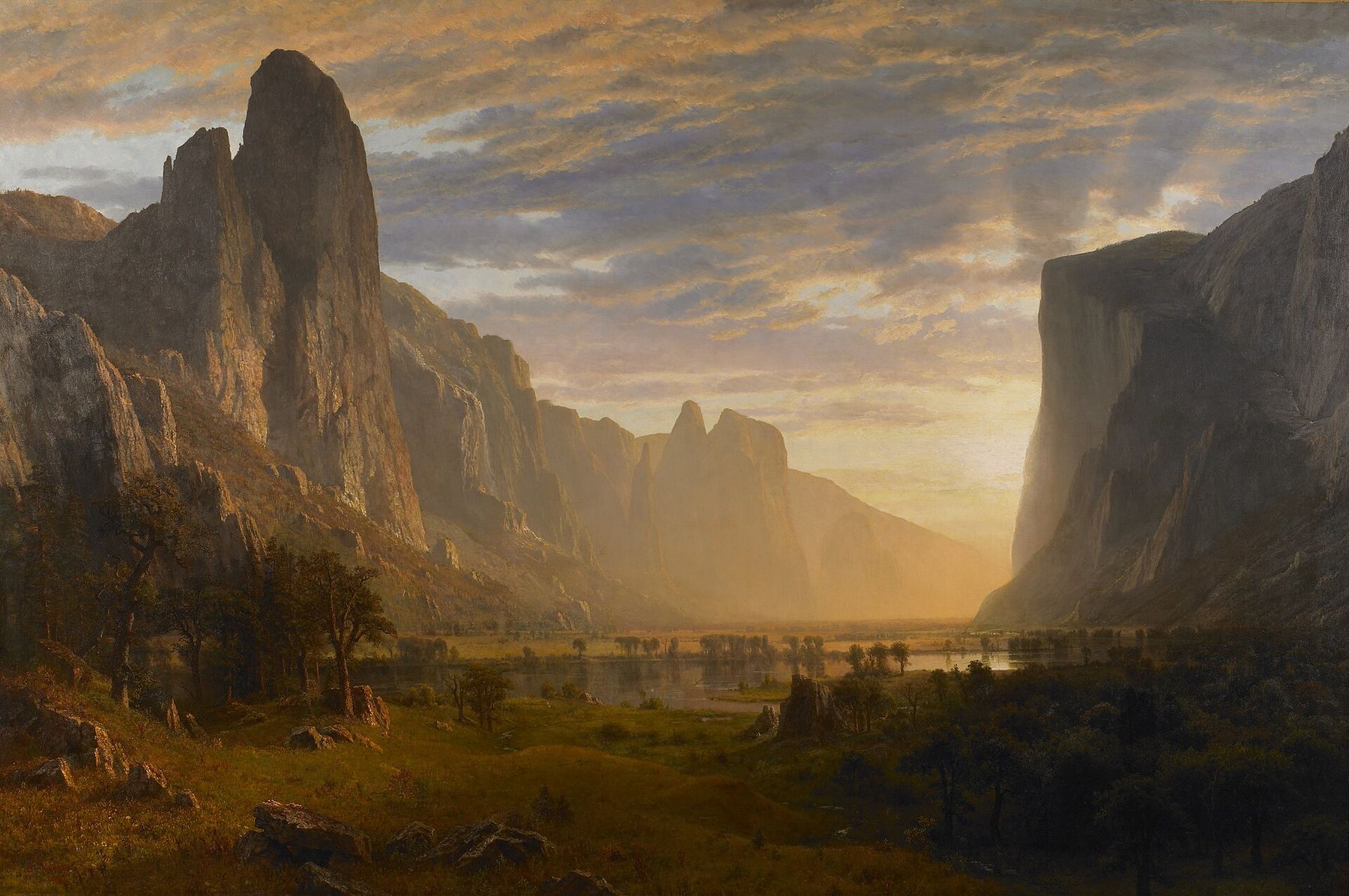
Bierstadt's Yosemite, the valley Muir fought to keep as it was.
Albert Bierstadt, Looking Down Yosemite Valley, California, 1865EcoAxes / Included ideologies / Classical environmental philosophies
Conservation philosophy and political movementPreservationism
The tradition associated with John Muir. Nature should be protected from human use and development, for its own sake and for its value to beauty, spirit and science, through parks, reserves and wilderness areas. In conservation practice it takes the form of wilderness preservation, which keeps large areas free of roads, settlement and extraction.
- Key figures
- John Muir, Robert Marshall, Howard Zahniser, David Brower, Roderick Nash (historian)
Where it stands
- Environmental EthicsAnthropocentrismEcocentrism
- Human–Nature RelationsHuman SeparationHuman Integration
- Ecological InterventionNoninterventionActive Stewardship
- Resource OwnershipPrivate StewardshipCommons Governance
- Environmental AuthorityCentralized AuthorityLocal Autonomy
- Conservation StrategySustainable UseStrict Protection
- Human–Wildlife RelationsHuman PriorityWildlife Accommodation
- Ecological Political PriorityIncremental ReformTransformative Change
Preservationism's positions on protection, wilderness and public land are well defined; it has no settled view on economics, technology, energy, agriculture or justice. Its reliance on national parks and federal law places it toward central authority and public ownership.
Definition
Preservationism holds that natural areas and species should be kept from human use and development, as close as possible to their present state. Managing them for a sustained yield is the wrong goal.
It is the classic opposite of conservationism in the sense of “wise use”. Gifford Pinchot’s conservationism asked how resources should be used. John Muir’s preservationism asked which places should be left alone. Its institutions are the national park, the nature reserve and the designated wilderness area.
Historical development
The movement grew with the American national parks: Yellowstone (1872) and Yosemite (1890), and the founding of the Sierra Club by Muir and others in 1892. The fight over damming Hetch Hetchy valley in Yosemite (1908–1913), which Muir lost, became the defining break between preservation and utilitarian conservation.
Robert Marshall and Aldo Leopold founded the Wilderness Society in 1935. Howard Zahniser drafted the Wilderness Act of 1964, which defined wilderness as land “where the earth and its community of life are untrammeled by man, where man himself is a visitor who does not remain.” The model spread around the world through the twentieth century. As later critics documented, it often spread by removing the people who already lived in the places set aside.
Principal claims
- Some places have a value, whether aesthetic, spiritual, scientific or intrinsic, that use destroys and that cannot be recovered.
- The right response is to protect those places by law from development and extraction, and to hold them in public trust.
- Wild nature should be able to carry on on its own terms. People should be present only as visitors.
- Protected areas are the core of conservation. What happens outside them comes second.
Policy implications
Preservationists support parks, reserves and wilderness designations with strict limits on logging, mining, grazing, roads and settlement. They want public ownership and national laws, and they oppose dams and extraction in scenic and ecologically valuable places. They support large, strictly protected areas, which in recent decades has become the agenda of “half-earth” and of protecting 30 per cent by 2030.
Internal disagreements
Preservationists disagree about how much management protected areas need, and they have split over putting out fires, bringing back predators and dealing with invasive species. They differ on whether recreation and tourism fit with preservation, on how to answer the criticism that parks displaced people, and on whether the idea of wilderness should be defended or revised.
Criticisms and controversies
Environmental historians, including William Cronon and Roderick Nash in his later work, attacked the “received wilderness idea” as a cultural invention that hid the Indigenous history of supposedly untouched landscapes. Ramachandra Guha and political ecologists argued that the model, once exported, took land from the rural poor and served tourists and elites. Conservation biologists have asked whether reserves alone can hold on to biodiversity as the climate changes.
Supporters answer that the critics exaggerate how much people had changed the land before European contact, that protected areas remain the most effective single tool of conservation, and that the problem of displacement is a reason to protect land justly, not to stop protecting it.
Relationships to other traditions
Preservationism is the parent of wilderness preservation and, in its coercive form abroad, of what critics call fortress conservation. It shares its ethics with ecocentrism and deep ecology, and its love of public land with green liberalism. It is the historic opposite of conservationism and a target of community conservation and convivial conservation.
References and further reading
- Muir, J. (1901). Our National Parks. Houghton Mifflin.
- Nash, R. F. (1967). Wilderness and the American Mind. Yale University Press.
- Cronon, W. (1995). “The trouble with wilderness; or, getting back to the wrong nature.” In W. Cronon, ed., Uncommon Ground. W. W. Norton.
- Guha, R. (1989). “Radical American environmentalism and wilderness preservation: A Third World critique.” Environmental Ethics 11(1), 71–83.
- Wilderness Act of 1964, Public Law 88-577 (United States).