
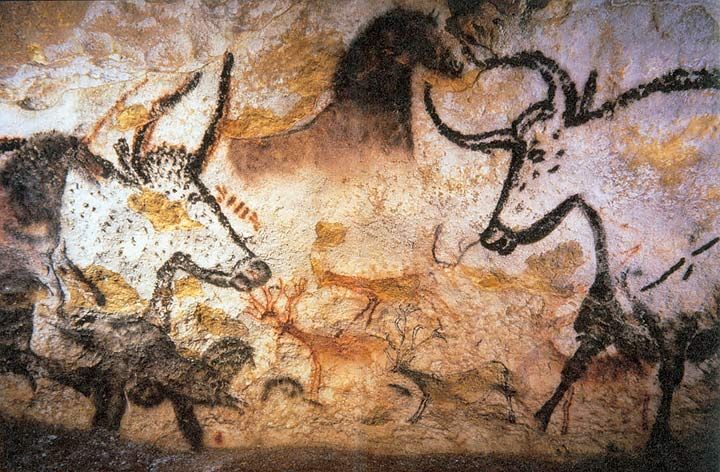
Lascaux: life before agriculture, the society anarcho-primitivists look back to.
EU, Lascaux painting, 2006EcoAxes / Included ideologies / Left and socialist ecologies
Political philosophy and critique of civilisationAnarcho-Primitivism
The view that civilisation itself, starting with farming and the domestication of plants and animals, is the root of ecological destruction and human alienation. Its answer is to give up industrial technology and mass society for small foraging communities.
- Key figures
- John Zerzan, Fredy Perlman, Derrick Jensen (as a related anti-civilisation writer), Paul Shepard (as an influence)
Where it stands
- Environmental EthicsAnthropocentrismEcocentrism
- Human–Nature RelationsHuman SeparationHuman Integration
- Ecological InterventionNoninterventionActive Stewardship
- Economic PhilosophyGreen GrowthPost-Growth
- Resource OwnershipPrivate StewardshipCommons Governance
- Environmental AuthorityCentralized AuthorityLocal Autonomy
- Technological OutlookTechnological OptimismEcological Precaution
- Energy PhilosophyEnergy AbundanceEnergy Sufficiency
- Conservation StrategySustainable UseStrict Protection
- Ecological Political PriorityIncremental ReformTransformative Change
Anarcho-primitivism's rejection of industrial technology, growth, the state and property is total and scores at the extremes; its conservation strategy is ambiguous (it rejects management but also the reserve model).
Definition
Anarcho-primitivism is a current within anarchism. Most anarchists oppose the state and capitalism. Primitivists go further and oppose civilisation as a whole: farming, domestication, the division of labour, cities and industrial technology. John Zerzan goes further still, rejecting symbolic culture, number, time and language.
Primitivists hold that for most of human history people lived as nomadic foragers, and that those societies were equal, had plenty of leisure and lived within their ecological means. Domestication was a “fall”. It began the domination of nature and of people, which industrial society has now driven to catastrophe. The aim is to take civilisation apart, which rules out both reforming it and seizing it in a revolution.
Historical development
The position took shape in Detroit’s anarchist circles in the 1980s, around the journal Fifth Estate. Its founding texts are Fredy Perlman’s Against His-story, Against Leviathan! (1983) and John Zerzan’s Elements of Refusal (1988) and Future Primitive (1994).
It leaned on anthropology that had changed the picture of hunter-gatherers, in particular Marshall Sahlins’s description of them as “the original affluent society” (1972). It also drew on Paul Shepard, who argued in The Tender Carnivore and the Sacred Game (1973) and Nature and Madness (1982) that the human mind is adapted to Pleistocene foraging. Primitivism influenced parts of Earth First!, the green anarchist scene of the 1990s and 2000s, and Derrick Jensen’s wider writing against civilisation.
Principal claims
- Domesticating plants and animals produced hierarchy, property, war and ecological destruction.
- Technology is never neutral. Industrial technology, and most technology before it, depends on domination and builds it in.
- Hunter-gatherer societies were egalitarian, healthy and sustainable, and those that survive still are.
- Civilisation cannot be reformed. It should be rejected and resisted, and as it collapses it should give way to “rewilded” human lives.
- The freedom of wild nature and the freedom of wild people are one cause.
Policy implications
Primitivism has no policies in the usual sense, because it refuses to use the state. In practice its adherents “rewild” themselves and their communities, teach one another foraging and primitive skills, and resist industrial infrastructure. Some welcome the collapse of civilisation.
Internal disagreements
Primitivists disagree about how far the critique reaches. Zerzan’s rejection of symbolic culture is a minority view. They also argue over whether any farming, gardening or technology can be accepted, and whether to wait for collapse, speed it up or prepare for it. Hardest of all is the question of what to say about the fall in population that the end of agriculture would bring.
Criticisms and controversies
Murray Bookchin and other social ecologists dismissed primitivism as “lifestyle anarchism”, a romantic mysticism hostile to reason. Anthropologists dispute its idealised account of foragers. Critics of many kinds point out that the present human population could not live by foraging. In their view this makes the position either utopian or, by implication, genocidal. Primitivists reply that they do not advocate mass death and that collapse is coming anyway.
Public debate has sometimes connected the movement’s fringe with eco-extremism. Most primitivists reject eco-extremism.
Relationships to other traditions
Anarcho-primitivism is the most extreme wing of green anarchism and the furthest point of distrust in technology. It shares deep ecology’s love of wilderness and goes well beyond degrowth in rejecting growth. It is completely opposed to ecomodernism, planetary stewardship and every tradition that would manage the planet. Its idea of human “rewilding” is a different thing from the conservation movement called rewilding.
References and further reading
- Zerzan, J. (1994). Future Primitive and Other Essays. Autonomedia.
- Perlman, F. (1983). Against His-story, Against Leviathan! Black & Red.
- Shepard, P. (1982). Nature and Madness. Sierra Club Books.
- Sahlins, M. (1972). Stone Age Economics. Aldine. (The “original affluent society.”)
- Bookchin, M. (1995). Social Anarchism or Lifestyle Anarchism: An Unbridgeable Chasm. AK Press. (The main critique.)