
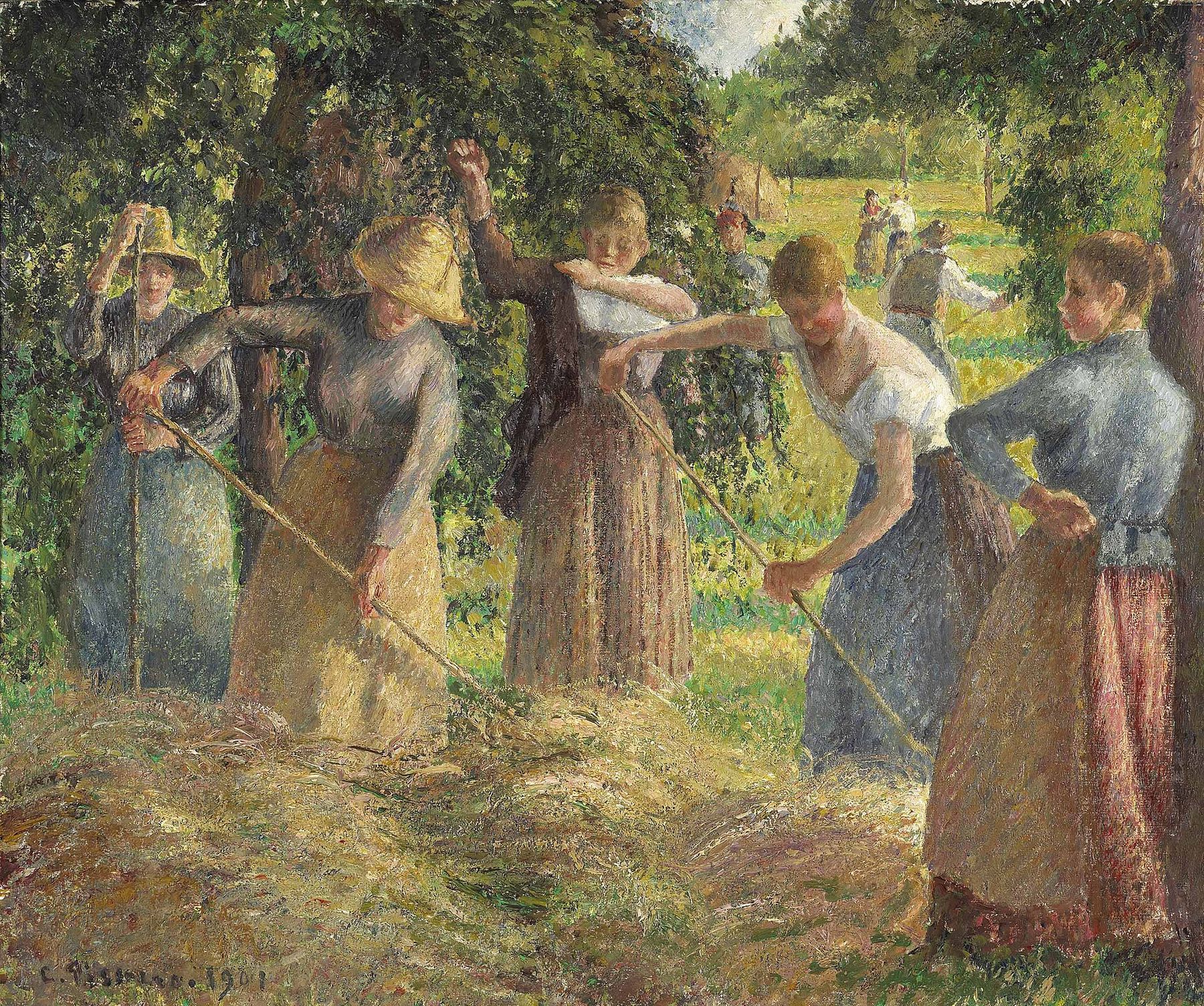
Pissarro, an anarchist, painting the shared work of the harvest.
Camille Pissarro, French: Fenaison à Éragny Hay Harvest at Éragny, 1901EcoAxes / Included ideologies / Left and socialist ecologies
Political ideologyGreen Anarchism
Anarchism with ecology at its centre. It holds that states, capitalism and hierarchy cause ecological destruction, and that a free society of self-governing, cooperative communities living within ecological limits is both possible and necessary.
- Key figures
- Peter Kropotkin (antecedent), Élisée Reclus (antecedent), Murray Bookchin, Colin Ward, Graham Purchase
Where it stands
- Environmental EthicsAnthropocentrismEcocentrism
- Human–Nature RelationsHuman SeparationHuman Integration
- Economic PhilosophyGreen GrowthPost-Growth
- Resource OwnershipPrivate StewardshipCommons Governance
- Environmental AuthorityCentralized AuthorityLocal Autonomy
- Environmental JusticeAggregate OutcomesDistributive Justice
- Technological OutlookTechnological OptimismEcological Precaution
- Energy PhilosophyEnergy AbundanceEnergy Sufficiency
- Ecological Political PriorityIncremental ReformTransformative Change
Green anarchism is a family of positions united by anti-statism, anti-capitalism and ecology; its ethics ranges from humanist (social ecology) to deep ecological, and its view of technology from liberatory to primitivist, so those bands are wide.
Definition
Green anarchism is the ecological branch of anarchism. It holds that every form of domination has to be abolished together: the state, capital, patriarchy and humanity’s domination of nature. An ecologically sound society, on this view, will have no state. It will be decentralised, cooperative and run by its members.
The branch includes social ecology, anarcho-primitivism, green syndicalism and the anti-authoritarian currents of radical environmental movements. They disagree about technology and civilisation, and agree about the state.
Historical development
Anarchism’s ecological strand goes back to two geographers. Élisée Reclus described humanity in L’Homme et la Terre (1905–08) as “nature becoming self-conscious”. Peter Kropotkin argued in Mutual Aid (1902) that cooperation, as well as competition, drives evolution, and proposed decentralised farming and industry working together in Fields, Factories and Workshops (1899).
Murray Bookchin made the link explicit from the 1960s, and his social ecology became the most fully worked-out form. In the 1980s and 1990s, Earth First! and the wider radical environmental movement drew on anarchist ways of organising, and anarcho-primitivism arose as a rejection of civilisation itself. Colin Ward’s Anarchy in Action (1973) offered a gentler, practical anarchism of allotments, squats and self-build housing.
Principal claims
- The state and capitalism are the organised forms of domination that produce ecological destruction. Reforming them cannot be enough.
- Free communities that govern themselves and join together by choice can manage their environments better than any central authority.
- Land and resources should be owned in common.
- Mutual aid and cooperation come naturally to people, and they are the basis of a sustainable society.
- Change comes through direct action. Petitioning those in authority does not bring it.
Policy implications
Green anarchism has no policies in the governmental sense. Its programme is to build the new society now: communes, cooperatives, community gardens, land occupations, mutual aid networks, direct action against extractive projects, and institutions that can take over from the state. It favours commons, local food, decentralised energy and, in most forms, small-scale technology.
Internal disagreements
The great divide is over technology and civilisation. Social ecologists see liberating technology as part of a free society. Anarcho-primitivists see agriculture, industry and perhaps even symbolic culture as the fall. Related arguments concern population, the value of wilderness, the place of violence in direct action, and whether standing in local elections betrays anarchist principle.
Criticisms and controversies
Critics of every kind argue that stateless federations could not deal with planetary problems, enforce ecological limits or defend themselves. Marxists see anarchism as ineffective politics. Liberals see direct action as undemocratic. The primitivist wing has been accused of misanthropy and of romanticising the past.
Anarchists answer that states have had a century to deal with the ecological crisis and have overseen its deepening.
Relationships to other traditions
Green anarchism contains social ecology and anarcho-primitivism. It overlaps with degrowth and ecosocialism in criticising growth and capital. Some of its currents share deep ecology’s ethics and others reject them. It is the opposite of eco-authoritarianism and of centralised planetary stewardship.
References and further reading
- Kropotkin, P. (1902). Mutual Aid: A Factor of Evolution. Heinemann.
- Bookchin, M. (1982). The Ecology of Freedom. Cheshire Books.
- Ward, C. (1973). Anarchy in Action. Allen & Unwin.
- Purchase, G. (1994). Anarchism and Environmental Survival. See Sharp Press.
- Clark, J. P. and Martin, C., eds. (2004). Anarchy, Geography, Modernity: The Radical Social Thought of Élisée Reclus. Lexington Books.