
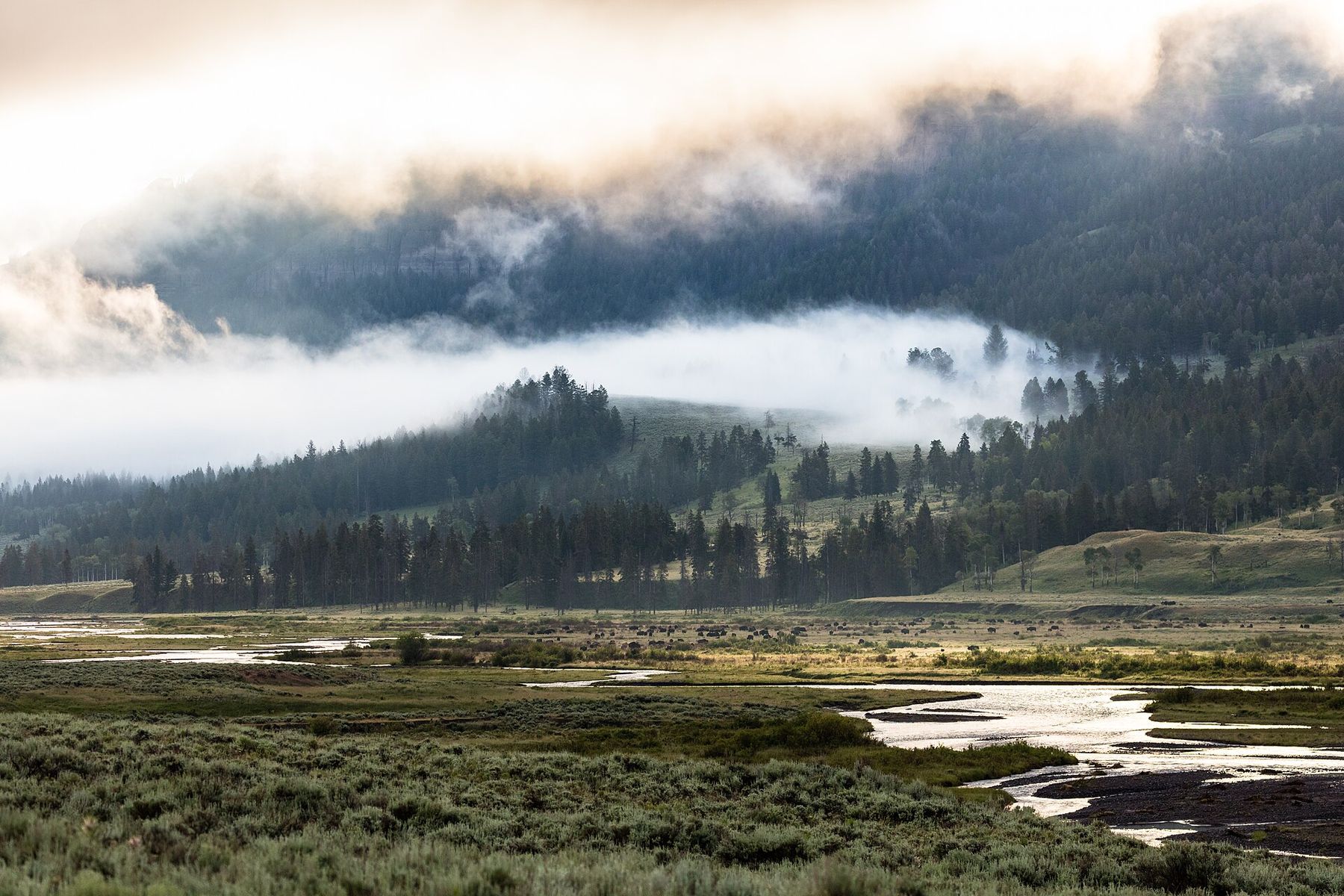
Bison in Yellowstone's Lamar Valley, a landscape running on its own again.
Yellowstone National Park, Bison herd in Lamar Valley on a foggy morning (36499082851), 2017EcoAxes / Included ideologies / Conservation philosophies and practice
Conservation movement and approachRewilding
Restoring ecosystems that sustain themselves by bringing back natural processes. Above all it returns missing species, especially large herbivores and predators, and reduces human management, so that nature can look after itself again. It runs from the continental plans for cores and corridors of the 1990s to the European and British rewilding movements of the 2010s. Trophic rewilding, its best-known form, focuses on the return of large animals and their effects on everything else.
- Key figures
- Michael Soulé and Reed Noss, Dave Foreman, Frans Vera, George Monbiot, Isabella Tree and Charlie Burrell (Knepp)
Where it stands
- Environmental EthicsAnthropocentrismEcocentrism
- Human–Nature RelationsHuman SeparationHuman Integration
- Ecological InterventionNoninterventionActive Stewardship
- Economic PhilosophyGreen GrowthPost-Growth
- Resource OwnershipPrivate StewardshipCommons Governance
- Environmental AuthorityCentralized AuthorityLocal Autonomy
- Technological OutlookTechnological OptimismEcological Precaution
- Conservation StrategySustainable UseStrict Protection
- Human–Wildlife RelationsHuman PriorityWildlife Accommodation
- Agricultural EcologyLand SparingLand Sharing
- Ecological Political PriorityIncremental ReformTransformative Change
Rewilding is united on wildlife and on recovering natural processes; it is divided on how much to intervene (passive versus active rewilding) and on people's place in rewilded land, so those axes carry wide bands.
Definition
Rewilding restores ecosystems to a state where natural processes run with little human management. Those processes include grazing, predation, scavenging, flooding, fire and the slow change of plant communities over time. Rewilding works mainly by bringing back the species that drive them, and by giving land and water room to change.
Classical restoration aims at a historical reference state and keeps it there. Rewilding is open-ended. Its goal is an ecosystem that follows its own course, not a particular mix of species. It ranges from “passive” rewilding, simply stopping management on abandoned land, to “active” or trophic rewilding, which reintroduces keystone species. In scale it runs from continental visions of connected wild land to the rewilding of a single farm or river.
Historical development
Dave Foreman coined the term. Michael Soulé and Reed Noss gave it scientific content in “Rewilding and Biodiversity” (1998), which proposed the “three Cs”: cores, corridors and carnivores. The return of wolves to Yellowstone in 1995 became its emblem, and the subject of a large literature on trophic cascades.
In Europe a distinct movement grew up, focused more on processes and on grazing animals. It drew on Frans Vera’s work on grazing and the Oostvaardersplassen experiment in the Netherlands, on Rewilding Europe (2011), and on the Knepp estate in England, rewilded from 2001 and described in Isabella Tree’s Wilding (2018). George Monbiot’s Feral (2013) made it popular in Britain. “Pleistocene rewilding” (Donlan and colleagues, 2005) proposed bringing in stand-ins for extinct megafauna, and Jens-Christian Svenning and colleagues formalised “trophic rewilding”.
Rewilding has entered European and British policy and the UN Decade on Ecosystem Restoration. It has drawn opposition from farmers, hunters and some conservationists.
Principal claims
- Ecosystems with their full set of species, large animals especially, are more resilient, more diverse and better at regulating themselves than managed ones.
- Conservation should restore processes and let the results unfold, instead of holding ecosystems in fixed states.
- Large areas and connections between them are needed. Abandoned and marginal land offers the chance.
- Bringing back predators and grazing animals can take over the work of human management, such as culling, mowing and burning.
- Rewilding can renew people’s relationship with wild nature and offer a living to replace marginal farming.
Policy implications
Rewilders support reintroducing species such as wolves, lynx, beavers, bison and other large grazers. They want core areas protected and linked by corridors, and farm subsidies redirected toward rewilding on marginal land. They favour less management in reserves, dam removal and river restoration, measures for living alongside wildlife with compensation for lost livestock, and nature tourism.
Internal disagreements
Rewilders disagree about passive as against active rewilding, and about whether to aim at a historical baseline, such as the Pleistocene or the time before farming, or at processes alone. They differ on people: some exclude farming and residents and others include them. They argue over using domestic breeds as stand-ins for extinct species, and over the welfare of free-ranging herds, which became a controversy at the Oostvaardersplassen.
Criticisms and controversies
Farmers and rural communities see rewilding as abandoning land and as a threat to their livelihoods and culture. Some conservationists argue that it loses the species of managed, semi-natural habitats, and that its results are unpredictable. Animal welfare critics objected to animals starving at the Oostvaardersplassen. Political ecologists note that rewilding has displaced herders and depends on wealthy landowners. Indigenous critics see the European idea of “wild” as one more erasure of human history.
Supporters point to the gains for biodiversity at Knepp and elsewhere, and argue that without rewilding, marginal land will be either farmed more intensively or abandoned with no plan.
Relationships to other traditions
Rewilding is the restorative successor to wilderness preservation and a more dynamic relative of restoration conservation, with trophic rewilding as its scientific core. It shares compassionate conservation’s preference for predators over culling by people, but clashes with it over animal welfare. It is the main opponent of agrarian conservatism’s managed countryside, and of land-sharing farming on marginal land. It meets ecomodernism on sparing land and ecological engineering on restoring processes.
References and further reading
- Soulé, M. and Noss, R. (1998). “Rewilding and biodiversity: Complementary goals for continental conservation.” Wild Earth 8(3), 18–28.
- Tree, I. (2018). Wilding: The Return of Nature to a British Farm. Picador.
- Monbiot, G. (2013). Feral: Searching for Enchantment on the Frontiers of Rewilding. Allen Lane.
- Jepson, P. and Blythe, C. (2020). Rewilding: The Radical New Science of Ecological Recovery. Icon Books.
- Perino, A. et al. (2019). “Rewilding complex ecosystems.” Science 364(6438), eaav5570.
- Lorimer, J. et al. (2015). “Rewilding: Science, practice, and politics.” Annual Review of Environment and Resources 40, 39–62.