
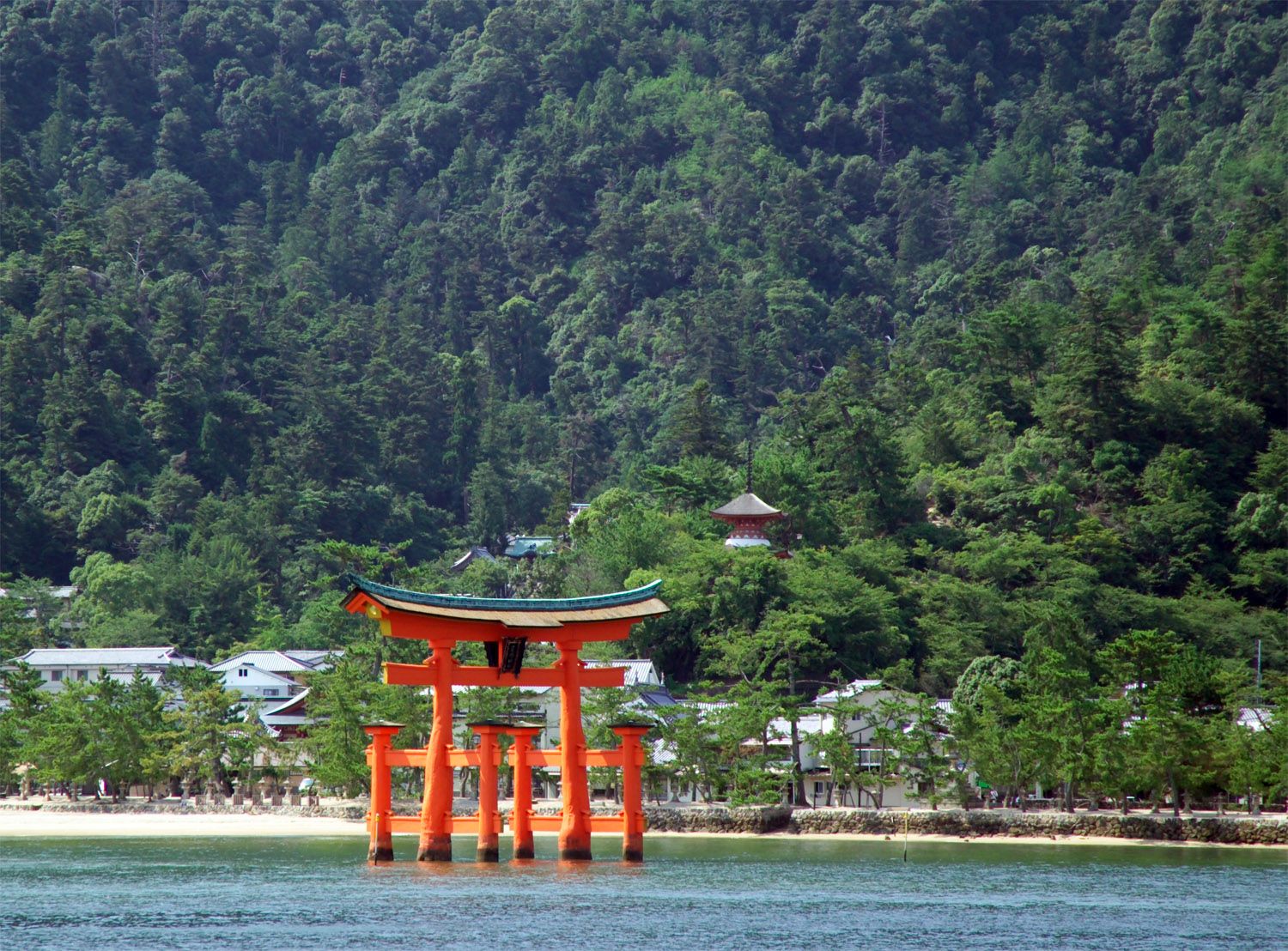
The torii of Itsukushima before Mount Misen, whose forest has been held sacred and left uncut for centuries.
No machine-readable author provided. Fg2 assumed, ItsukushimaTorii7359, 2005EcoAxes / Included ideologies / Religious and spiritual environmental ethics
Religious environmental ethicShinto Chinju no Mori
The Shinto reverence for kami, the sacred presences in mountains, rivers, rocks, trees and the land itself. It is embodied in the chinju no mori, the forests left uncut around Japan's shrines for centuries, and modern movements for forest protection and native forest restoration have taken it up as a model of nature protected because it is sacred.
- Key figures
- Motoori Norinaga (tradition), Minakata Kumagusu, Akira Miyawaki, Sonoda Minoru, Aike P. Rots (as scholar)
Where it stands
- Environmental EthicsAnthropocentrismEcocentrism
- Human–Nature RelationsHuman SeparationHuman Integration
- Ecological InterventionNoninterventionActive Stewardship
- Economic PhilosophyGreen GrowthPost-Growth
- Resource OwnershipPrivate StewardshipCommons Governance
- Environmental AuthorityCentralized AuthorityLocal Autonomy
- Environmental JusticeAggregate OutcomesDistributive Justice
- Technological OutlookTechnological OptimismEcological Precaution
- Energy PhilosophyEnergy AbundanceEnergy Sufficiency
- Conservation StrategySustainable UseStrict Protection
- Human–Wildlife RelationsHuman PriorityWildlife Accommodation
- Agricultural EcologyLand SparingLand Sharing
- Global ResponsibilityNational SovereigntyInternational Ecological Obligation
- Ecological Political PriorityIncremental ReformTransformative Change
Read from Shinto practice and its modern interpreters: nature as the dwelling of kami; the shrine forest as sacred ground left uncut; purity (harae) and the avoidance of pollution; the seasonal rice cycle and its festivals; and the shrine community's care for its own place. Its firmest commitments are to people within nature, strict protection of sacred places, local and community authority, and continuity with tradition. Shinto has no single doctrine or scripture, so the bands are wide.
Definition
Shinto, Japan’s indigenous religious tradition, finds the sacred in the world itself. Kami, sacred presences or powers, dwell in mountains, waterfalls, ancient trees, unusual rocks and whole landscapes, and shrines are built where people sense them. Around many shrines stands a chinju no mori, a “forest of the tutelary kami”. These woods belong to the shrine and have often been left uncut for many centuries, marked off by a sacred rope (shimenawa) and a gate (torii).
As an environmental ethic, Shinto protects places through sacredness instead of law. A place is cared for because it is holy, by the community that worships there. Pollution (kegare) is a spiritual wrong as well as a physical one, and it is cleansed by purification (harae).
Historical development
Shrine forests are among the oldest protected woodlands in Japan. The Kasugayama primeval forest behind the Kasuga Taisha shrine in Nara has been closed to hunting and felling since 841. In the early twentieth century the naturalist Minakata Kumagusu campaigned against the government’s merging of local shrines, which led to their forests being cut down, in one of Japan’s first environmental movements. After the Second World War, Shinto institutions distanced themselves from the State Shinto of the imperial era.
From the 1970s the ecologist Akira Miyawaki studied shrine forests as remnants of Japan’s native vegetation. From them he developed a method of planting dense native forests, since used across Asia and around the world. In recent decades the Association of Shinto Shrines and scholars such as Sonoda Minoru have presented Shinto as a “religion of the forest”, and the “chinju no mori” movement has made shrine forests a symbol of environmental care. The scholar Aike Rots calls this the “greening” of Shinto.
Principal claims
- Nature is where the kami dwell. Mountains, forests, rivers and rocks can be sacred.
- Sacred places, above all shrine forests, should be left whole and protected.
- Pollution is a kind of impurity, to be avoided and cleansed.
- People belong inside nature and live by its seasons, celebrated in festivals of planting and harvest.
- Each community is responsible for the shrine and the land of its own place.
- Continuity with the ways of the ancestors is valuable in itself.
Policy implications
Shinto environmental thought today supports protecting shrine forests and sacred mountains, restoring native forest by Miyawaki’s method, and care for local landscapes and satoyama, the managed countryside of village, woodland and rice field, by the communities who live there. It respects the cycle of seasons and farming. Shrines take part in planting trees, cleaning rivers and protecting sacred sites from development.
Internal disagreements
Scholars disagree about how much of Shinto’s ecological reading recovers old practice and how much is a modern reinterpretation. Shrine communities sometimes favour protecting their forests and sometimes developing shrine land. There is a continuing debate about Shinto and nationalism, since some environmental language about Japan’s sacred land overlaps with conservative and nationalist politics.
Criticisms and controversies
Critics point to the gap between reverence for nature and Japan’s industrial pollution in the twentieth century, from Minamata to the loss of coastal wetlands, and argue that Shinto institutions rarely opposed development. Others note how the imperial state used Shinto, and worry that “nature Shinto” can carry a nationalist message about Japanese uniqueness. Scholars of religion such as Rots treat the green image of Shinto as real but recent.
Supporters point to the shrine forests themselves, which survived where most lowland forest did not.
Relationships to other traditions
Shinto shares with Daoism and eco-spirituality a sense that nature is sacred. It shares a respect for life with Buddhism, with which it was intertwined in Japan for a thousand years. Its stress on place, community and continuity with tradition links it to green and agrarian conservatism, and its care for the village countryside links it to traditions of land sharing. Its sacred groves resemble those of Hindu and African traditions.
References and further reading
- Miyawaki, A. (2006). Chinju no mori (Shrine forests). Tokyo: Shinchōsha.
- Sonoda, M. (2000). Shinto and the natural environment. In J. Breen and M. Teeuwen (eds.), Shinto in History. Richmond: Curzon.
- Kalland, A. (2002). Holism and sustainability: lessons from Japan. Worldviews, 6(2), 145–158.
- Rots, A. P. (2017). Shinto, Nature and Ideology in Contemporary Japan: Making Sacred Forests. London: Bloomsbury.
- Breen, J. and Teeuwen, M. (2010). A New History of Shinto. Chichester: Wiley-Blackwell.
- Miyawaki, A. and Box, E. O. (2006). The Healing Power of Forests. Tokyo: Kosei.