
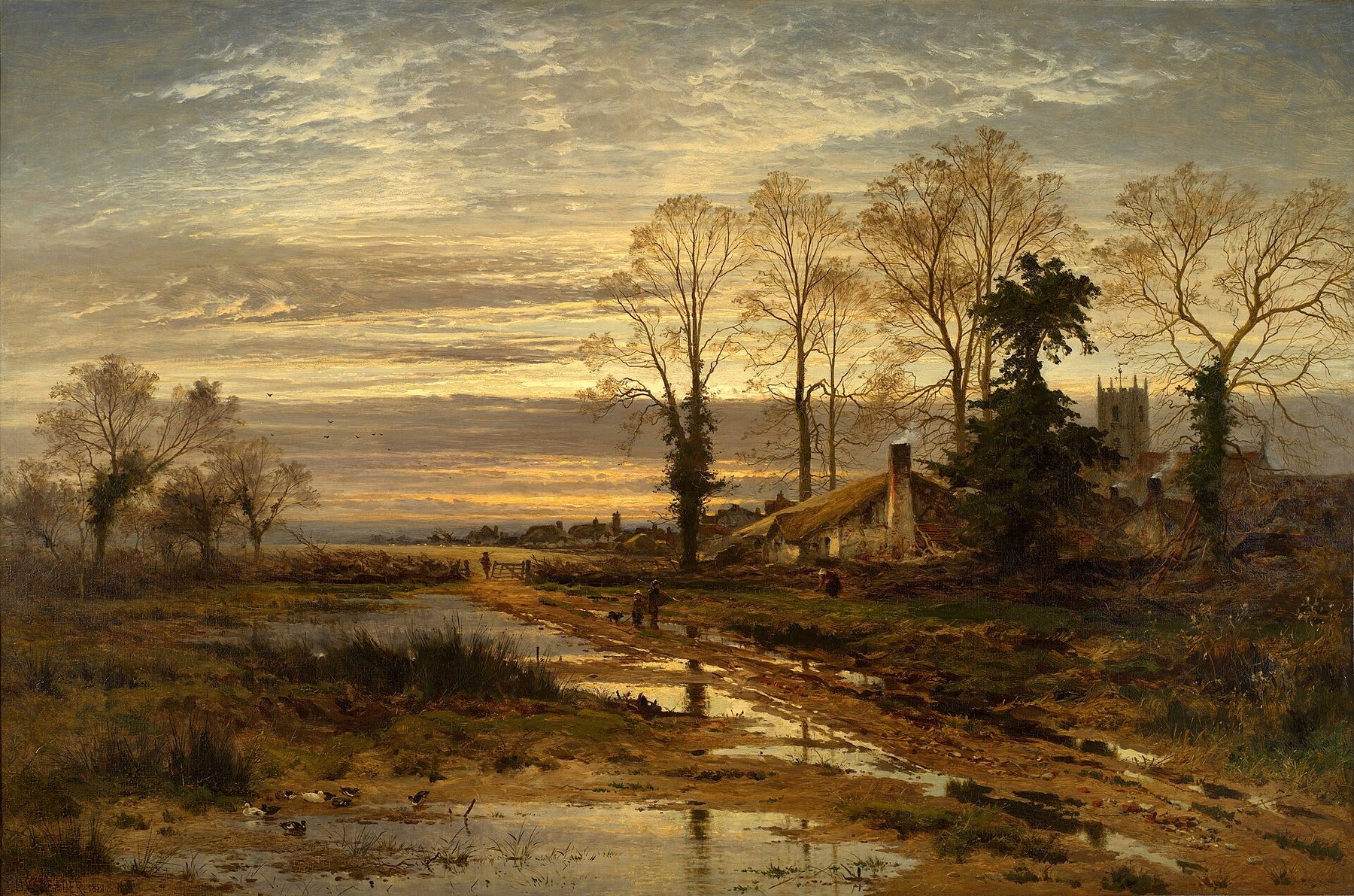
Leader's February Fill Dyke, 1881: a wet English lane between hedged fields, an inherited landscape kept by those who live in it.
Benjamin Williams Leader, February Fill Dyke, 1881EcoAxes / Included ideologies / Conservative and traditionalist environmentalism
Political ideologyGreen Conservatism
Conservative environmentalism, given its fullest statement by Roger Scruton. It grounds care for the environment in love of home and place, in duties of inheritance between generations, and in local association and private stewardship, and it distrusts both large state programmes and international bureaucracy. It includes the traditionalist view that inherited ways of farming, building and living on the land hold a wisdom modern society has lost.
- Key figures
- Roger Scruton, Edmund Burke (antecedent), John Gray, Russell Kirk, Jonathan Porritt (as interlocutor)
Where it stands
- Environmental EthicsAnthropocentrismEcocentrism
- Human–Nature RelationsHuman SeparationHuman Integration
- Economic PhilosophyGreen GrowthPost-Growth
- Resource OwnershipPrivate StewardshipCommons Governance
- Environmental AuthorityCentralized AuthorityLocal Autonomy
- Environmental JusticeAggregate OutcomesDistributive Justice
- Technological OutlookTechnological OptimismEcological Precaution
- Energy PhilosophyEnergy AbundanceEnergy Sufficiency
- Conservation StrategySustainable UseStrict Protection
- Human–Wildlife RelationsHuman PriorityWildlife Accommodation
- Agricultural EcologyLand SparingLand Sharing
- Global ResponsibilityNational SovereigntyInternational Ecological Obligation
- Ecological Political PriorityIncremental ReformTransformative Change
Green conservatism is explicit on localism, inheritance, private stewardship and reform, and on scepticism of international governance. Its economic position is mixed (pro-market, anti-consumerist).
Definition
Green conservatism holds that conservatism, properly understood, is already an environmental philosophy. Conservatives are attached to home, place, inheritance and settled community, which Scruton called oikophilia, love of home. That attachment, the argument goes, is the most dependable motive for protecting the environment, more dependable than abstract principles, global institutions or state planning.
Edmund Burke’s description of society as a partnership between the living, the dead and those not yet born is its founding text. Green conservatism prefers action that is local, voluntary, civic and based on property. It distrusts international and centralised solutions. It treats the countryside, the landscape and inherited buildings and towns as things to be cared for.
Historical development
Conservative environmental thought draws on Burke and on the Romantic and Tory criticism of industrialism: John Ruskin and William Morris on one side, Benjamin Disraeli’s “two nations” on another. It draws on Theodore Roosevelt’s conservation and on the rural traditionalism of the Southern Agrarians and the English countryside movement.
Explicit statements came late. Russell Kirk and John Gray wrote about it, and John Bliese’s The Greening of Conservative America (2001) documented it. Roger Scruton’s Green Philosophy: How to Think Seriously About the Planet (2012) set it out systematically, defining it against both radical environmentalism and the indifference of free-market thinking. Conservative parties in Europe have sometimes adopted it. In the United States it remains a minority current in conservatism.
Principal claims
- Love of home and place is the natural root of caring for the environment. Environmentalism should build on it instead of on global abstractions.
- Each generation holds the environment in trust, received from the past and owed to the future.
- Civic association, local initiative and private property work better than state programmes and international bodies, and have more right to act.
- Markets have value, but law and custom must limit them. Consumerism and pushing costs onto others are vices.
- Beauty, landscape and settled country life are environmental values in their own right.
Policy implications
Green conservatives support local conservation trusts, stewardship of the countryside and planning that protects landscape. They favour incentives that work through property, and resist large infrastructure and targets set from the centre. They distrust international agreements and carbon markets, and support farming and rural communities. They see pollution law as the protection of one’s neighbours. Scruton favoured making polluters pay, but doubted the international climate regime.
Internal disagreements
Green conservatives disagree about how far to trust markets, and Scruton was more critical of them than most American conservatives. They range from active engagement on climate change to scepticism about it. They weigh protecting the landscape against property rights differently, and argue about whether hunting and field sports are part of stewardship or its opposite.
Criticisms and controversies
Critics argue that love of home cannot deal with problems on a planetary scale, that localism serves people who own property, that green conservatism has been more talk than achievement, and that its distrust of international action adds up to doing nothing about climate. Free-market conservatives find it too interventionist. Environmentalists find it too complacent.
Green conservatives answer that the environmental movement’s reliance on the state and on global institutions has produced alienation and backlash, and that most real conservation is done by local people attached to their places.
Relationships to other traditions
Green conservatism includes agrarian and traditionalist environmentalism and conservation conservatism. It shares the land ethic’s faith in landowners as stewards and overlaps with Christian stewardship. It sits beside free-market environmentalism but rejects its indifference to beauty and custom. It is the opposite of eco-authoritarianism and of international planetary stewardship, and it defines itself against the ecological left.
References and further reading
- Scruton, R. (2012). Green Philosophy: How to Think Seriously About the Planet. Atlantic Books. (Published in the United States as How to Think Seriously About the Planet: The Case for an Environmental Conservatism, Oxford University Press.)
- Burke, E. (1790). Reflections on the Revolution in France.
- Bliese, J. R. E. (2001). The Greening of Conservative America. Westview Press.
- Kirk, R. (1970). “Conservatives and the environment.” Reprinted in The Essential Russell Kirk (2007), ISI Books.