
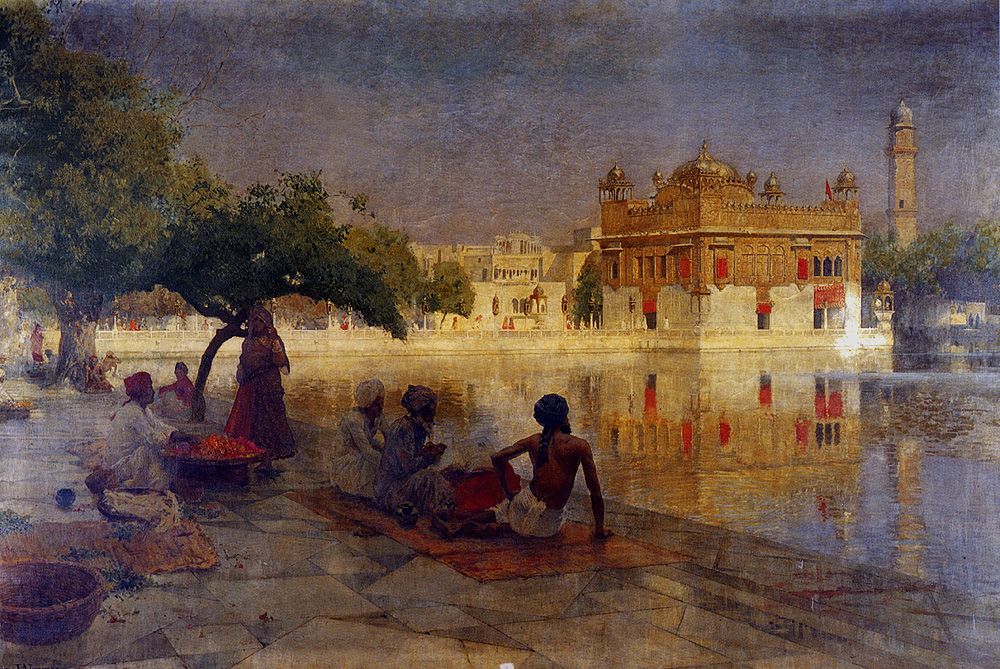
The Harmandir Sahib in its sacred pool: water, the father of all, at the centre of Sikh worship.
Edwin Lord Weeks, The Golden Temple Amritsar 1890, 1890EcoAxes / Included ideologies / Religious and spiritual environmental ethics
Religious ethical traditionSikh Sarbat da Bhala
The Sikh teaching that the one Creator is present throughout creation, summed up in the closing verse of the Japji Sahib: "Air is the Guru, water the father, and earth the great mother of all". Joined to the ideals of honest work, sharing and the welfare of all (sarbat da bhala), it has grown into a modern environmental movement of tree planting, river restoration and community service.
- Key figures
- Guru Nanak (tradition), Guru Har Rai (tradition), Sant Balbir Singh Seechewal, Rajwant Singh and EcoSikh, Bhagat Puran Singh
Where it stands
- Environmental EthicsAnthropocentrismEcocentrism
- Human–Nature RelationsHuman SeparationHuman Integration
- Ecological InterventionNoninterventionActive Stewardship
- Economic PhilosophyGreen GrowthPost-Growth
- Resource OwnershipPrivate StewardshipCommons Governance
- Environmental AuthorityCentralized AuthorityLocal Autonomy
- Environmental JusticeAggregate OutcomesDistributive Justice
- Technological OutlookTechnological OptimismEcological Precaution
- Energy PhilosophyEnergy AbundanceEnergy Sufficiency
- Conservation StrategySustainable UseStrict Protection
- Human–Wildlife RelationsHuman PriorityWildlife Accommodation
- Agricultural EcologyLand SparingLand Sharing
- Global ResponsibilityNational SovereigntyInternational Ecological Obligation
- Ecological Political PriorityIncremental ReformTransformative Change
Read from Guru Nanak's Japji Sahib ('air is the guru, water the father, earth the great mother'), the ideal of sarbat da bhala (the welfare of all), the householder's life in the world, and the duties of vand chhakko (sharing), kirat karni (honest work), langar and seva, of which river restorations such as the Kali Bein are the best-known environmental form. Equality and universal welfare are its firmest commitments.
Definition
Sikh sarbat da bhala rests on the teaching of the Guru Granth Sahib that the one Creator (Ik Onkar) runs through all of creation. The natural world expresses the divine and should be treated with reverence. The closing verse of Guru Nanak’s Japji Sahib names air as the Guru, water as the father and earth as the great mother of all.
Sikh ethics joins this to three practical duties: kirat karo, earn an honest living; vand chhako, share what you have; and naam japo, remember the divine. It adds the ideal of sarbat da bhala, the welfare of all, and seva, selfless service to the community. In modern form these ground an ethic of restraint, sharing, equality and practical service toward land, water and living things.
Historical development
Guru Nanak (1469–1539) and the Gurus after him taught in the farming country of Punjab, and their hymns are full of images of nature. The seventh Guru, Har Rai (1630–1661), is remembered for his gardens, his herbal dispensary and his care for animals. The langar, the free communal kitchen of every gurdwara, embodies sharing and equality.
The modern environmental movement arose in response to what the Green Revolution cost Punjab: falling water tables, damaged soils, heavy pesticide use and polluted rivers. From 2000 Sant Balbir Singh Seechewal led a volunteer kar seva (service) campaign that cleaned the 160-kilometre Kali Bein rivulet, which is associated with Guru Nanak, and it became a model for river restoration in India. Bhagat Puran Singh, founder of the Pingalwara charity in Amritsar, had campaigned for the environment from the mid-twentieth century.
EcoSikh, founded in 2009, promoted Sikh Environment Day on 14 March, the anniversary of Guru Har Rai’s succession, and environmentally friendly gurdwaras. For the 550th anniversary of Guru Nanak’s birth in 2019 it planted hundreds of thousands of trees in small “Guru Nanak Sacred Forests”.
Principal claims
- The divine is present throughout creation, so nature should be revered and not merely used.
- Air, water and earth are Guru, father and mother, sources of life that are owed respect.
- Honest work, sharing and moderation are religious duties. Greed and waste are failings.
- All people are equal. The welfare of all, future generations included, is the measure of right action.
- Faith is practised through selfless service (seva), and that includes service to land and water.
Policy implications
Sikh environmentalism supports restoring rivers and water through volunteer service, planting trees and small native forests, saving water and reforming the irrigation that is draining Punjab’s groundwater. It wants less pesticide and more sustainable farming. It greens gurdwaras and their langars by cutting waste and energy use, and it teaches environmental care in Sikh communities in India and abroad.
Internal disagreements
Sikhs disagree about how to reconcile reverence for the land with Punjab farmers’ economic dependence on intensive rice and wheat. They differ on the roles of religious institutions and community movements, on the balance between local action through seva and political campaigning, and on emphasis between Punjab and the diaspora.
Criticisms and controversies
Observers note the gap between the teaching and Punjab’s environmental crisis, in which Sikh farming communities are central. Critics of campaigns built on seva argue that volunteer clean-ups cannot replace regulation of industrial and municipal pollution.
Supporters point to the measurable success of the Kali Bein restoration and to the power of religious service to bring people out.
Relationships to other traditions
Sikh sarbat da bhala shares a South Asian setting and a sacred regard for rivers, earth and living things with Hindu dharmic ecology and Islamic amanah. Its stress on equality and the welfare of all links it to environmental justice. Its practice of seva aligns it with community conservation and restoration-centred conservation, and its sense of the divine in nature connects it to eco-spirituality.
References and further reading
- Guru Granth Sahib, Japji Sahib (closing shalok: “Pavan guru pani pita, mata dharat mahat”).
- Nesbitt, E. (2016). Sikhism: A Very Short Introduction, 2nd ed. Oxford University Press.
- Singh, P. and Fenech, L. E., eds. (2014). The Oxford Handbook of Sikh Studies. Oxford University Press.
- Palmer, M. and Finlay, V. (2003). Faith in Conservation: New Approaches to Religions and the Environment. World Bank.