
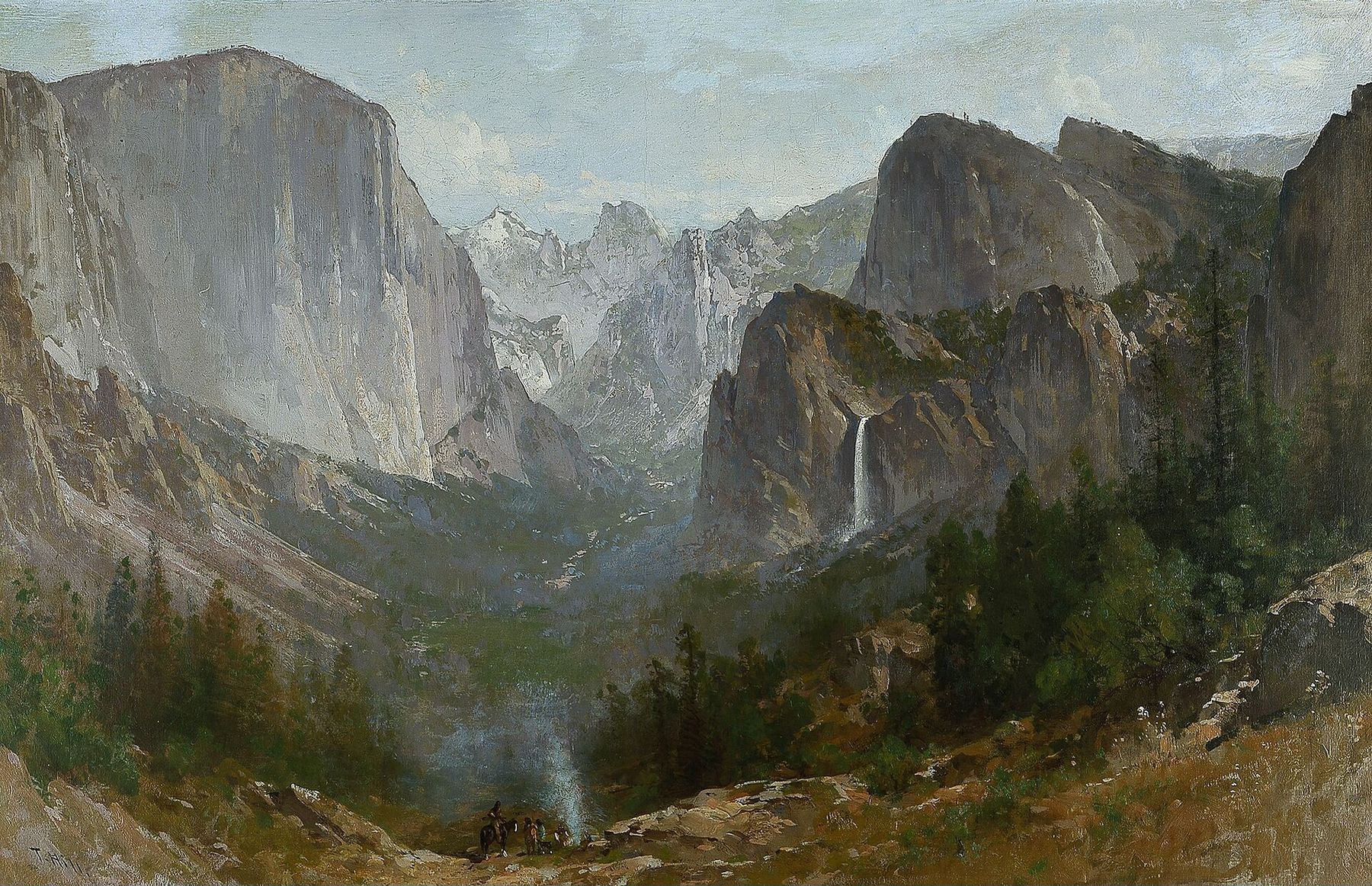
The Ahwahneechee of Yosemite, removed from the valley to make the park.
Thomas Hill, Indians at Campfire, Yosemite Valley, California, 1885EcoAxes / Included ideologies / Conservation philosophies and practice
Conservation frameworkRights-Based Conservation
The framework that makes respect for human rights a binding condition of all conservation, including the rights of Indigenous peoples and local communities to land, resources, consent and participation. Conservation that violates rights is illegitimate whatever its ecological results, and securing rights is itself an effective way to conserve.
- Key figures
- Jessica Campese, Peter Veit, Victoria Tauli-Corpuz (UN Special Rapporteur), Forest Peoples Programme, Rights and Resources Initiative
Where it stands
- Environmental EthicsAnthropocentrismEcocentrism
- Human–Nature RelationsHuman SeparationHuman Integration
- Resource OwnershipPrivate StewardshipCommons Governance
- Environmental AuthorityCentralized AuthorityLocal Autonomy
- Environmental JusticeAggregate OutcomesDistributive Justice
- Conservation StrategySustainable UseStrict Protection
- Human–Wildlife RelationsHuman PriorityWildlife Accommodation
- Global ResponsibilityNational SovereigntyInternational Ecological Obligation
- Ecological Political PriorityIncremental ReformTransformative Change
Rights-based conservation is defined by its justice and governance commitments; its positions on conservation strategy and wildlife follow from them and carry wider bands.
Definition
Rights-based conservation, also called the rights-based approach to conservation, holds that conservation policy and practice must respect, protect and fulfil human rights. Above all these are the rights of Indigenous peoples and local communities to their lands, territories and resources, to free, prior and informed consent, to take part in decisions, to their culture and livelihood, and to a remedy when their rights are violated.
Rights work in two ways here. They limit conservation, by setting out what may not be done in its name. And they are a means to it, because people with secure rights look after the land.
The approach draws on international human rights law, the UN Declaration on the Rights of Indigenous Peoples and the Convention on Biological Diversity. The IUCN and the major conservation NGOs have adopted it, at least on paper.
Historical development
The approach grew out of criticism, in the 1990s and 2000s, of conservation that displaced and abused people. The World Parks Congress at Durban in 2003 called for a “new paradigm” that respected rights, and the UN Declaration on the Rights of Indigenous Peoples followed in 2007. The IUCN’s Conservation Initiative on Human Rights (2009) and the social principles of the Conservation Standards came next.
In 2016 Victoria Tauli-Corpuz, as UN Special Rapporteur on the Rights of Indigenous Peoples, reported that conservation projects were still violating rights and called for reform based on rights. Investigations in 2019–20 into abuses linked to rangers supported by WWF led to independent reviews and renewed commitments. The Rights and Resources Initiative and the Forest Peoples Programme have led the policy work. The Kunming–Montreal framework (2022) is the first global biodiversity agreement to make respect for rights a condition of its targets.
Principal claims
- Human rights cannot be traded for conservation results. Conservation that violates them is illegitimate.
- Indigenous peoples and local communities have rights to their lands and to consent, and conservation must honour them.
- Secure rights lead to better conservation. Insecure tenure drives damage.
- Conservation organisations and states are accountable for abuses committed in conservation’s name, and must provide a remedy.
- Participation has to be real, informed and backed by power.
Policy implications
The approach calls for human rights checks and safeguards in every conservation project, recognition of rights to land and resources, and consent requirements. It wants ways to raise grievances and obtain remedy, reform of ranger forces and enforcement, and conservation money directed to those who hold the rights. It calls for land taken for conservation to be audited and returned, and for rights outcomes to be monitored alongside outcomes for biodiversity.
Internal disagreements
Practitioners disagree about whether rights limit conservation or underpin it. They differ on how to handle conflicts between rights and urgent threats to biodiversity, and on how far the approach can be carried out through existing NGOs and states. Some see Land Back as part of their work, while others regard it as beyond their remit.
Criticisms and controversies
Neoprotectionists argue that the language of rights has been used to weaken protection. Indigenous critics argue that rights frameworks leave decisions with states and NGOs, and offer process in place of giving land back. Political ecologists say safeguards are often commitments on paper only.
Supporters point to growing evidence that secure tenure goes with better conservation, and to abuses that came to light only because rights were being monitored.
Relationships to other traditions
Rights-based conservation is the legal and institutional core of community conservation, grounded in Indigenous environmental sovereignty and environmental justice. Land Back and convivial conservation are its radical extensions. It is the leading reformist opponent of fortress conservation and of militarised enforcement.
References and further reading
- Campese, J., Sunderland, T., Greiber, T. and Oviedo, G., eds. (2009). Rights-based Approaches: Exploring Issues and Opportunities for Conservation. CIFOR and IUCN.
- Tauli-Corpuz, V. (2016). Report of the Special Rapporteur on the Rights of Indigenous Peoples: Conservation and Indigenous Peoples’ Rights. UN Doc. A/71/229.
- Rights and Resources Initiative (2020). Rights-Based Conservation: The Path to Preserving Earth’s Biological and Cultural Diversity?
- Tauli-Corpuz, V., Alcorn, J., Molnar, A., Healy, C. and Barrow, E. (2020). “Cornered by PAs: Adopting rights-based approaches to enable cost-effective conservation and climate action.” World Development 130, 104923.