
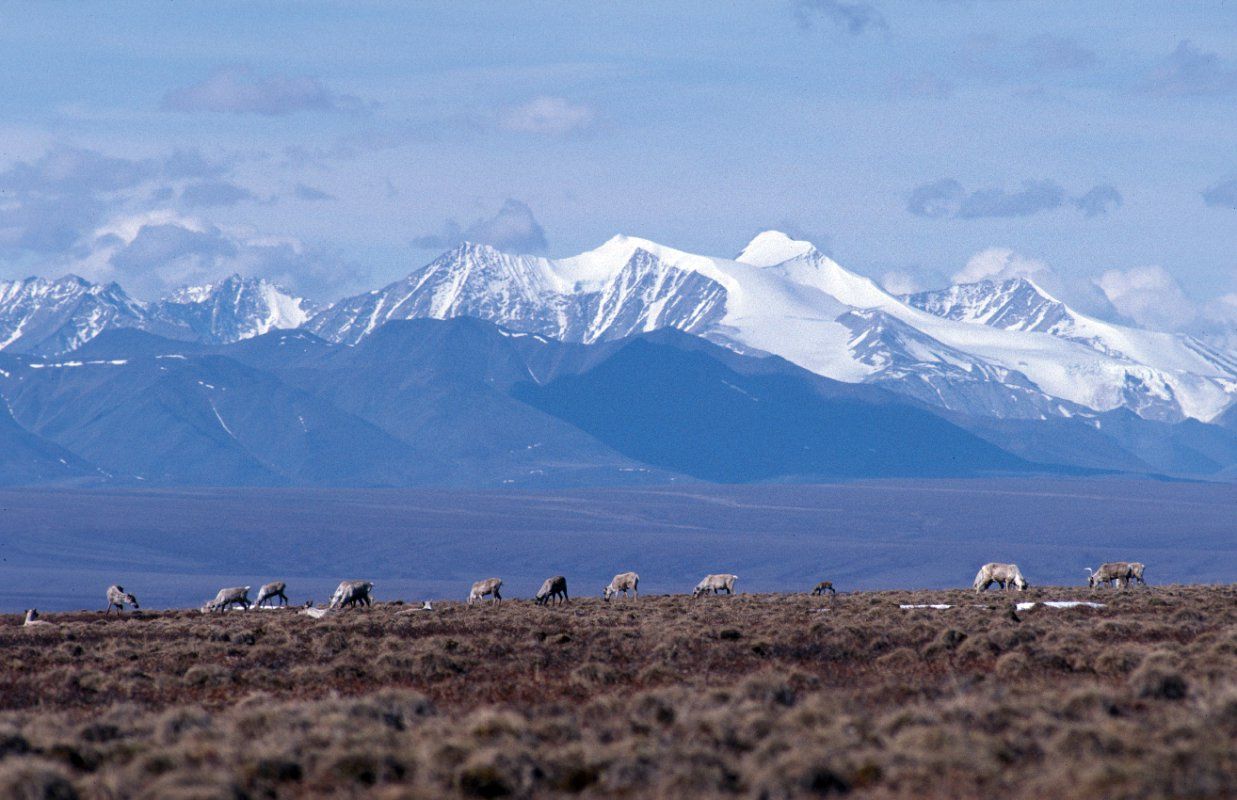
Caribou on the Arctic National Wildlife Refuge's coastal plain, protected by federal law and fought over in Congress for forty years.
Department of the Interior. U.S. Fish and Wildlife Service. National C, 1002 Area- Caribou with mountain backdrop - DPLA - c55ad0a9decbbc4074a695117387aa4bEcoAxes / Included ideologies / Liberal, reformist and market environmentalism
Political movement and strategyReform Environmentalism
The environmentalism of the large national and international organisations, from the Sierra Club and the Natural Resources Defense Council to the Environmental Defense Fund and WWF. It protects land, wildlife, air, water and climate through law, regulation, lawsuits, elections, science and international agreements, working to reform existing institutions instead of replacing them.
- Key figures
- Rachel Carson, David Brower (in his Sierra Club years), Gaylord Nelson, Fred Krupp, Gus Speth
Where it stands
- Environmental EthicsAnthropocentrismEcocentrism
- Human–Nature RelationsHuman SeparationHuman Integration
- Ecological InterventionNoninterventionActive Stewardship
- Economic PhilosophyGreen GrowthPost-Growth
- Resource OwnershipPrivate StewardshipCommons Governance
- Environmental AuthorityCentralized AuthorityLocal Autonomy
- Environmental JusticeAggregate OutcomesDistributive Justice
- Technological OutlookTechnological OptimismEcological Precaution
- Energy PhilosophyEnergy AbundanceEnergy Sufficiency
- Conservation StrategySustainable UseStrict Protection
- Human–Wildlife RelationsHuman PriorityWildlife Accommodation
- Agricultural EcologyLand SparingLand Sharing
- Global ResponsibilityNational SovereigntyInternational Ecological Obligation
- Ecological Political PriorityIncremental ReformTransformative Change
Its firmest commitments are to protected land and wildlife, to binding international environmental agreements, and to change through existing institutions. Its positions on growth, technology and energy sit near the middle and vary across organisations, so they carry wider bands; its support for national agencies and federal law places it toward central authority.
Definition
Reform environmentalism is the environmentalism of the established organisations, and of the laws they won. It treats environmental harms as problems that good public policy can solve. Pollution can be regulated, wild places protected by statute, endangered species listed and brought back, and climate change tackled through treaties, standards and investment in clean energy.
Its method is to work through institutions. It lobbies legislators, sues polluters and government agencies, pays for science, endorses candidates, negotiates with companies and mobilises its members. It measures success in laws passed and enforced. The sociologist Robert Brulle identified it as one of the main strands of American environmentalism. It is the form most people meet when they join, give to or read about an environmental group.
Historical development
Its roots are in the conservation and preservation organisations of the early twentieth century, but its modern form was made around 1970. Rachel Carson’s Silent Spring (1962) made pesticide pollution a public issue. The first Earth Day, organised by Senator Gaylord Nelson in 1970, drew millions. Within a few years the United States passed the National Environmental Policy Act, amendments to the Clean Air Act, the Clean Water Act and the Endangered Species Act, and similar laws followed in Europe and elsewhere.
New organisations built around law and science, the Environmental Defense Fund (1967) and the Natural Resources Defense Council (1970), joined older groups such as the Sierra Club and the National Audubon Society. Internationally, WWF (1961), the Stockholm Conference (1972), and later the Montreal Protocol (1987), the Rio conventions (1992) and the Paris Agreement (2015) carried the same reforming approach to the global scale.
Principal claims
- Environmental problems are real and serious, and public policy can solve most of them.
- Law, regulation and enforcement are the main tools of environmental progress.
- Protected areas and the protection of species are among the greatest achievements of environmental politics.
- Science should guide policy, and environmental organisations should help produce it and defend it.
- Problems that cross borders need international cooperation through binding agreements.
- Progress comes from working inside democratic institutions: winning elections, passing laws and building broad coalitions.
Policy implications
Reform environmentalists support strong pollution standards, protected areas and laws on endangered species, and environmental impact assessment. They back carbon pricing or clean energy standards, public investment in renewables and efficiency, defence of the powers of environmental agencies, and participation in international agreements on climate and biodiversity. Some organisations, such as the Environmental Defense Fund, pioneered market mechanisms like emissions trading. Others prefer direct regulation.
Internal disagreements
The organisations differ on how far to compromise with industry and government, a division that deepened when some groups backed emissions trading or partnerships with corporations. They differ on nuclear power, on large renewable energy projects in wild places, and on whether climate or biodiversity comes first. Since the 1990s they have also divided over how fully to take up environmental justice, whose advocates criticised the major groups’ leadership and priorities.
Criticisms and controversies
Radical critics, from Earth First! to ecosocialists, argue that reform environmentalism has traded principle for access, and that step-by-step policy cannot match the scale of the crisis. Mark Dowie argued in Losing Ground (1995) that the major groups had grown cautious and close to the interests they were supposed to regulate. Environmental justice advocates charged that the large organisations were mostly white and middle class, and cared more for wild places than for the communities living with pollution. Conservatives and libertarians argue the opposite: that the regulatory model is costly, centralised and hostile to property.
Supporters point to cleaner air and water, species brought back, and the systems of protected areas built over half a century.
Relationships to other traditions
Reform environmentalism is the practical, organisational counterpart of green liberalism, which supplies much of its political philosophy, and it inherits preservationism’s aim of protecting land. It overlaps with sustainable development internationally and with green social democracy on climate policy, and environmental justice has shaped and challenged it. Radical wilderness defence and the anti-capitalist traditions define themselves against its reformism.
References and further reading
- Carson, R. (1962). Silent Spring. Boston: Houghton Mifflin.
- Hays, S. P. (1987). Beauty, Health, and Permanence: Environmental Politics in the United States, 1955–1985. Cambridge: Cambridge University Press.
- Gottlieb, R. (1993). Forcing the Spring: The Transformation of the American Environmental Movement. Washington, DC: Island Press.
- Dowie, M. (1995). Losing Ground: American Environmentalism at the Close of the Twentieth Century. Cambridge, MA: MIT Press.
- Brulle, R. J. (2000). Agency, Democracy, and Nature: The U.S. Environmental Movement from a Critical Theory Perspective. Cambridge, MA: MIT Press.
- Speth, J. G. (2004). Red Sky at Morning: America and the Crisis of the Global Environment. New Haven: Yale University Press.
- Shellenberger, M. and Nordhaus, T. (2004). The Death of Environmentalism. (Essay, as critique.)