
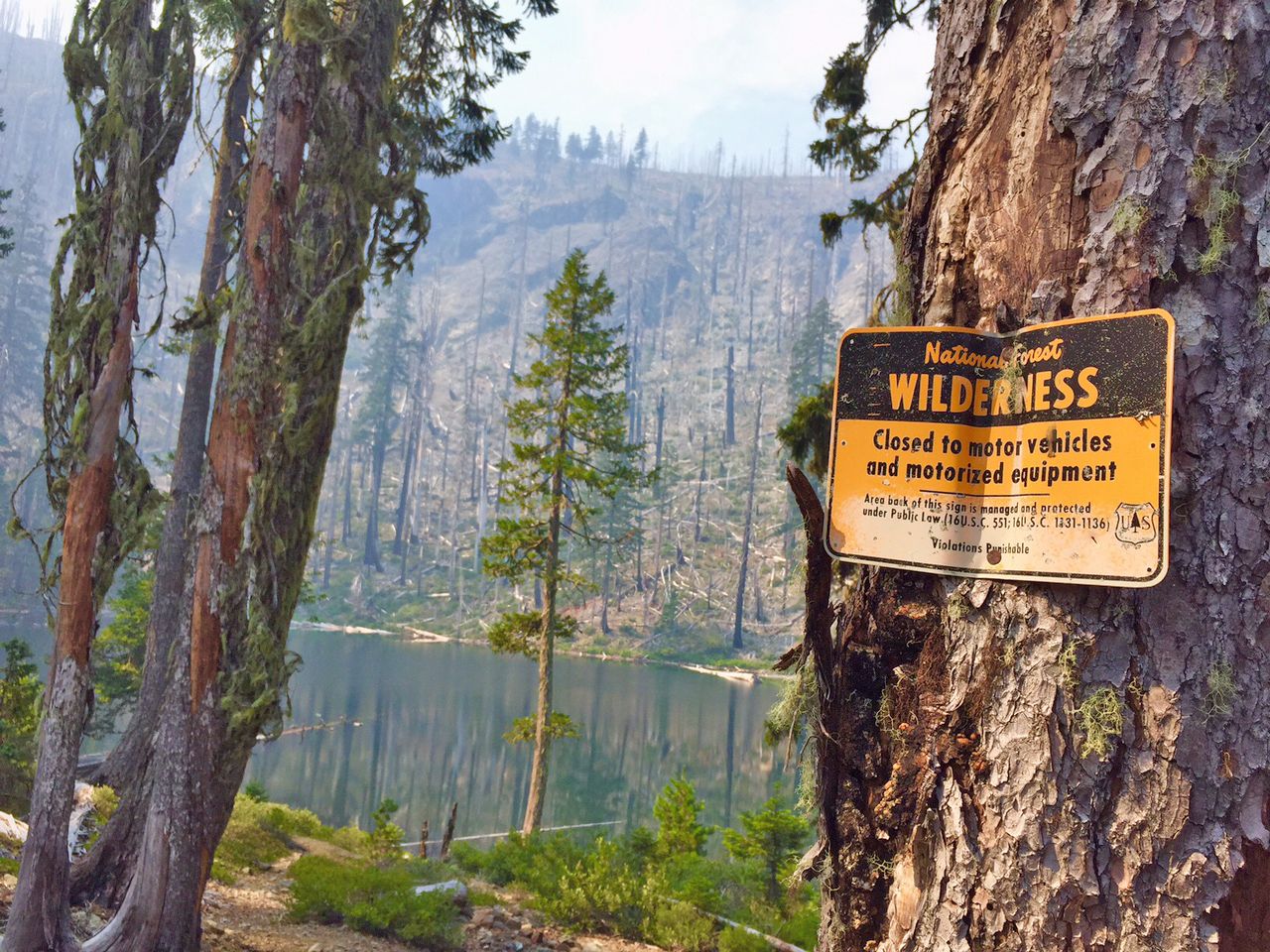
The Kalmiopsis Wilderness, Oregon, where Earth First! staged its first forest blockade in 1983.
U.S. Forest Service- Pacific Northwest Region, Babyfoot Lake in the Kalmiopsis Wilderness, Rogue River Siskiyou National Forest (25232370, 2015EcoAxes / Included ideologies / Conservation philosophies and practice
Direct-action movementRadical Wilderness Defence
The movement launched by Earth First! in 1980, drawing on Edward Abbey's fiction, that defends wild nature by direct action, civil disobedience and sometimes sabotage. It rests on the ecocentric conviction that wilderness has value in itself, and that mainstream environmentalism has bargained it away.
- Key figures
- Dave Foreman, Edward Abbey, Mike Roselle, Howie Wolke, Judi Bari
Where it stands
- Environmental EthicsAnthropocentrismEcocentrism
- Human–Nature RelationsHuman SeparationHuman Integration
- Ecological InterventionNoninterventionActive Stewardship
- Economic PhilosophyGreen GrowthPost-Growth
- Resource OwnershipPrivate StewardshipCommons Governance
- Environmental AuthorityCentralized AuthorityLocal Autonomy
- Environmental JusticeAggregate OutcomesDistributive Justice
- Technological OutlookTechnological OptimismEcological Precaution
- Energy PhilosophyEnergy AbundanceEnergy Sufficiency
- Conservation StrategySustainable UseStrict Protection
- Human–Wildlife RelationsHuman PriorityWildlife Accommodation
- Agricultural EcologyLand SparingLand Sharing
- Global ResponsibilityNational SovereigntyInternational Ecological Obligation
- Ecological Political PriorityIncremental ReformTransformative Change
Its defining commitments are firm: wilderness valued for its own sake and kept free of human use, strict protection, and transformative rather than incremental change pursued outside institutions. Its suspicion of the state and of corporate power places it toward local autonomy; its views on justice and international obligation vary widely across the movement and carry wide bands.
Definition
Radical wilderness defence protects wild places by confronting their destruction head on. Its activists block logging roads, sit in old-growth trees and occupy sites. In its most militant form they disable machinery, which they call “ecotage” or “monkeywrenching”.
Its ethics are ecocentric: wilderness and wild species have value whatever their use to people. Its politics are anti-institutional: mainstream groups, by negotiating and lobbying, have given away too much. Its slogan, “No compromise in defense of Mother Earth”, states both commitments at once.
Historical development
Edward Abbey’s novel The Monkey Wrench Gang (1975), about saboteurs plotting to blow up the Glen Canyon Dam, gave the movement its imagery. In 1980 Dave Foreman, Howie Wolke, Mike Roselle and others, disillusioned with the Wilderness Society and the Sierra Club after the RARE II review of roadless areas, founded Earth First!. In its first action, in 1981, members unrolled a huge plastic “crack” down the face of Glen Canyon Dam. Blockades followed in Oregon’s Kalmiopsis wilderness in 1983 and across the Pacific Northwest, where sitting in trees became the signature tactic. Foreman and Bill Haywood set out techniques of sabotage in Ecodefense (1985).
In the late 1980s Judi Bari and others steered the movement toward alliances with timber workers and toward nonviolence, culminating in Redwood Summer (1990). That year Bari’s car was bombed, and infiltration by the FBI hardened divisions. Foreman left in 1990 and turned to the Wildlands Project and conservation biology. The tradition continues in campaigns to defend forests, in Britain’s road protests of the 1990s, and in later blockades of pipelines and logging.
Principal claims
- Wilderness and wild species have value in themselves, apart from any benefit to people.
- Large, connected, roadless wild areas, free of extraction and development, are the heart of conservation.
- Mainstream environmental organisations, by seeking influence in government and industry, have bargained away the wild places they claim to defend.
- When legal routes fail to stop destruction that cannot be undone, civil disobedience and direct action are justified.
- The central environmental problem is industrial civilisation spreading into the last wild places.
Policy implications
The movement presses for permanent protection of every remaining roadless area and old-growth forest, and for an end to logging, mining and road-building on wild public land. It wants dams removed and large cores of wilderness restored, linked by corridors where predators can return. Foreman’s later Wildlands Project made that last aim a programme of conservation biology. What sets the movement apart is its methods more than any package of laws.
Internal disagreements
The deepest split has been over sabotage. Foreman’s generation defended monkeywrenching aimed at property. Bari and others renounced tree spiking after it injured a mill worker in 1987, and argued that alliances with workers required strict nonviolence. A second split separated an ecocentrism that put wilderness first, which some early leaders expressed in misanthropic and anti-immigrant terms, from a social justice wing influenced by social ecology and anarchism. Murray Bookchin’s attacks on the movement’s early rhetoric sharpened that divide.
Criticisms and controversies
Critics in government and industry called the movement eco-terrorist. Its sabotage was aimed at property, but in at least one well-known case it endangered a worker. Social ecologists and environmental justice advocates attacked the misanthropy of some early statements. Historians of conservation such as William Cronon argued that the ideal of untouched wilderness erases the peoples who shaped and lived on those lands.
Supporters point to the old-growth forests, roadless areas and rivers that would have been lost without the movement.
Relationships to other traditions
Radical wilderness defence is the activist form of deep ecology and ecocentrism, and the radical edge of preservationism. It differs from John Muir’s tradition in rejecting the political compromises through which the national parks were won. Its call for wild cores and corridors anticipates rewilding. Its rejection of the state and its direct action overlap with green anarchism, but its focus on wilderness sets it apart from anarchism’s concern with social hierarchy.
References and further reading
- Abbey, E. (1975). The Monkey Wrench Gang. Philadelphia: Lippincott.
- Foreman, D. and Haywood, B. (eds.) (1985). Ecodefense: A Field Guide to Monkeywrenching. Tucson: Ned Ludd Books.
- Manes, C. (1990). Green Rage: Radical Environmentalism and the Unmaking of Civilization. Boston: Little, Brown.
- Foreman, D. (1991). Confessions of an Eco-Warrior. New York: Harmony Books.
- Bari, J. (1994). Timber Wars. Monroe, ME: Common Courage Press.
- Scarce, R. (1990). Eco-Warriors: Understanding the Radical Environmental Movement. Chicago: Noble Press.
- Zakin, S. (1993). Coyotes and Town Dogs: Earth First! and the Environmental Movement. New York: Viking.
- Cronon, W. (1995). The trouble with wilderness; or, getting back to the wrong nature. In W. Cronon (ed.), Uncommon Ground. New York: Norton.
- Woodhouse, K. M. (2018). The Ecocentrists: A History of Radical Environmentalism. New York: Columbia University Press.