
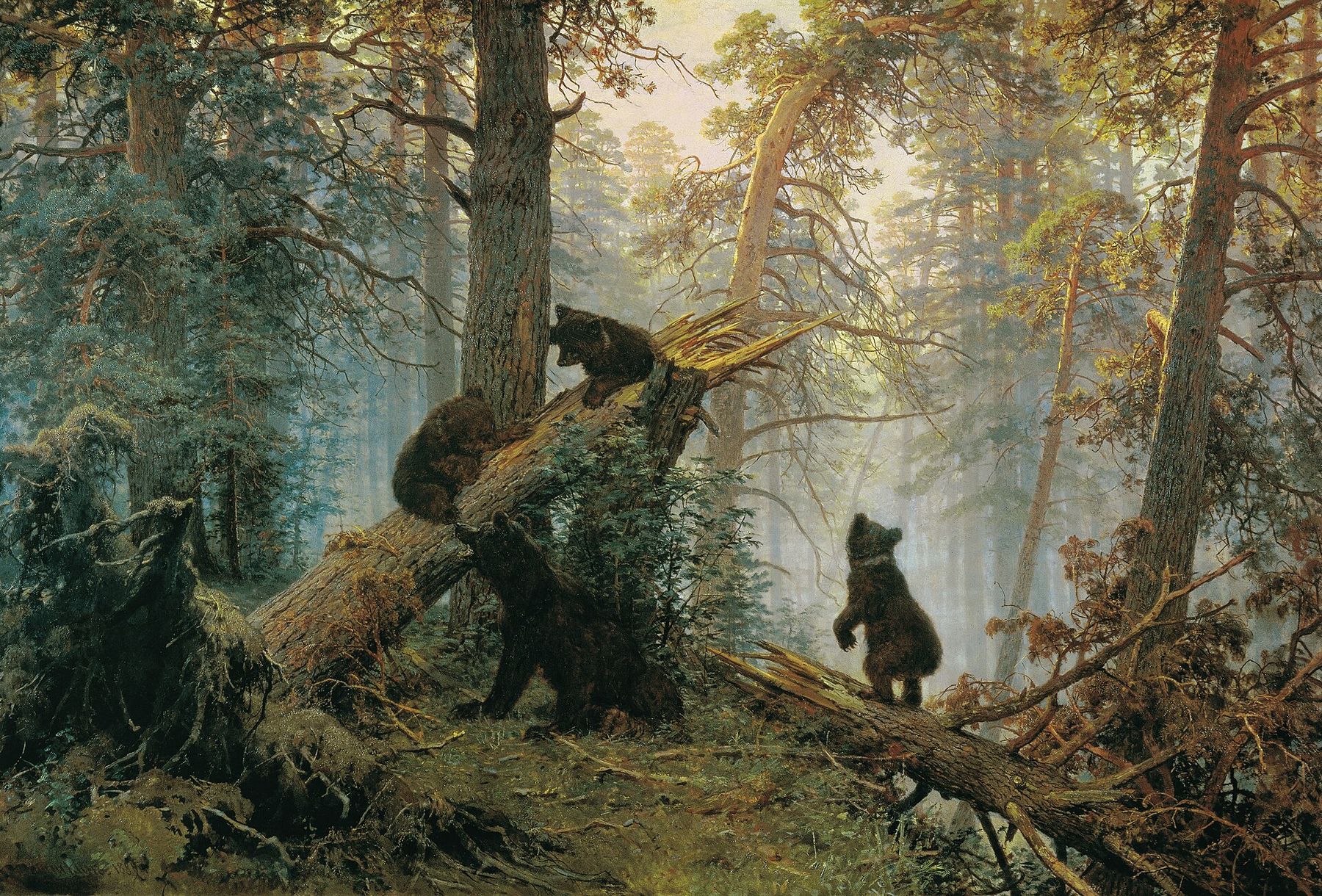
Shishkin's pine forest at morning: the living forest restoration works to bring back.
Ivan Shishkin / Konstantin Savitsky, Russian: «Утро в сосновом лесу» A Morning in a Pine Forest, 1889EcoAxes / Included ideologies / Conservation philosophies and practice
Conservation approach and scientific fieldRestoration-Centred Conservation
The approach that puts active repair of damaged ecosystems at the centre of conservation, alongside protecting intact ones. It restores forests, wetlands, rivers, grasslands, reefs and soils toward reference conditions through deliberate intervention, as organised by the Society for Ecological Restoration and the UN Decade on Ecosystem Restoration (2021–2030). Its engineering wing, ecological engineering, designs ecosystems such as constructed wetlands, living shorelines and built reefs, using natural processes to do most of the work.
- Key figures
- William R. Jordan III, Aldo Leopold (the Curtis Prairie), Eric Higgs, Richard Hobbs, Katharine Suding
Where it stands
- Environmental EthicsAnthropocentrismEcocentrism
- Human–Nature RelationsHuman SeparationHuman Integration
- Ecological InterventionNoninterventionActive Stewardship
- Economic PhilosophyGreen GrowthPost-Growth
- Technological OutlookTechnological OptimismEcological Precaution
- Conservation StrategySustainable UseStrict Protection
- Human–Wildlife RelationsHuman PriorityWildlife Accommodation
- Agricultural EcologyLand SparingLand Sharing
- Global ResponsibilityNational SovereigntyInternational Ecological Obligation
- Ecological Political PriorityIncremental ReformTransformative Change
Restoration is defined by active intervention toward recovery; it sits between protection and use on conservation strategy and between separation and integration on relations, since it repairs both wild and working landscapes.
Definition
Restoration-centred conservation holds that, since most of the earth’s ecosystems are already damaged, conservation cannot rely on protecting what is left. It has to actively repair what has been harmed.
The Society for Ecological Restoration defines ecological restoration as “the process of assisting the recovery of an ecosystem that has been degraded, damaged, or destroyed.” In practice it includes replanting forests and letting them regrow naturally, restoring wetlands and rivers, removing invasive species, repairing soils and reefs, reintroducing species, and bringing back natural disturbances such as fire.
It intervenes more than preservation does. It aims more closely at a defined reference state than rewilding does. And it cares more about ecology than ecological engineering does. It overlaps with all three.
Historical development
The symbolic starting point is Aldo Leopold’s planting of the Curtis Prairie at the University of Wisconsin Arboretum in 1935. William Jordan’s journal Restoration & Management Notes (1981) and the founding of the Society for Ecological Restoration (1988) turned restoration into a field. The Society’s Primer (2004) and its International Principles and Standards (2019) set down its practice.
The 1990s and 2000s brought large programmes in the Everglades, on the Rhine, on China’s Loess Plateau and in the forests of Costa Rica. They also brought “forest landscape restoration”, the Bonn Challenge (2011), the Aichi target to restore 15 per cent of degraded ecosystems, and finally the UN Decade on Ecosystem Restoration (2021–30). Recent debates have shaped the field’s thinking: on “novel ecosystems” (Richard Hobbs and colleagues), on reference states adjusted for climate change, and on restoration’s role in carbon markets.
Principal claims
- Damaged ecosystems can be largely recovered with deliberate help. Passive protection alone is not enough.
- Restoration should aim at a reference ecosystem, adjusted for environmental change, and be measured against it.
- Restoration brings benefits for biodiversity, carbon, water, livelihoods and culture at the same time.
- Local participation and knowledge are essential if restoration is to last.
- Restoration adds to the protection of intact ecosystems. It cannot replace it.
Policy implications
Restorationists support national and global restoration targets and the money to meet them, programmes of replanting and natural regrowth, restoration of rivers and wetlands, and control of invasive species. They want ecological standards that separate real restoration from simply planting trees. They favour linking restoration with farming through agroforestry and soil repair, and including it in climate policy, with safeguards.
Internal disagreements
Restorationists disagree about whether to aim at historical reference states, at states adjusted for a changing climate, or at new kinds of ecosystem. They differ on whether non-native species are acceptable, and on whether to restore for ecological integrity or for ecosystem services and carbon. They worry that restoration can be used to excuse destruction elsewhere, through offsets and mitigation banking. They also argue over letting land regrow by itself as against planting it.
Criticisms and controversies
Wilderness and non-interventionist traditions see restoration as arrogance and as a substitute for protection. Political ecologists point to the land grabs and displacement that tree-planting programmes have caused. Ecologists criticise single-species plantations sold as restoration, and the overselling of restoration’s potential to store carbon. The “restoration industry” is accused of licensing development.
Practitioners answer with standards that separate restoration from tree planting, and with the evidence of ecosystems that have recovered.
Relationships to other traditions
Restoration is the ecological core shared by ecological engineering, which designs for function; by rewilding and trophic rewilding, which restore processes and animals more than exact species mixes; by conservationism, which restores working land; and by planetary stewardship, which sets its global targets. It is at odds with wilderness preservation’s refusal to intervene. Market environmentalism’s offset schemes both use and draw criticism for it.
References and further reading
- Gann, G. D. et al. (2019). “International principles and standards for the practice of ecological restoration,” 2nd ed. Restoration Ecology 27(S1), S1–S46.
- Jordan, W. R. III (2003). The Sunflower Forest: Ecological Restoration and the New Communion with Nature. University of California Press.
- Hobbs, R. J., Higgs, E. S. and Hall, C. M., eds. (2013). Novel Ecosystems: Intervening in the New Ecological World Order. Wiley-Blackwell.
- Chazdon, R. L. (2014). Second Growth: The Promise of Tropical Forest Regeneration in an Age of Deforestation. University of Chicago Press.
- Higgs, E. (2003). Nature by Design: People, Natural Process, and Ecological Restoration. MIT Press.