
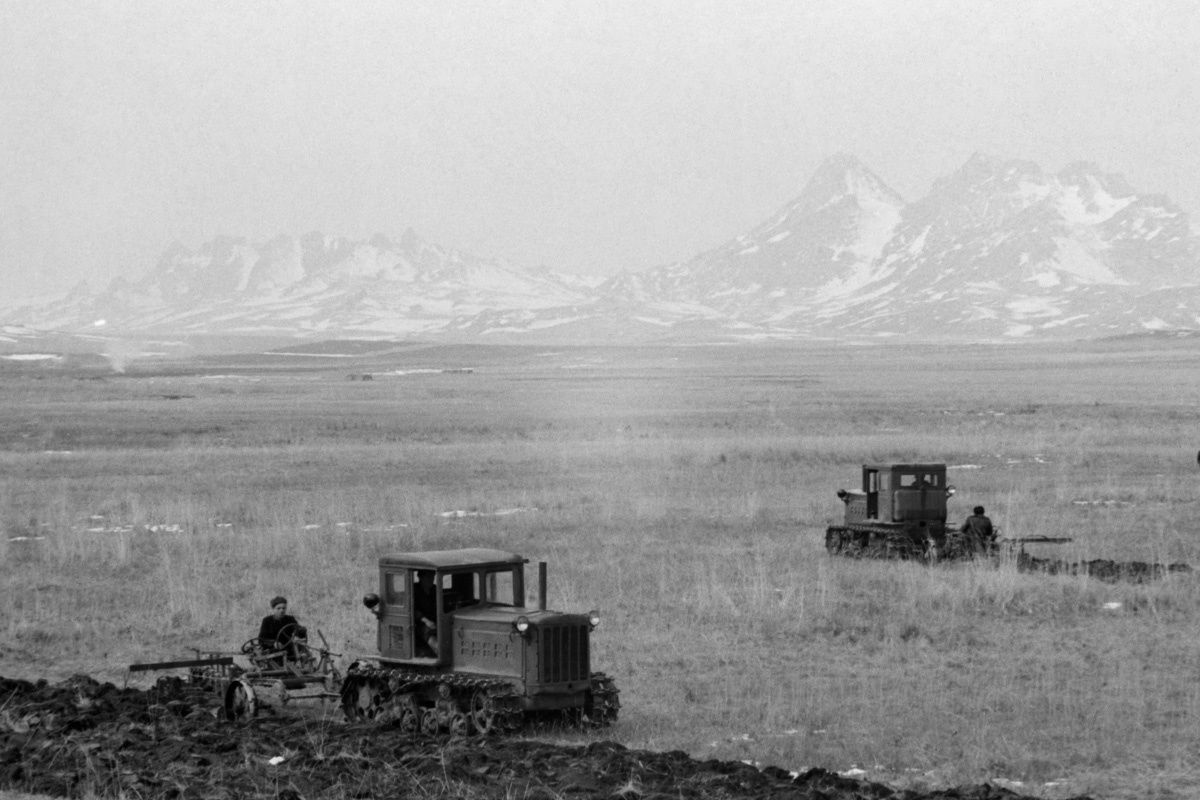
Tractors ploughing the steppe in Khrushchev's Virgin Lands campaign, 1950s: nature remade for the plan.
Емельянов Г, Освоение целины в тракторной бригаде совхоза "Передовой", 1955EcoAxes / Included ideologies / Left and socialist ecologies
Political traditionProductivist Socialism
The socialist tradition that dominated the twentieth-century Soviet Union and Maoist China. It saw the transformation of nature, through planned industry, great engineering works and the full development of the forces of production, as the road to human freedom, and treated nature mainly as material to be mastered for the people's needs.
- Key figures
- Vladimir Lenin, Joseph Stalin (as programme), Trofim Lysenko (as case), Mao Zedong, Paul Josephson (as historian)
Where it stands
- Environmental EthicsAnthropocentrismEcocentrism
- Human–Nature RelationsHuman SeparationHuman Integration
- Ecological InterventionNoninterventionActive Stewardship
- Economic PhilosophyGreen GrowthPost-Growth
- Resource OwnershipPrivate StewardshipCommons Governance
- Environmental AuthorityCentralized AuthorityLocal Autonomy
- Environmental JusticeAggregate OutcomesDistributive Justice
- Technological OutlookTechnological OptimismEcological Precaution
- Energy PhilosophyEnergy AbundanceEnergy Sufficiency
- Conservation StrategySustainable UseStrict Protection
- Human–Wildlife RelationsHuman PriorityWildlife Accommodation
- Agricultural EcologyLand SparingLand Sharing
- Global ResponsibilityNational SovereigntyInternational Ecological Obligation
- Ecological Political PriorityIncremental ReformTransformative Change
Read from the record of state-socialist development: nature valued for human use; vast intervention through dams, canals, reclamation and collectivised farming; common or state ownership; central planning; abundant energy and confidence in technology; and wholesale transformation of society. Its firmest commitments are to the mastery of nature and to transforming the economic order. Few people hold it today in its full form, but its outlook persists in parts of the left.
Definition
Productivist socialism holds that a socialist society exists to free people from scarcity, and that doing so means transforming nature collectively, by plan and on a huge scale. Rivers are to be dammed and turned back, deserts watered, swamps drained, forests cut and grasslands ploughed, so that the forces of production, once freed from capitalism, can meet everyone’s needs.
Nature appears in this tradition as raw material and as an obstacle to overcome, and the struggle against it is part of the struggle for human freedom. It is included here as a historical position on the questions this survey asks. It has never presented itself as environmentalist.
Historical development
Lenin set the tone in 1920 with the slogan “communism is Soviet power plus the electrification of the whole country”. Stalin’s Great Plan for the Transformation of Nature (1948) proposed belts of trees across the steppe, giant canals and hydroelectric dams, and the agronomist Trofim Lysenko promised to remake crops at will. In the 1950s Khrushchev’s Virgin Lands campaign ploughed tens of millions of hectares of steppe in Kazakhstan and Siberia, and Soviet planners diverted the rivers that fed the Aral Sea to grow cotton.
In China, Mao’s call that “man must conquer nature” drove the Great Leap Forward (1958–62). Its campaign against the “four pests” killed millions of sparrows, which contributed to the famine that followed. Historians including Douglas Weiner, Paul Josephson and Judith Shapiro have documented both the ambition of these projects and their ecological cost.
Principal claims
- Human freedom needs abundance, and abundance needs the forces of production developed to the full.
- Nature can and should be transformed by planned human labour for the good of the people.
- Common or state ownership lets nature be used rationally, for need instead of profit.
- Science and engineering on a large scale are tools of progress.
- Environmental limits are, for the most part, technical problems with technical solutions.
Policy implications
Its programmes included electrification by the state, giant dams and canal systems, collectivised and mechanised farming, the ploughing of new land, the draining of wetlands, and heavy industry as the base of development, all planned from the centre.
Internal disagreements
Inside the socialist tradition there is a long argument between productivism and an ecological reading of Marx. Ecosocialists such as John Bellamy Foster argue that Marx’s idea of a “metabolic rift” between society and nature makes him an ecological thinker, and that Soviet productivism betrayed him. Others argue that productivism was faithful to a real strand in Marxism. Within state socialism itself, Soviet scientists defended nature reserves (zapovedniki) against the planners, a conflict Weiner traces in Models of Nature.
Criticisms and controversies
Its record includes some of the largest environmental disasters of the century: the destruction of the Aral Sea, the dust storms of the Virgin Lands, the deforestation and famine of the Great Leap Forward, and the pollution of Soviet industrial cities. Critics on left and right alike argue that central planning without democracy or ecological knowledge produced waste on an enormous scale.
Defenders of its legacy point to fast industrialisation, electrification and rising living standards.
Relationships to other traditions
Within the socialist family, productivist socialism is the historical opposite of ecosocialism. It shares ecosocialism’s commitment to common ownership and transformation, but not its ecological limits. Its faith in technology and abundance lives on in eco-accelerationism and the ecomodernist left. Its model of the state engineering nature informs ecological civilisation, which differs in giving protection a central place.
References and further reading
- Weiner, D. R. (1988). Models of Nature: Ecology, Conservation, and Cultural Revolution in Soviet Russia. Bloomington: Indiana University Press.
- Josephson, P. R. (2002). Industrialized Nature: Brute Force Technology and the Transformation of the Natural World. Washington, DC: Island Press.
- Shapiro, J. (2001). Mao’s War against Nature: Politics and the Environment in Revolutionary China. Cambridge: Cambridge University Press.
- Feshbach, M. and Friendly, A. (1992). Ecocide in the USSR. New York: Basic Books.
- Foster, J. B. (2000). Marx’s Ecology: Materialism and Nature. New York: Monthly Review Press.