
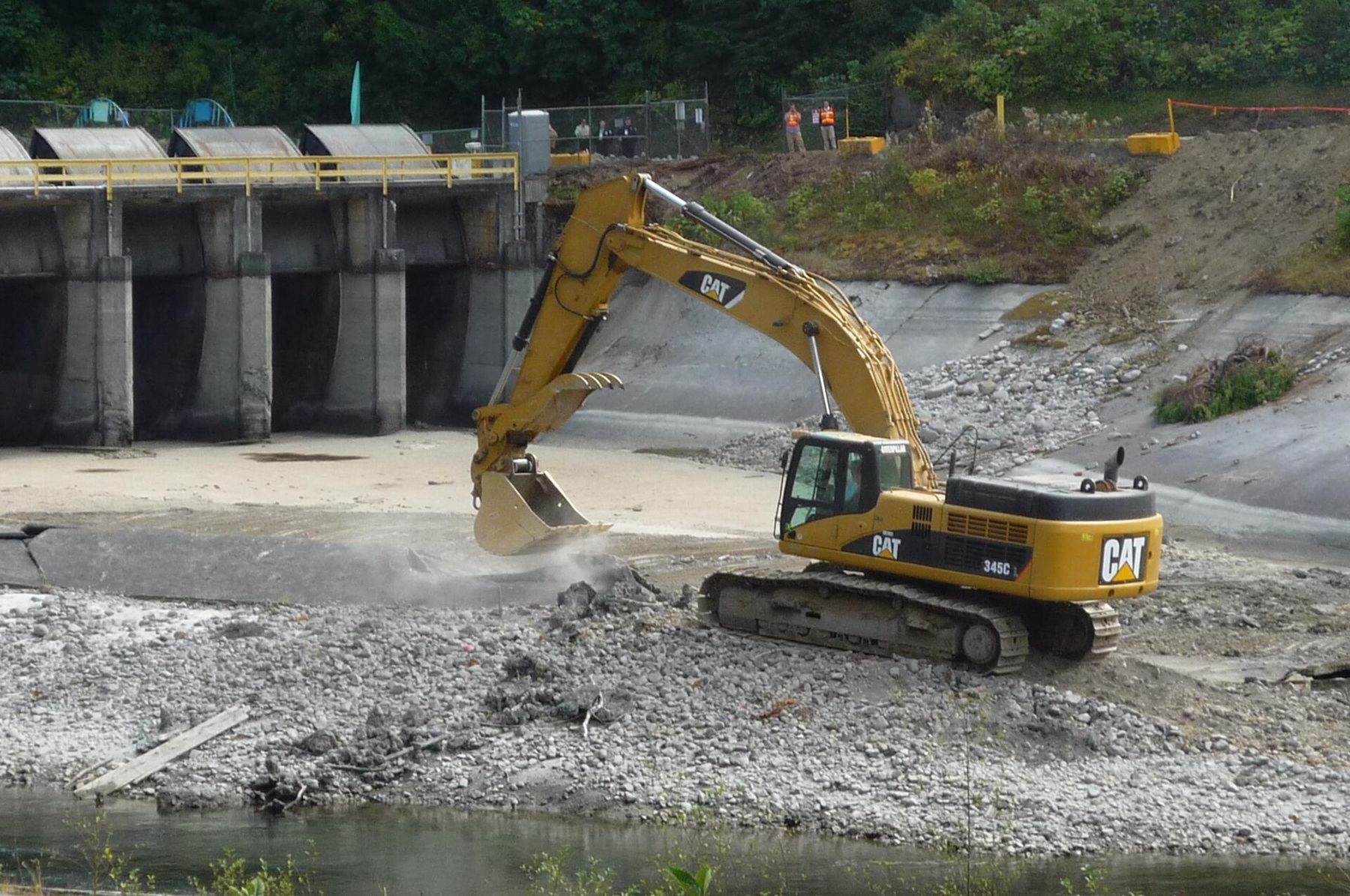
Removal of the Elwha Dam in Washington begins, 2011. Deep Green Resistance wants far more of industrial infrastructure taken down.
USFWS Fish and Aquatic Conservation, Elwha Dam Removal - first bite of removal process, 2018EcoAxes / Included ideologies / Left and socialist ecologies
Radical movement and strategyDeep Green Resistance
The movement launched by Aric McBay, Lierre Keith and Derrick Jensen's book Deep Green Resistance (2011). It holds that industrial civilisation is destroying the living world and cannot be reformed, and calls for an organised resistance, including underground sabotage of industrial infrastructure, to bring it down. It is included to complete the range of views, and is described here, not endorsed.
- Key figures
- Derrick Jensen, Lierre Keith, Aric McBay
Where it stands
- Environmental EthicsAnthropocentrismEcocentrism
- Human–Nature RelationsHuman SeparationHuman Integration
- Ecological InterventionNoninterventionActive Stewardship
- Economic PhilosophyGreen GrowthPost-Growth
- Resource OwnershipPrivate StewardshipCommons Governance
- Environmental AuthorityCentralized AuthorityLocal Autonomy
- Environmental JusticeAggregate OutcomesDistributive Justice
- Technological OutlookTechnological OptimismEcological Precaution
- Energy PhilosophyEnergy AbundanceEnergy Sufficiency
- Conservation StrategySustainable UseStrict Protection
- Human–Wildlife RelationsHuman PriorityWildlife Accommodation
- Ecological Political PriorityIncremental ReformTransformative Change
Its position is extreme and explicit on the value of wild nature, on industrial technology and energy, on growth and on the need for change outside the system; its views on people's place in the landscape and on justice are stated less precisely, so those bands are wide. It takes no settled position on farming methods or on international obligation.
Definition
Deep Green Resistance holds that industrial civilisation is killing the planet, that it will not stop by choice, and that it cannot be reformed. Voluntary simplicity, green consumerism, clean technology and lobbying all leave its machinery running. The only adequate response is to stop it, by force where necessary.
The movement takes its name from the book Deep Green Resistance: Strategy to Save the Planet (2011), by Aric McBay, Lierre Keith and Derrick Jensen. The book proposes a strategy it calls “Decisive Ecological Warfare”. An above-ground movement would build support and alternatives, while separate underground groups would sabotage the infrastructure that industrial society depends on, such as energy, transport and communications, with the aim of bringing about its collapse.
Historical development
The ideas grew out of Derrick Jensen’s earlier books, above all Endgame (2006), which argued that civilisation is inherently destructive and that violence in defence of the land can be justified. McBay, Keith and Jensen set out the full strategy in 2011, and an organisation of the same name formed around it, with chapters in the United States and abroad.
In early 2012 the group split. Aric McBay and others left after Jensen and Keith cancelled a policy that included trans women in women-only spaces, and the dispute cost the movement many allies on the radical left. Jensen, Keith and Max Wilbert went on to attack mainstream renewable energy in Bright Green Lies (2021), arguing that wind, solar and batteries extend industrial destruction under a green label.
Principal claims
- Industrial civilisation is destroying the living world, and the harm is accelerating.
- Civilisation cannot be made sustainable. Reform, technology and personal lifestyle change all leave it intact.
- People who love the land have a duty to defend it, as they would defend a person under attack.
- Stopping the destruction requires organised resistance, including the sabotage of industrial infrastructure by underground groups.
- Renewable energy and “green” growth are not solutions. They extend industrial extraction.
- The collapse of industrial civilisation would be a gain for the living world, and the sooner it comes the more of that world survives.
Policy implications
Deep Green Resistance does not seek policy change from governments, which it regards as part of the problem. Its above-ground wing supports land defence, the protection of wild places, campaigns against dams, pipelines and mines, and building small communities able to live without industrial supply chains. Its strategy assigns the attack on infrastructure to clandestine groups, which the public organisation says it does not run.
Internal disagreements
The deepest division concerns its politics on gender. The group’s position on trans people split it in 2012 and separated it from most of the radical environmental and anarchist movement. Supporters of the strategy also differ on how far the above-ground organisation should go in endorsing sabotage, on whether any industrial technology can be kept, and on how to treat the human costs that a collapse of industrial society would bring.
Criticisms and controversies
Critics on the left, including Ian Angus of Climate & Capitalism (2012) and Michelle Renee Matisons and Alexander Reid Ross (2015), argue that its strategy is a path to certain defeat. Small underground groups cannot bring down industrial society, they say, and attacks on infrastructure would harm the poor first and invite repression. Others reject it on moral grounds, because a collapse of industrial civilisation would bring mass death. Trans activists and many allies condemn the organisation’s position on trans people as transphobic.
Its authors answer that industrial civilisation is already causing mass death, of species and of people, and that refusing to resist it is itself a choice with consequences.
Relationships to other traditions
Deep Green Resistance shares deep ecology’s view that nature has value in itself, pushed to its furthest point. It shares anarcho-primitivism’s rejection of civilisation, but it differs in calling for an organised strategy to end it instead of waiting for collapse. It goes beyond radical wilderness defence, which protects particular places, in aiming at the industrial system as a whole. It overlaps with Dark Mountain’s conviction that industrial civilisation cannot last, but rejects Dark Mountain’s turn to grief and art in place of resistance. It is the furthest point from ecomodernism, planetary stewardship and every tradition that would manage the planet through technology.
References and further reading
- McBay, A., Keith, L. and Jensen, D. (2011). Deep Green Resistance: Strategy to Save the Planet. New York: Seven Stories Press.
- Jensen, D. (2006). Endgame, 2 vols. New York: Seven Stories Press.
- Jensen, D., Keith, L. and Wilbert, M. (2021). Bright Green Lies: How the Environmental Movement Lost Its Way and What We Can Do About It. Rhinebeck, NY: Monkfish.
- Matisons, M. R. and Reid Ross, A. (2015). Against Deep Green Resistance. Perspectives on Anarchist Theory 28: 101–118. https://theanarchistlibrary.org/library/michelle-renee-matisons-and-alexander-reid-ross-against-deep-green-resistance
- Angus, I. (2012). “Deep Green Resistance”: how not to build a movement. Climate & Capitalism, 10 May. https://climateandcapitalism.com/2012/05/10/deep-green-resistance-a-path-to-certain-defeat