
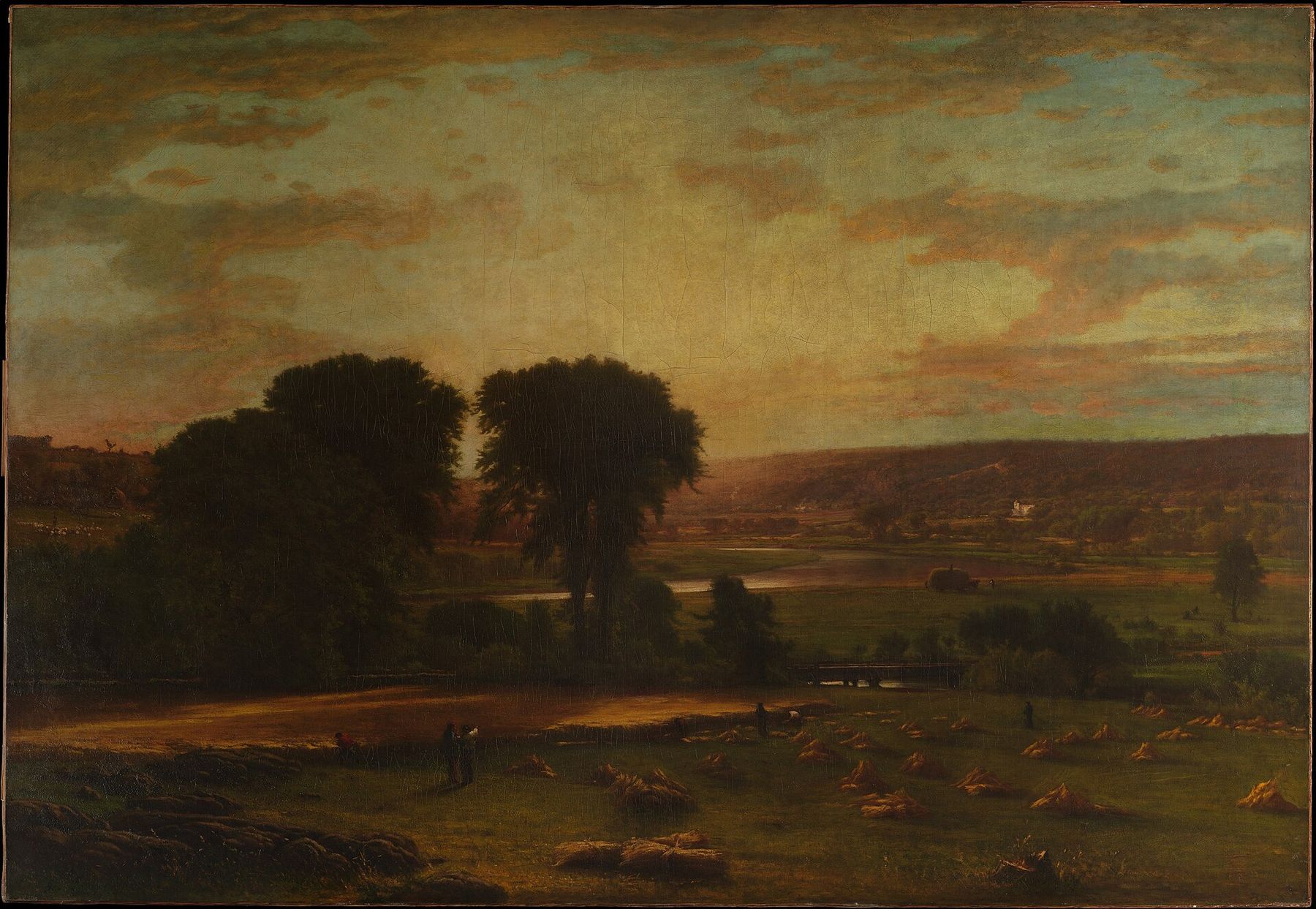
Inness's Peace and Plenty: farmland as a community of soil, water, plants and people.
George Inness, Peace and Plenty, 1865EcoAxes / Included ideologies / Classical environmental philosophies
Ethical theory and conservation philosophyLand Ethic
Aldo Leopold's ethic, which widens the moral community to include soils, waters, plants and animals. It asks people to act as "plain members and citizens" of the land community instead of its conquerors, and judges actions by what they do to the integrity, stability and beauty of that community.
- Key figures
- Aldo Leopold, J. Baird Callicott, Curt Meine, Wendell Berry (as a kindred agrarian voice)
Where it stands
- Environmental EthicsAnthropocentrismEcocentrism
- Human–Nature RelationsHuman SeparationHuman Integration
- Ecological InterventionNoninterventionActive Stewardship
- Resource OwnershipPrivate StewardshipCommons Governance
- Conservation StrategySustainable UseStrict Protection
- Human–Wildlife RelationsHuman PriorityWildlife Accommodation
- Agricultural EcologyLand SparingLand Sharing
- Ecological Political PriorityIncremental ReformTransformative Change
Leopold wrote as a forester, game manager and farm restorer, so the land ethic combines ecocentric value with active management, working landscapes and a landowner's conservation. Economic, governance, technological, energy and international positions are not developed in his work.
Definition
The land ethic is the environmental philosophy Aldo Leopold set out in the closing essay of A Sand County Almanac (1949). Ethics, Leopold argued, has widened its reach over history, from relations between individuals to relations with society. The land ethic “simply enlarges the boundaries of the community to include soils, waters, plants, and animals, or collectively: the land.”
Its central rule is this: “a thing is right when it tends to preserve the integrity, stability, and beauty of the biotic community. It is wrong when it tends otherwise.”
Historical development
Leopold (1887–1948) trained as a forester in Gifford Pinchot’s Forest Service, under its utilitarian conservationism. He pioneered the field of game management and fought for the designation of wilderness within the national forests.
His views changed with experience. His well-known account of shooting a wolf and watching “a fierce green fire dying in her eyes” records his turn away from killing predators toward an ecological understanding of the land. In 1935 he bought a worn-out farm in Wisconsin and began restoring it, and that farm is the setting of the Almanac. The land ethic was published after his death. It became central to environmental ethics in the 1970s, when J. Baird Callicott defended and developed it philosophically.
Principal claims
- The land is a community that people belong to. It is not a commodity they own.
- Ethics must extend to this community. The land ethic changes the role of Homo sapiens from conqueror to plain member and citizen.
- Right action keeps the biotic community whole, stable and beautiful.
- Economic self-interest alone cannot carry conservation, because most members of the land community have no economic value. Conservation needs an ethic that individuals hold, landowners above all.
- The ethic depends on ecological literacy, on understanding the land as a circuit of energy running through soils, plants and animals.
Policy implications
The land ethic supports protecting wilderness, but its distinctive contribution concerns working land. Farms, woodlots and ranches should be managed with ecological understanding by owners who have taken on duties the law cannot enforce. The ethic supports active restoration and management, hunting included as a tool, and it treats predators as members of the community to be kept, not removed. Leopold doubted that government ownership and regulation could replace private conscience.
Internal disagreements
Readers disagree about whether the land ethic is holist, as in Callicott’s reading, where value lies in the community as a whole, or pluralistic, an addition to duties toward people and animals that leaves those duties in place. “Stability” has been reread in the light of ecology that no longer assumes nature tends toward balance. Leopold’s heirs dispute whether the ethic needs private landowners or can be carried out through public programmes.
Criticisms and controversies
Tom Regan aimed his charge of “environmental fascism” at the holist reading. Ecologists have questioned whether “integrity” and “stability” work as scientific concepts. Some critics see the land ethic as a rural North American landowner’s philosophy, with little to say about cities, industry or global injustice.
Callicott and others answer that the ethic adds to existing duties without replacing them, and that its concepts can be updated without losing their point.
Relationships to other traditions
The land ethic is the source of ecocentrism and ecological holism and the philosophical ancestor of restoration ecology. It bridges Pinchot’s conservationism and John Muir’s preservationism. Its concern for working land links it to agrarian conservatism and Wendell Berry, and its defence of wilderness links it to wilderness preservation.
References and further reading
- Leopold, A. (1949). A Sand County Almanac, and Sketches Here and There. Oxford University Press.
- Callicott, J. B. (1989). In Defense of the Land Ethic. SUNY Press.
- Callicott, J. B., ed. (1987). Companion to A Sand County Almanac. University of Wisconsin Press.
- Meine, C. (1988). Aldo Leopold: His Life and Work. University of Wisconsin Press.