
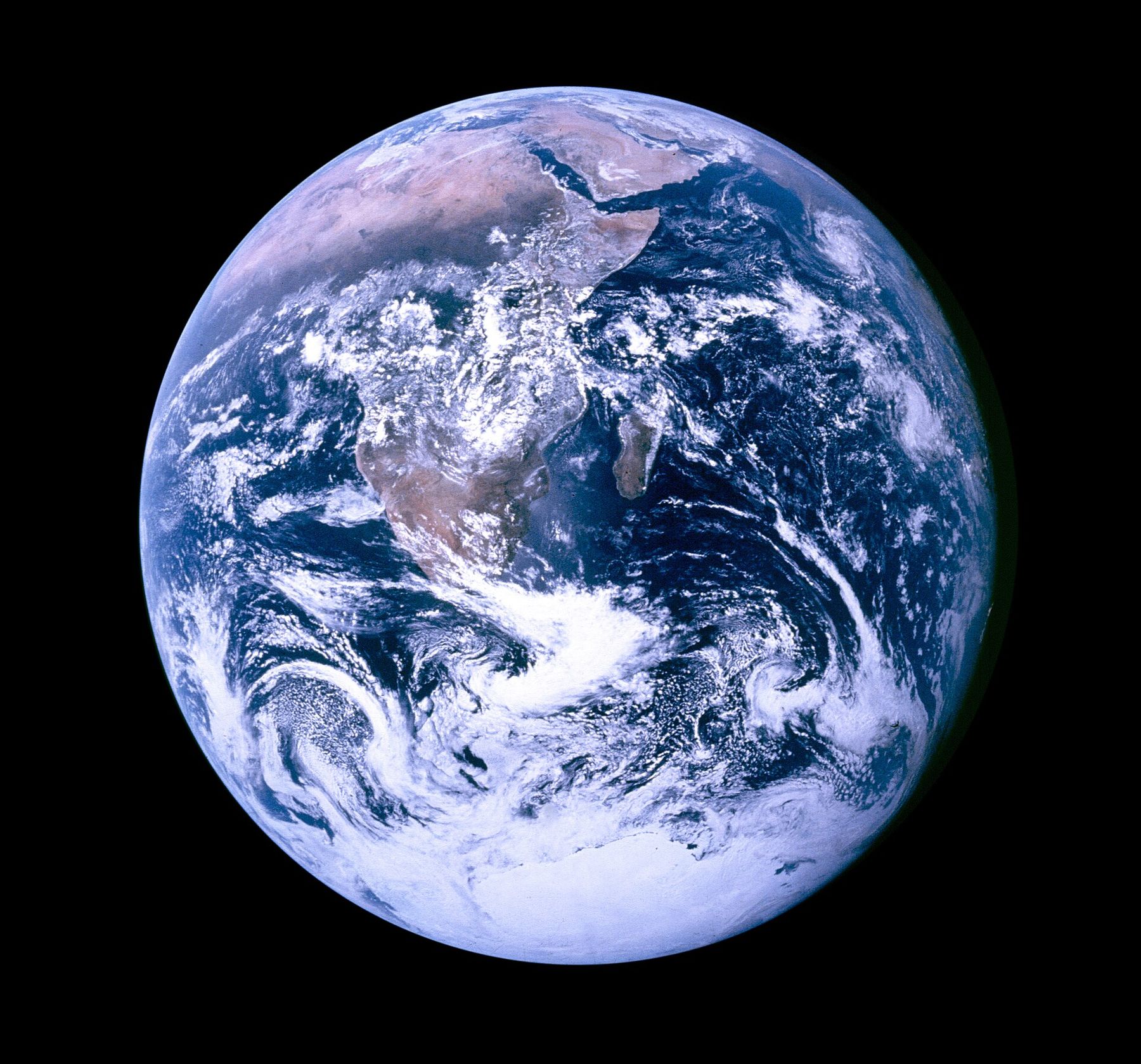
The Blue Marble, photographed by the crew of Apollo 17 in 1972: the living Earth seen whole.
NASA. Photo taken by either Harrison Schmitt or Ron Evans, The Blue Marble 4463x4163, 1972EcoAxes / Included ideologies / Classical environmental philosophies
Scientific hypothesis and environmental philosophyGaian Ecology
The view, grounded in James Lovelock and Lynn Margulis's Gaia hypothesis, that the earth's living things and its rocks, oceans and air form one self-regulating system that keeps the planet habitable. Humanity's task is to protect the health of that whole, which Lovelock came to believe might require nuclear power, adaptation and even strong central government.
- Key figures
- James Lovelock, Lynn Margulis, Timothy Lenton, Bruno Latour, Stephan Harding
Where it stands
- Environmental EthicsAnthropocentrismEcocentrism
- Human–Nature RelationsHuman SeparationHuman Integration
- Ecological InterventionNoninterventionActive Stewardship
- Economic PhilosophyGreen GrowthPost-Growth
- Resource OwnershipPrivate StewardshipCommons Governance
- Environmental AuthorityCentralized AuthorityLocal Autonomy
- Environmental JusticeAggregate OutcomesDistributive Justice
- Technological OutlookTechnological OptimismEcological Precaution
- Energy PhilosophyEnergy AbundanceEnergy Sufficiency
- Conservation StrategySustainable UseStrict Protection
- Human–Wildlife RelationsHuman PriorityWildlife Accommodation
- Agricultural EcologyLand SparingLand Sharing
- Global ResponsibilityNational SovereigntyInternational Ecological Obligation
- Ecological Political PriorityIncremental ReformTransformative Change
Its firmest commitments are to the value of the living Earth as a whole, to strict protection of the natural systems that regulate climate, and to planetary rather than national responsibility. Lovelock's own later views, favouring nuclear power, adaptation and emergency government, pull its positions on technology, energy and authority away from those of most ecocentric traditions, so those carry wide bands.
Definition
Gaian ecology treats the earth as one living system. The chemist James Lovelock proposed the Gaia hypothesis and developed it with the microbiologist Lynn Margulis. In it, life does more than adapt to its surroundings. It helps regulate them. Through their combined effects on the air, the oceans and the soil, living things keep the temperature, the make-up of the atmosphere and the chemistry of the sea within the limits life needs.
As an environmental philosophy, Gaia moves attention away from single species and places toward the health of the planetary system as a whole. Humanity is one part of Gaia, now powerful enough to disrupt the regulation everything depends on.
Historical development
Lovelock developed the idea in the 1960s while working on how NASA might detect life on Mars. He set it out with Margulis in papers in the early 1970s and in Gaia: A New Look at Life on Earth (1979). The novelist William Golding suggested the name. Environmental and spiritual movements took it up with enthusiasm, while biologists objected that natural selection could not produce regulation on a planetary scale.
Lovelock’s “Daisyworld” model, built with Andrew Watson in 1983, answered part of that objection. The idea fed into the new field of Earth system science, where researchers such as Timothy Lenton carry it on. In later books, The Revenge of Gaia (2006) and The Vanishing Face of Gaia (2009), Lovelock argued that climate change had gone too far to prevent, that nuclear power was the only safe source of energy on a large scale, and that democracy might have to be suspended in an emergency. In the 2010s the philosopher Bruno Latour reworked Gaia as a political idea.
Principal claims
- Life and its physical surroundings form one self-regulating system that keeps the earth habitable.
- What matters in the end is the health of that system, more than any single species or place.
- Humanity has become a force that can disrupt the planet’s regulation, the climate above all.
- Natural systems such as forests and oceans play parts in that regulation that nothing else can play, and they must be protected.
- Responsibility for Gaia is planetary. No nation can meet it alone.
Policy implications
Gaian thinkers have supported protecting tropical forests and oceans for their role in regulating climate, cutting greenhouse emissions quickly, and cooperating globally. Lovelock himself argued for nuclear power, for adapting to warming that could no longer be avoided, and for pulling back from intensive farming. He doubted that renewable energy or carbon trading would be enough.
Internal disagreements
Scientists divide between a strong reading of Gaia, in which the earth regulates itself for the sake of life, and a weaker one, in which life and environment simply evolve together. Environmentalists who embraced Gaia as a spiritual vision of the whole earth often rejected Lovelock’s later enthusiasm for nuclear power and his pessimism about democracy.
Criticisms and controversies
Biologists such as Richard Dawkins and Ford Doolittle argued that the original hypothesis assumed a purpose in nature and could not be squared with natural selection. Others warn that describing the earth as self-regulating can breed complacency, or, in Lovelock’s later form, fatalism and authoritarianism.
Supporters note that Gaia anticipated much of Earth system science, and that it gave the public a powerful image of how the planet’s parts depend on one another.
Relationships to other traditions
Gaian ecology shares ecocentrism’s valuing of wholes. It gives planetary stewardship its picture of an Earth system to be kept within boundaries. Its holism has inspired eco-spirituality and deep ecology, and Lovelock’s late pessimism anticipates Dark Mountain.
References and further reading
- Lovelock, J. E. and Margulis, L. (1974). Atmospheric homeostasis by and for the biosphere: the Gaia hypothesis. Tellus, 26(1–2), 2–10.
- Lovelock, J. (1979). Gaia: A New Look at Life on Earth. Oxford: Oxford University Press.
- Watson, A. J. and Lovelock, J. E. (1983). Biological homeostasis of the global environment: the parable of Daisyworld. Tellus B, 35(4), 284–289.
- Lovelock, J. (2006). The Revenge of Gaia. London: Allen Lane.
- Lenton, T. (2016). Earth System Science: A Very Short Introduction. Oxford: Oxford University Press.
- Latour, B. (2017). Facing Gaia: Eight Lectures on the New Climatic Regime. Cambridge: Polity.