
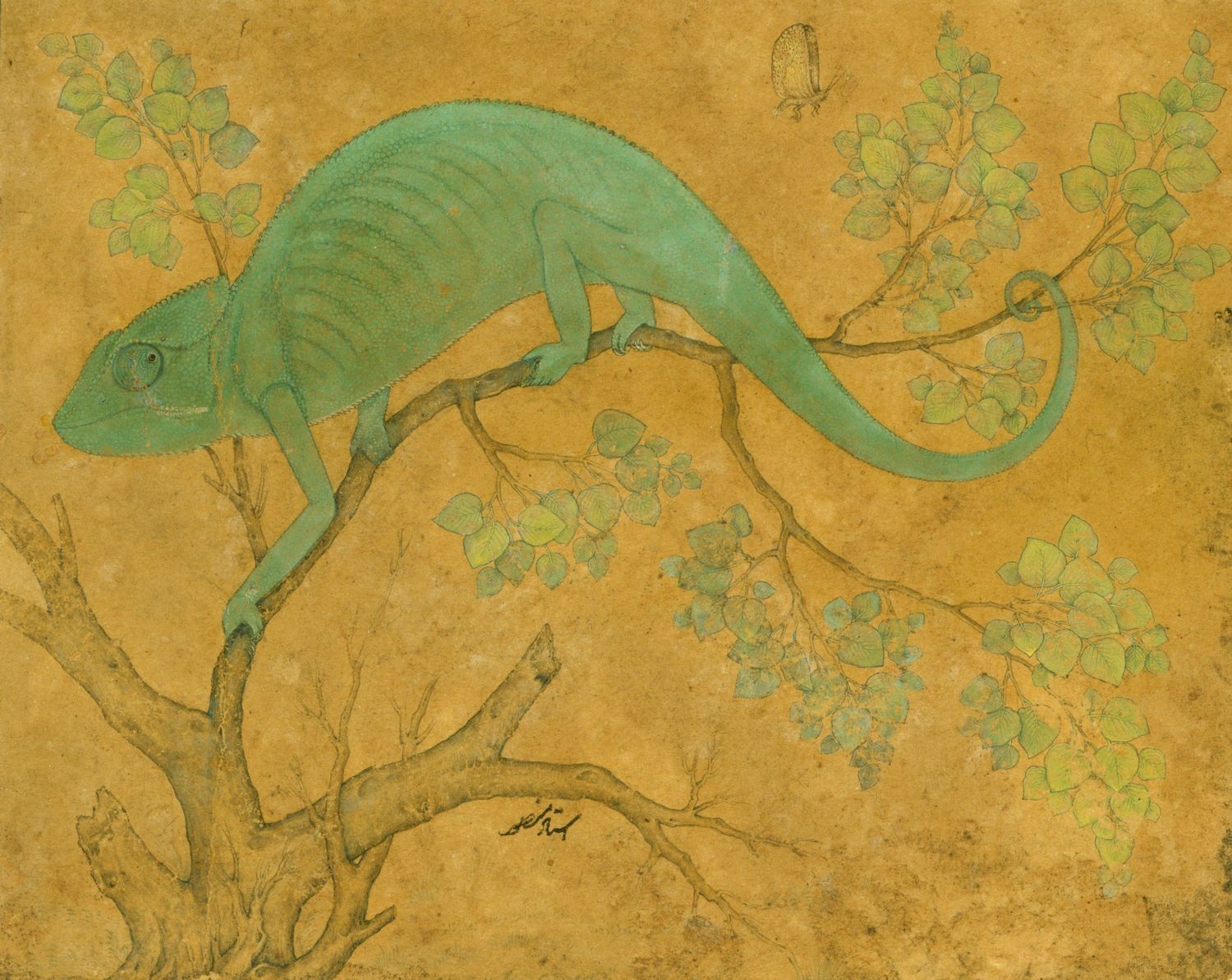
Ustad Mansur's chameleon, Mughal Empire, c. 1612: one creature studied for its own sake.
Ustad Mansur, A Chameleon, 1612EcoAxes / Included ideologies / Classical environmental philosophies
Ethical theoryBiocentrism
The view that every living organism has a good of its own and inherent worth, so that moral consideration reaches past humans and feeling animals to all living things. In practice it is carried by wildlife protection: bans on hunting, trapping, culling and the wildlife trade, strict habitat protection and non-lethal answers to conflict.
- Key figures
- Paul W. Taylor, Albert Schweitzer, Kenneth Goodpaster, Robin Attfield, Gary Varner
Where it stands
- Environmental EthicsAnthropocentrismEcocentrism
- Human–Nature RelationsHuman SeparationHuman Integration
- Ecological InterventionNoninterventionActive Stewardship
- Economic PhilosophyGreen GrowthPost-Growth
- Technological OutlookTechnological OptimismEcological Precaution
- Conservation StrategySustainable UseStrict Protection
- Human–Wildlife RelationsHuman PriorityWildlife Accommodation
- Agricultural EcologyLand SparingLand Sharing
- Global ResponsibilityNational SovereigntyInternational Ecological Obligation
- Ecological Political PriorityIncremental ReformTransformative Change
Biocentrism is an ethic of individual living things, so it speaks to ethics and wildlife directly and to intervention through Paul Taylor's rule of noninterference. The wildlife-protection movement that puts it into practice adds its firm commitments to strict habitat protection and to ending the killing and trade of wild animals.
Definition
Biocentrism gives moral standing to every living thing. Each organism has a good of its own, a way of flourishing that can be helped or hindered, whether or not it is conscious.
Three neighbouring views draw the line elsewhere. Anthropocentrism gives standing to humans only. Sentientism gives it to beings that can suffer. Ecocentrism places value in wholes, such as species and ecosystems, either instead of or as well as in individual organisms.
Historical development
The usual starting point is Albert Schweitzer’s “reverence for life”, set out in Civilization and Ethics (1923). The ethical person, Schweitzer wrote, “shatters no ice crystal that sparkles in the sun, tears no leaf from its tree.” Kenneth Goodpaster argued in “On Being Morally Considerable” (1978) that being alive, and not the capacity to feel, is the sensible test for moral consideration.
Paul Taylor’s Respect for Nature (1986) is the fullest statement. Taylor grounds an “attitude of respect” in what he calls the biocentric outlook. Humans belong to Earth’s community of life on the same terms as other organisms. Every organism is a goal-directed centre of life. There is no argument for human superiority that does not assume its conclusion. From this Taylor derives four duties, of nonmaleficence, noninterference, fidelity and restitutive justice, and a set of priority principles for settling conflicts.
Principal claims
- Every organism has a good of its own and therefore inherent worth.
- Humans are not superior to other living things in any way that would give them greater moral worth.
- Moral agents owe living things respect. That respect takes the form of rules against interfering, harming and betraying trust.
- Conflicts between human interests and the good of other organisms should be settled by principles of self-defence, proportionality, least wrong, distributive justice and restitution. Human priority cannot simply be assumed.
Policy implications
Taylor’s priority principles let people meet their basic needs at the expense of other organisms, but they restrict the pursuit of non-basic interests. That bears on sport hunting, luxury consumption and destroying habitat for convenience. The duty not to interfere argues for restraint in managing ecosystems. In general biocentrism supports strong protection for wild organisms and their habitats, and caution about killing wildlife.
Internal disagreements
Biocentrists disagree about whether all organisms count equally. Biocentric egalitarians say they do, while Robin Attfield and Gary Varner allow different weights for different capacities. They also disagree about whether plants literally have interests. A practical problem is how the duty of noninterference fits with restoration, or with removing invasive organisms, which are also living things with goods of their own.
Criticisms and controversies
Critics say biocentrism is impossible to live by, since every action kills organisms. They say it cannot explain why ecological wholes matter, and that having a good of one’s own does not entail moral standing. Ecocentrists add that it is an individualism badly suited to conservation, which deals in populations, species and processes, and that its rule of noninterference would forbid the management conservation needs. Many who share Taylor’s broader outlook find his egalitarianism implausible.
Relationships to other traditions
Biocentrism shares deep ecology’s and ecocentrism’s belief in intrinsic value but places that value in individuals. In conservation practice it is closer to compassionate conservation and animal protection than to ecosystem management. It opposes anthropocentrism and conservationism’s tradition of sustained yield.
References and further reading
- Taylor, P. W. (1986). Respect for Nature: A Theory of Environmental Ethics. Princeton University Press.
- Schweitzer, A. (1923). Civilization and Ethics. A. & C. Black.
- Goodpaster, K. E. (1978). “On being morally considerable.” Journal of Philosophy 75(6), 308–325.
- Attfield, R. (1983). The Ethics of Environmental Concern. Blackwell.
- Varner, G. (1998). In Nature’s Interests? Interests, Animal Rights, and Environmental Ethics. Oxford University Press.